

Scotland: Clyde Hydrogen aims to reduce costs with integrated electrolyzer +++ Canada: Max Power discovers white hydrogen +++ Austria: Bosch and Linz AG plan to develop a hydrogen economy +++ USA: Nimbus tests fuel cells for space missions +++ Finland: P2X Solutions supplies green hydrogen to Finavia +++ USA: Fastech develops portable hydrogen refueling station +++ Germany: "National Alliance for Hydrogen Security" founded +++ Finland: Fortum produces first hydrogen in Kalla +++ Germany: Weser-Ems-Bus puts six hydrogen buses into operation +++ Namibia: Plug Power delivers 5 MW electrolyzer to Cleanergy Solutions
A selection of PtX topics summarized at the end of the week
+ + + + +
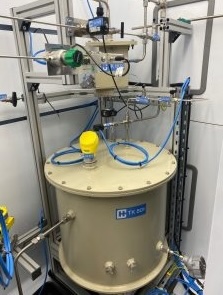
Clyde Hydrogen will use renewable energy directly for hydrogen production to reduce costs. © Clyde Hydrogen Systems Ltd.
(Scotland) Clyde Hydrogen Systems Ltd. has unveiled a prototype for an electrolysis process that aims to make the use of hydrogen "significantly safer, simpler, and cheaper" compared to currently available conventional systems. The system will be powered directly by renewable energy, and the hydrogen will be stored in a non-gaseous form. Hydrogen was first produced under high pressure using this process last year. With the launch of the prototype, the company will now focus on scaling up to a commercial demonstrator. The first market-ready product is planned for 2028. Clyde Hydrogen is a spin-off from the School of Chemistry at the University of Glasgow and is supported by pre-seed funding from Zinc Investment Management LLP, the University of Glasgow, and Dale Vince's Ecotricity, as well as grants from the Scottish Hydrogen Innovation Scheme (HIS) and the Net Zero Technology Centre (NZTC). The company aims to raise £5 million in seed capital in the first half of 2026.
+ + + + +
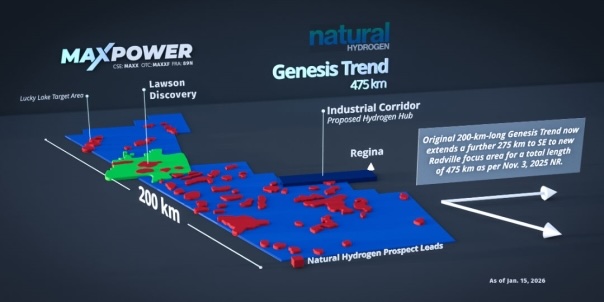
Max Power derives the presence of natural hydrogen from boreholes drilled to depths of 2.000 meters based on the geological formation. © Max Power Mining Corp.
(Canada) Max Power Mining Corp. has announced the discovery of naturally occurring underground (white) hydrogen. The well is located near Central Butte in the province of Saskatchewan. Hydrogen concentrations in the well, named "Lawson," reached up to 286.000 ppm (28,6 percent). Max Power is confident that the geological formations will lead to the discovery of hydrogen at other locations within the 475-kilometer-long "Genesis Trend" area, where the company is exploring. A fully funded second well is planned to be drilled. The Genesis Trend borders the Regina-Moose Jaw industrial corridor, where there is strong demand for hydrogen. Its entire eastern boundary borders the Prairie Evaporite, which contains the world's largest potash reserves. Max Power's geological team believes this acts as a regional "salt barrier," creating a seal conducive to the enrichment of natural hydrogen. A 47 square kilometer 3D seismic survey is now planned for February, as well as a drilling operation to assess commercial usability.
+ + + + +
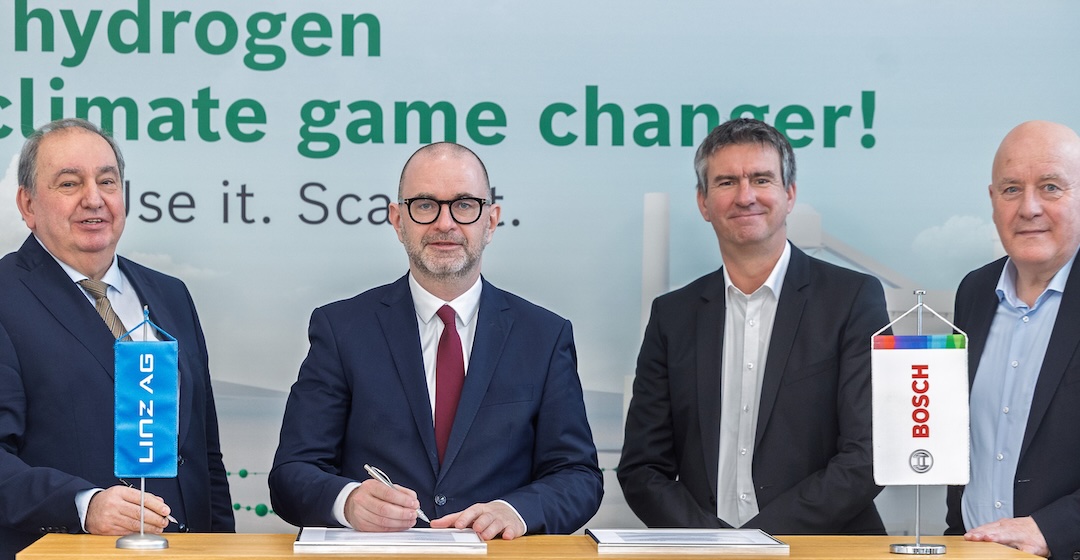
Bosch and Linz are jointly planning hydrogen projects in Upper Austria (from left): Erich Haider (CEO of Linz AG), Linz Mayor Dietmar Prammer, Helmut Weinwurm (Chairman of the Board of Management of Robert Bosch AG), Thomas Pauer (Chairman of the Supervisory Board of Bosch). © Robert Bosch AG / APA-Fotoservice / Schneeberger
(Austria) Robert Bosch AG and the municipal utility Linz AG plan to develop innovative hydrogen solutions for Linz in Upper Austria. The focus will be on the future use of green hydrogen from the Bosch electrolysis test field at the Engineering Center, as well as its connection to the emerging H2 start-up network and other pilot projects for hydrogen production. Furthermore, Bosch and Linz are examining options for the construction of additional electrolysis plants and the potential for optimization through shared infrastructure use. Another focus will be on testing grid-supportive operation to stabilize the electricity grid and the efficient use of renewable energies. Research partners will be involved to provide scientific support for technical, economic, and environmental aspects.
+ + + + +
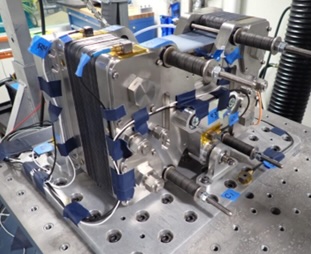
Nimbus is testing fuel cells for NASA's Artemis lunar landing mission. © Nimbus Power System Inc.
(USA) Nimbus Power Systems Inc. has announced the completion of shock and vibration tests on its gravity-independent fuel cell technology. These tests simulated the expected mechanical loads, including launch, for NASA's planned Artemis mission. Fuel cells react with oxygen and hydrogen to produce electricity, heat, and drinking water—three essential resources for crewed space operations. Nimbus's technology removes product water through a combination of capillary and hydraulic forces unaffected by the space environment. This advantage in water management reduces system complexity and offers significant weight savings. Jeff Bezos's aerospace company, Blue Origin, plans to use the polymer electrolyte membrane fuel cell technology for NASA's Blue Moon Lunar Lander program, which aims to deliver a crewed lunar landing. Blue Origin builds and operates reusable rocket engines, launch vehicles, space systems, and lunar landers.
+ + + + +
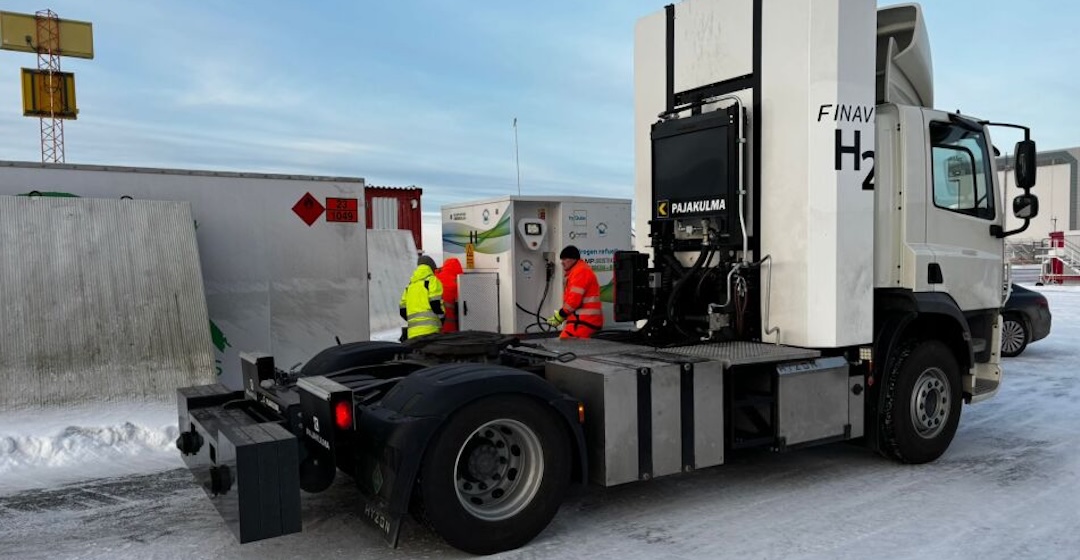
P2X Solutions is supplying green hydrogen to Finnish airport operator Finavia for a pilot project in Helsinki. © P2X Solutions Oy
(Finland) P2X Solutions Oy is supplying green hydrogen to Finland's largest airport operator, Finavia, for a pilot project at Helsinki Airport. The energy carrier will be tested as fuel for an airport maintenance vehicle. The vehicle is suitable for various attachments, such as a sweeper or snowplow, allowing it to be used year-round in diverse climatic conditions. The pilot project is part of the EU-funded Interreg Baltsee Regional Programme HyAirport. It will provide Finavia with valuable information on the safe use of green hydrogen in the aviation sector and lay the foundation for wider adoption in the future.
+ + + + +
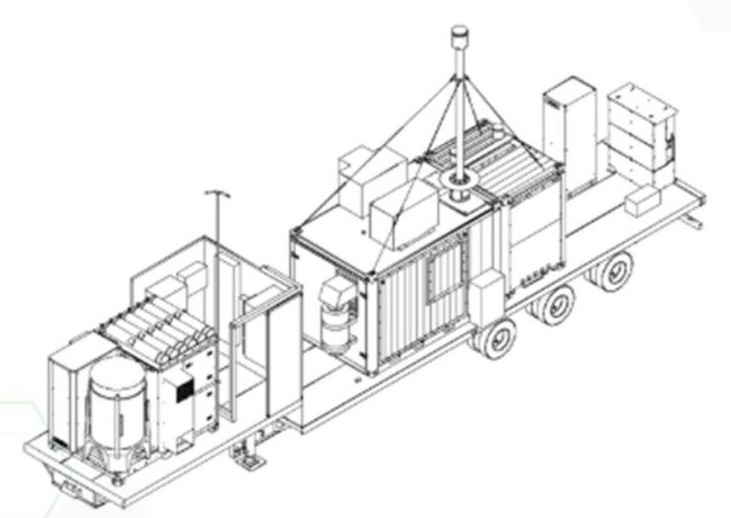
Fastnet is developing a mobile hydrogen refueling station and aims to bring it to mass production. © Fastech Fueling and Service Technologies Inc.
(USA) Engineering services provider Fastech Fueling and Service Technologies Inc., in collaboration with trailer manufacturer Kwik Equipment Sales LLC, has developed a portable hydrogen refueling station. The trailer, equipped with a compression module called the "Maximator 1.5," is designed to compress, store, and cool hydrogen at both low and high pressures up to 700 bar. It has a capacity of 110 kilograms per hour and a power output of 200 kilowatt-hours. The next phase involves final assembly of the trailer at Fastech's headquarters in Fountain Valley, California. According to the company, it has already developed and built over 50 stationary hydrogen refueling stations.
+ + + + +
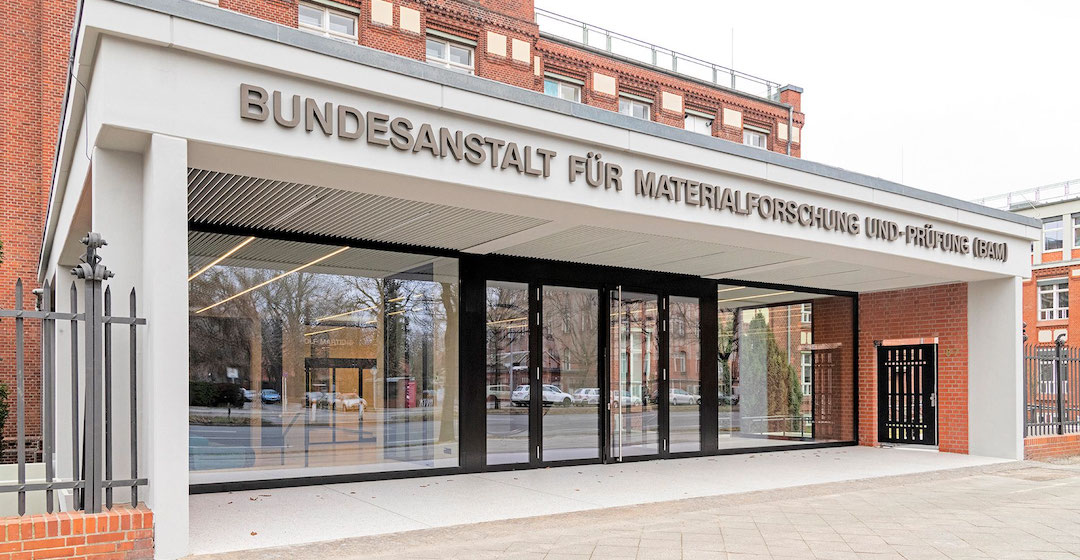
Eight institutions have founded a "National Alliance for Hydrogen Safety". © Federal Institute for Materials Research
(Germany) Eight institutions have founded a "National Alliance for Hydrogen Safety" (NAWS). "To support the market ramp-up of hydrogen technologies, coordinated cooperation among the key players in hydrogen safety is essential," according to the Federal Institute for Materials Research and Testing (BAM), which is leading the initiative. "General acceptance of hydrogen technologies" is currently considered high. However, studies also show "that most people have not yet considered the use of hydrogen in their immediate environment in detail." Individual incidents could therefore have a significant impact on public opinion during the current phase of market ramp-up. "It can hinder the ramp-up of hydrogen technologies if safety measures are not considered from the outset and existing knowledge gaps are addressed too late." In addition to BAM, the alliance includes the Physikalisch-Technische Bundesanstalt (PTB), Forschungszentrum Jülich, the Karlsruhe Institute of Technology (KIT), the Fraunhofer Society, the German Social Accident Insurance Institution for the Raw Materials and Chemical Industry (BG RCI), the Society for Plant and Reactor Safety (GRS), and the Otto von Guericke University Magdeburg. The institutions intend to "utilize their diverse networks in particular to effectively advance hydrogen safety at all levels."
+ + + + +
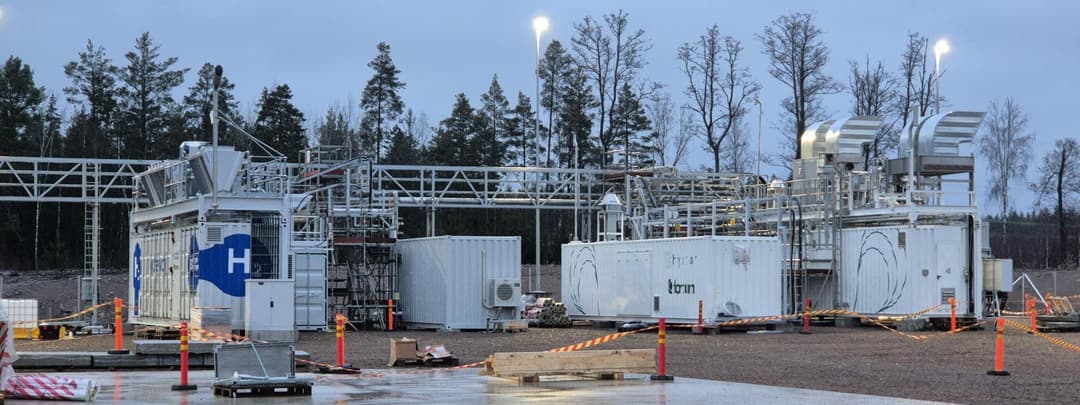
Fortum produces its first hydrogen at the Kalla test center. The image is from December 2025. © Fortum Oy
(Finland) Power plant operator Fortum Oy has produced hydrogen for the first time at the Kalla test center during the initial commissioning phases of its electrolyzer plant. It is scheduled to be fully operational in spring 2026. "This first hydrogen production from Kalla is an important milestone for Fortum in exploring the potential of hydrogen for decarbonizing Nordic industry," says Satu Sipola, Vice President of P2X. The plant has a capacity of 32,5 kilograms of hydrogen per hour. The company is testing two technologies: a one-megawatt alkaline electrolyzer from the Estonian company Stargate Hydrogen Solutions and a 0,75-megawatt PEM electrolyzer from Hystar A/S. The Kalla Test Center will serve as a learning and development platform until 2028. The hydrogen produced in Kalla will be supplied to P2X Solutions under an existing agreement.
+ + + + +
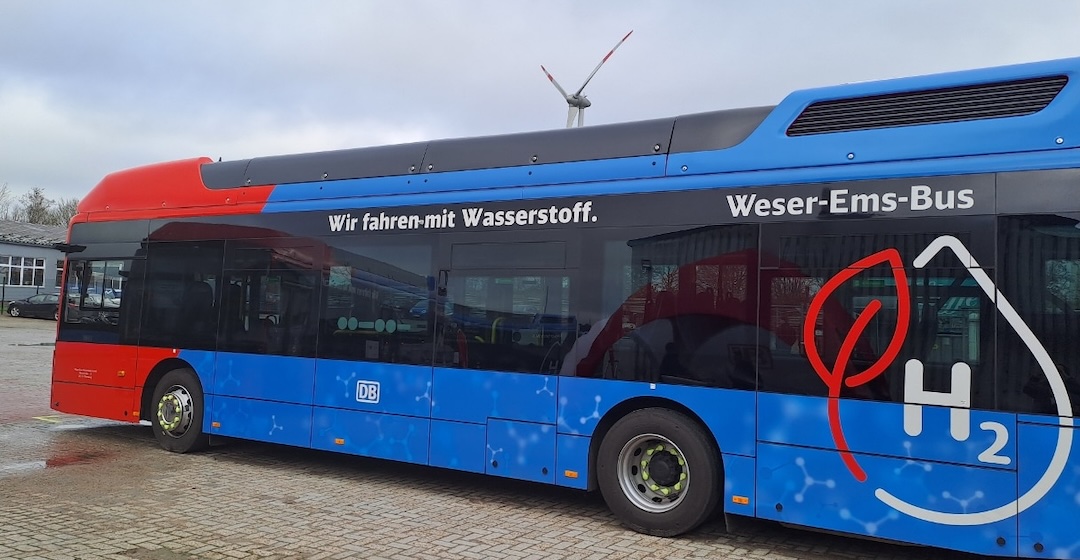
Weser-Ems-Bus puts six hydrogen buses into operation. © DB AG / Angelika Theidig
(Germany) DB Regio AG, a subsidiary of Deutsche Bahn (DB), has put six hydrogen buses from the Portuguese manufacturer Caetano into operation at Weser-Ems-Busverkehr GmbH in the Friesland district. The vehicles have a range of 590 kilometers. The roof-mounted tanks have a capacity of 37,5 kilograms of hydrogen. The fuel cell, manufactured by Toyota, continuously charges a battery that powers the bus. Refueling initially takes place at a mobile station at the depot in Jever. This station was installed jointly with the independent research institution Technology Transfer Center (ttz) Bremerhaven and the hydrogen producer and supplier Lhyfe. A public hydrogen refueling station is planned to open in 2026 by the operator Score. This station is to be conveniently located in Schortens. The procurement of a total of 152 buses with alternative drive systems for DB Regio Bus Nord is being subsidized with a total of 16,5 million euros by the Federal Ministry of Transport.
+ + + + +

Illustration of the Cleanergy pilot plant near Walvis Bay, Namibia. © Cleanergy
(Namibia) US electrolyzer manufacturer Plug Power Inc. is installing a five-megawatt GenEco PEM electrolyzer in partnership with Cleanergy Solutions Namibia. The company describes it as Africa's "first fully integrated green hydrogen plant." Located near Walvis Bay on the country's west coast, the plant combines solar-powered hydrogen production, public refueling stations, and supporting infrastructure. The solar park has an installed capacity of five megawatts and is connected to a 5,9-megawatt-hour battery storage system, enabling off-grid hydrogen production. The hydrogen will be used for various local applications, including Namibia's port, mining, and transportation sectors, as well as road and rail transport. Cleanergy Solutions Namibia is a joint venture between the Namibian company Ohlthaver & List Group, which provides the solar power, and the Belgian cleantech company CMB.TECH, which specializes in sustainable energy solutions. In November 2023, the Federal Institute for Materials Research and Testing (BAM) announced that it was participating in a cooperation in Walvis Bay to research a hydrogen production plant and a filling station.
+ + + + +
Photo above
iStock / © Danil Melekhin



