
(Lakewood, USA) – The global shift towards hydrogen-based steel production holds great potential for Australia to process its vast iron ore reserves for export. Direct hydrogen-based reduced iron (DRI) is “an important alternative to fossil fuels in iron production.” Australia’s renewable energy resources make the production of green hydrogen for steelmaking “relatively inexpensive.” These are the findings of a report by the US-based Institute of Energy Economic and Financial Analysis (IEEFA).
“Hydrogen export unaffordable”
Since its export appears "prohibitive," Australian green hydrogen should be "used domestically," with the iron industry "being an important potential consumer," says IEEFA analyst and author Soroush Basirat: "Iron ore is Australia's largest export commodity. A low-carbon transformation of this sector using green hydrogen is the potentially most impactful part of the Future Made in Australia plan."

In "direct reduction" (DRI), the CO2-intensive coke is replaced with natural gas or hydrogen to produce iron. The process turns ore into "sponge iron" in pellet form. These pellets are pressed into small iron briquettes (HBI, hot briquetted iron) and then processed into crude steel in an electric arc furnace. The technology has been in use since the 70s. What is new is the use of green hydrogen and green electricity. © Graphic: Steel Institute VDEh
The government's Future Made in Australia initiative aims to leverage the country's renewable energy advantages to help manufacturing make the energy transition. It includes a tax incentive for green hydrogen production of two Australian dollars (1,20 euros) per kilogram and an additional $1,3 billion (0,8 billion euros) to develop green hydrogen projects over the next decade.
According to the report, a number of new iron production projects using green hydrogen are currently underway in Australia:
- In the state Queensland invests Quinbrook Infrastructure Partners is investing $3,5 billion (€2,1 billion) in the use of green hydrogen from the "Central Queensland Hydrogen" project (CQ-H2) of a consortium led by the state-owned energy supplier Stanwell Corp. and Marubeni, which is scheduled to start production in 2028. Electrolyzers with an output of 640 megawatts are planned. The plant will initially supply 200 tonnes, later 800 tonnes, of green hydrogen per day for ammonia production, as well as liquid hydrogen for export, primarily to Japan and Singapore.
- The government of South Australia plans to build a green hydrogen-based DRI plant by 2030, using solar and wind energy as well as deposits of high-quality magnetite iron ore for steel production.
- In Western Australia builds it Fortescue Metals Group a green iron pilot plant at the Christmas Creek mining centre, and its Iron Bridge magnetite mine is ramping up production of DRI steelmaking grade ore with the aim of becoming a major supplier to China.
International car manufacturers have already signed purchase agreements for green steel produced with hydrogen. The analysts say it is to be expected that "the definitions of green iron and green steel will become even stricter". Basirat: Manufacturers are "increasingly exposed to the risk that steel consumers do not want any fossil fuels in their supply chain at all".
Hardly any commercial CCS plants in the steel sector
CCS (Carbon Capture and Storage) technology for CO2 capture and storage does not change this. Numerous CCS projects have been discontinued or have failed in recent years, according to an IEEFA report published in March ("The Good, the Bad, and the Ugly reality about CCS"). Another analysis in July describes CCS as an "unproven technology" and a financial risk.
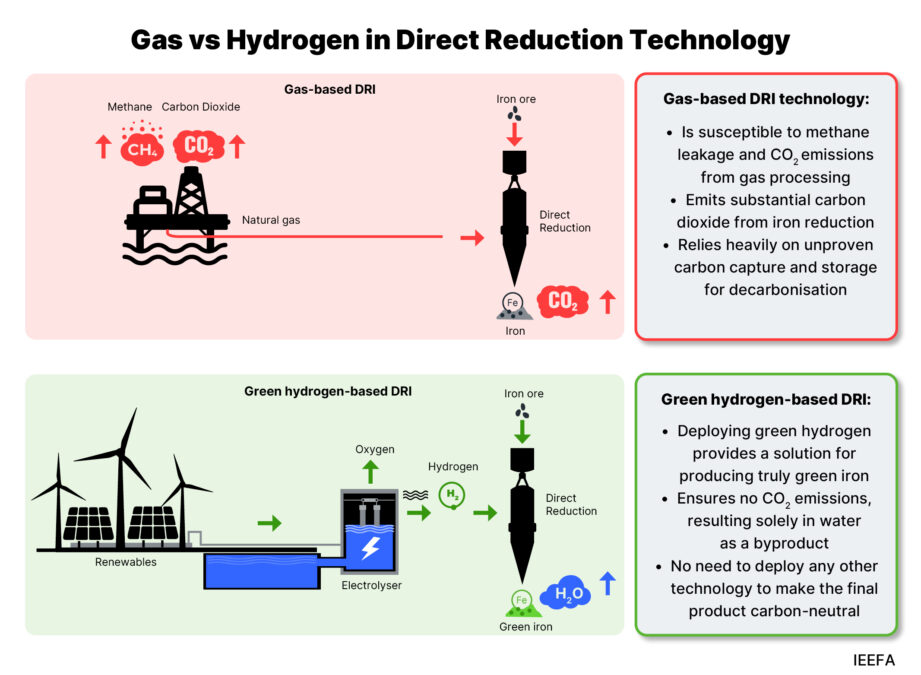
DRI technology: Natural gas use is prone to leaks with methane losses. It causes CO2 emissions because CCS technology has not proven itself so far, according to IEEFA. The use of hydrogen, on the other hand, is a solution to produce green iron. There are no CO2 emissions in the process and no additional technology is required to achieve carbon neutrality. © IEEFA
There is only one commercial-scale CCS plant in the steel sector worldwide. The Al Reyadah CCS project captures the emissions of Emirates Steel Arkan's DRI-based steel plant, but has only been able to capture 19 to 26 percent of these emissions in recent years. "Therefore, this plant cannot be considered decarbonized. Since it was commissioned in 2016, no other commercial-scale CCS projects have been carried out in the steel sector.
Australian CCS projects have also shown a poor track record. Even the steel company Liberty Steel, which is planning to switch from blast furnace steel production to DRI in Whyalla in South Australia, wants to use a mixture of natural gas and green hydrogen.
Global competition for green iron is growing
On the other hand, DRI plants are being built around the world to use environmentally friendly hydrogen. The IEEFA analysis gives a number of examples:
- The Swedish company H2 Green Steel AB builds in Northern Sweden a plant that produces not only steel but also green iron in the form of hot briquetted iron (HBI) for export. It is scheduled to go into operation in 2026. Rio Tinto has signed an agreement to purchase and resell the green HBI. H2 Green Steel is already planning further plants for green hydrogen and steel based on DRI in Canada, Portugal, the USA and Brazil.
- Brazil is one of the world's largest producers of direct reduction grade iron ore. This has a higher iron content and fewer impurities. This puts Brazil in a good position to become an exporter of green iron with its high-quality ore and green hydrogen. Iron ore giant Vale signed a memorandum of understanding with the port of Açu in September 2023 to explore the export of HBI.
- Kobe Steel and Mitsui have signed a letter of intent to explore the feasibility of DRI production and HBI export in Oman The aim is to produce five million tonnes of DRI from 2027, with a switch to hydrogen or CCS being considered.
- Vulcan Green Steel plans to invest three billion dollars in a H2-DRI plant with an annual capacity of five million tons. The plant will be located in the special economic zone of the port city of Duqm (Oman) near green hydrogen facilities that could later directly supply the DRI plant. The company is targeting demand for low-carbon steel in the Middle East, Europe and Japan. In June 2024, the Volkswagen Group announced that it was partnering with Vulcan Green Steel to purchase low-carbon steel from Oman.
- In the United Arab Emirates Emirates Steel Arkan has partnered with Japanese steelmaker JFE Steel and trading house Itochu Corporation to explore producing iron in Abu Dhabi that will be shipped to Asia from late 2025 and used by JFE Steel and other companies to make steel. The plan envisages a later transition to hydrogen-based steelmaking.
- The steel giant China Baowu Group has signed an agreement with Aramco and the Saudi Arabian Public Investment Fund (PIF) to invest in Saudi Arabia to build a hydrogen-capable DRI steel plant to supply the domestic and regional market with steel.
Africa is not left out either: A plant is being built in Namibia that will use green hydrogen to produce iron. It is expected to begin exporting to Germany on a small scale at the end of 2024 and will then be ramped up to a capacity of one million tons per year. According to IEEFA, there are similar plans in Mauritania.
Hydrogen versus natural gas lobby
At the same time, however, the government's Future Gas Strategy claims that natural gas is a key element in iron and steel. "These strategies show different and contradictory paths for the future of iron production in Australia," says Simon Nicholas, IEEFA senior analyst for Global Steel. "Continued reliance on gas poses risks for Australian industry in a world that is moving away from fossil fuels: "Green iron cannot be made with natural gas.
“As other countries now realise their green iron and steel opportunities, Australia must act quickly to become a world leader in green iron, not just iron ore,” the institute’s analysis said.
The “Briefing Note” is available free of charge in English as a PDF (seven pages).
Photo above
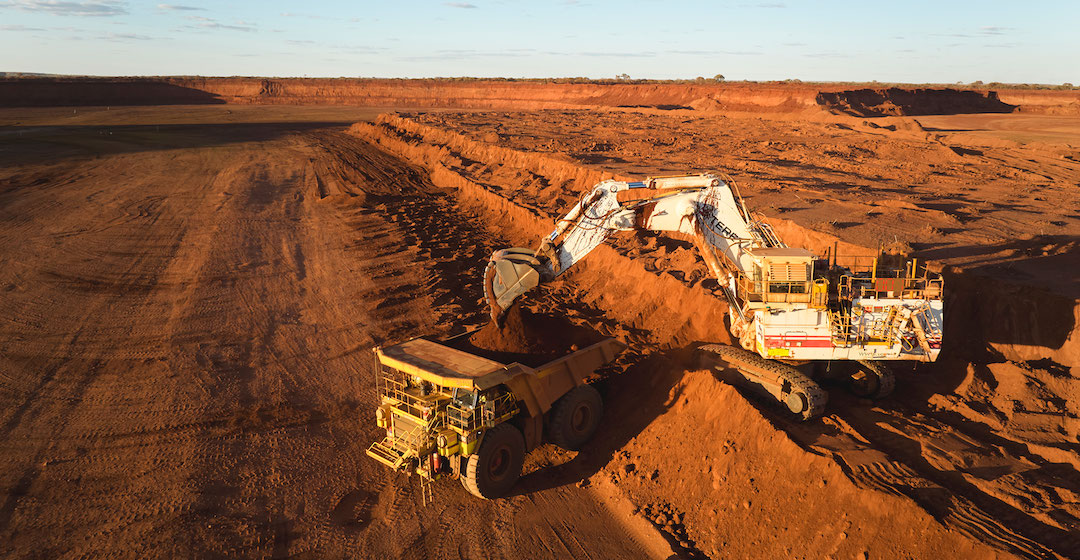
Ore mining in the Australian region of Pilabara: The mining company Fortescue Metals Group has started building a commercial plant there to produce green iron using hydrogen and solar-powered smelting furnaces. In the future, the "Christmas Creek Green Iron" project is expected to produce more than 1.500 tonnes for further use in steelworks. © Fortescue Metals Group



