
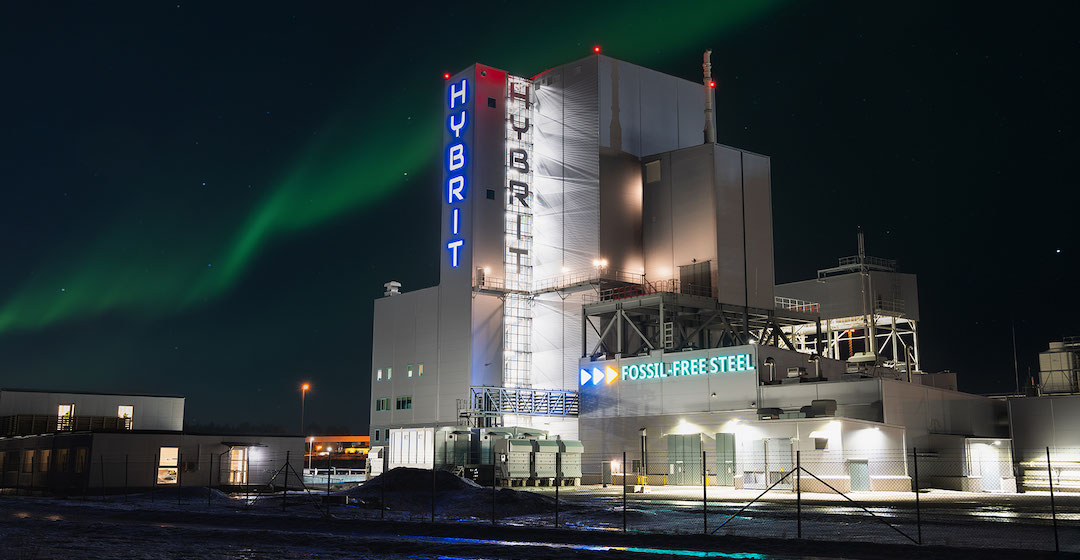
(Luleå, Sweden) – The "Hybrit" pilot project for storing gaseous hydrogen has been extended for further testing until 2026. The joint venture, "Hybrit Development AB," comprised of steelmaker SSAB, mining company LKAB, and state-owned energy provider Vattenfall AB, launched the project in 2016 with the goal of developing ore-based iron and steel production using fossil-free electricity and hydrogen. The companies aim to create a completely fossil-free value chain from the mine to the finished steel. A pilot plant for storing hydrogen in rock caverns was inaugurated in 2022, marking the start of a two-year test phase , which was recently completed as planned.

Schematic layout of the pilot storage facility: The tests encompassed approximately 3.800 operating hours in campaigns lasting three to six weeks, with combined hydrogen gas production and storage at 94 percent availability. The choice of material for sealing the rock cavity was one of the most important tasks. The selected steel proved to be resistant to hydrogen. No leakage from the storage facility's sealing layer was detected. © Vattenfall AB
The results demonstrated that it is technically feasible to store gaseous hydrogen for the production of fossil-free iron and steel on an industrial scale. Additional tests are now being conducted to further improve "the conditions for the development of commercial hydrogen storage," Vattenfall explains. As part of the project, a 100-cubic-meter hydrogen storage facility based on a steel-lined rock cavern was designed and built in Svartöberget, in close proximity to the DR pilot project for sponge iron production in Luleå, Sweden.
The now-completed trials demonstrated that the technology is suitable for a large-scale hydrogen consumer and that savings of approximately 25 to 40 percent of the variable operating costs of hydrogen gas production could be achieved. The pilot storage facility was subjected to accelerated mechanical testing equivalent to approximately 50 years of operation, thus demonstrating the plant's safety, functionality, and performance.

The interior of the rock cavern before commissioning. © Vattenfall AB
"We have demonstrated that it is possible to increase the flexibility of the electricity system with this technology and that it is a safe concept that can be sustained over time," says Mikael Nordlander, Director of Industry Decarbonization at Vattenfall's Industrial Partnerships. "With the results and experience from the pilot project, the technology is now ready for scale-up." Hydrogen storage is "an important piece of the puzzle for electrifying industrial processes while simultaneously increasing the amount of weather-dependent electricity."
The primary purpose of a hydrogen storage facility is to adapt hydrogen production to fluctuations in the electricity market. Production costs are optimized "by producing and storing excess hydrogen gas when electricity prices are low, and reducing production and using the stored hydrogen gas when prices are high."
Investment decision still pending
Hydrogen is "an important part of LKAB's future strategy" toward carbon-free products and processes, says Jenny Greberg, the company's Vice President of Technology. "We haven't made any decisions about storage yet, but the successful results of the pilot project give us a good foundation as we assess the need and possibilities for storage in conjunction with our planned sponge iron production facilities."
Photo above
The Hybrit Development AB joint venture was established in 2016 with the goal of developing ore-based iron and steel production using fossil-free electricity and hydrogen. The pilot project has now been completed, but an investment decision for the next phase has not yet been made. © Vattenfall AB



