
(Kassel, Germany) – Chile offers, in international comparison, “excellent conditions for the cost-efficient, climate-neutral production of green methanol with high potential for local use and export.” This is the conclusion of the recently completed German-Chilean research project “Power-to-MEDME-R&D.” A consortium led by the Fraunhofer Institute for Energy Economics and Energy System Technology IEE spent two years investigating “key technological, economic, and systemic foundations for the sustainable production of green hydrogen and its derivatives methanol and dimethyl ether” (DME).
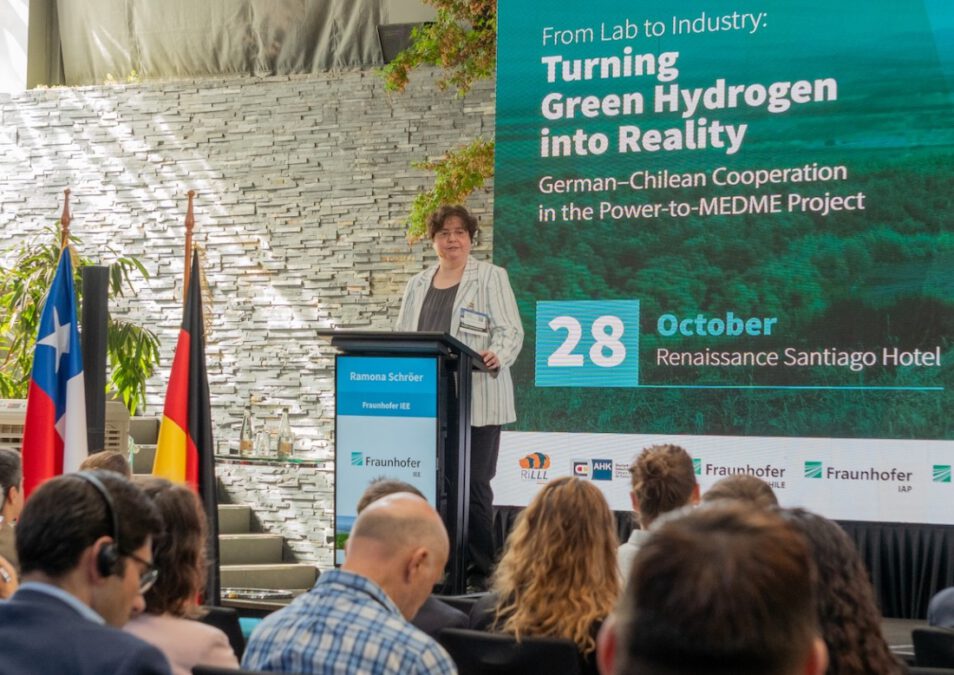
Project manager Ramona Schröer at the closing event for the "Power-to-MEDME" research project in October in Santiago, Chile. © AHK Chile
The aim was to analyze the entire value chain of green hydrogen produced from renewable energies and to assess its technical, economic, environmental, and social aspects. According to project manager Ramona Schröer, green methanol and DME from Chile can "not only make a significant contribution to climate protection but also be competitive in the medium term." "Our analyses demonstrate that Chile, with its outstanding potential in photovoltaics and wind energy, offers particularly favorable conditions for the cost-efficient production of these energy carriers." Based on current prices and price trends, green methanol is already "competitive with gray methanol in the medium term." This provides a basis for "reliable prospects for markets, industry, and exports."
Low production costs with sun and wind
Chile's ideal conditions for hydrogen production using PV and wind power plants "enable extremely low production costs compared internationally," according to the study. Furthermore, green DME has "great potential" in Chile itself as a replacement for diesel, liquefied petroleum gas (LPG), and natural gas, both as an additive and as a complete replacement in sectors such as heating, transportation, and mining.
Looking ahead, exporting green DME offers a viable option for gradually replacing fossil LPG. The existing liquefied gas infrastructure could be largely utilized for this purpose. Green methanol is also suitable for export and can be used in various sectors, including shipping, the chemical industry, and for the production of other derivatives such as sustainable aviation fuel (SAF).
DME pilot plant and PEM electrolyzers
As part of the project, a 7,5-meter-high pilot plant for DME reactive distillation was also commissioned as a demonstrator. Currently, the scaling and commercialization of the technology are being investigated. Cost-effective catalysts for PEM electrolyzers could also be developed in Chile.
Furthermore, specific operational profiles and vehicle requirements of several mining companies were directly incorporated into the analyses. This enabled the development of practical concepts for retrofitting existing heavy-duty and off-road vehicle fleets with green DME. "The local production of green fuels opens up the possibility of gradually decarbonizing the entire value chain in mining," according to Fraunhofer IEE. "We were able to create concrete prospects for industry and markets, thereby making an important contribution to the energy transition in Chile, strengthening the local economy, and, building on this, to the long-term supply of climate-neutral energy carriers for Germany," says Ramona Schröer.
Ten consortium partners
The project, led by Fraunhofer IEE, also involved the Fraunhofer Institute for Solar Energy Systems ISE, the Fraunhofer Institute for Microtechnology and Microsystems IMM, the Fraunhofer Institute for Silicate Research ISC, the Fraunhofer Institute for Applied Polymer Research IAP, the Fraunhofer Institute for Ceramic Technologies and Systems IKTS, RWTH Aachen University and the Research Institute on Lifelong Learning (RILLL), Fraunhofer Chile Research and the German-Chilean Chamber of Industry and Commerce (AHK Chile).
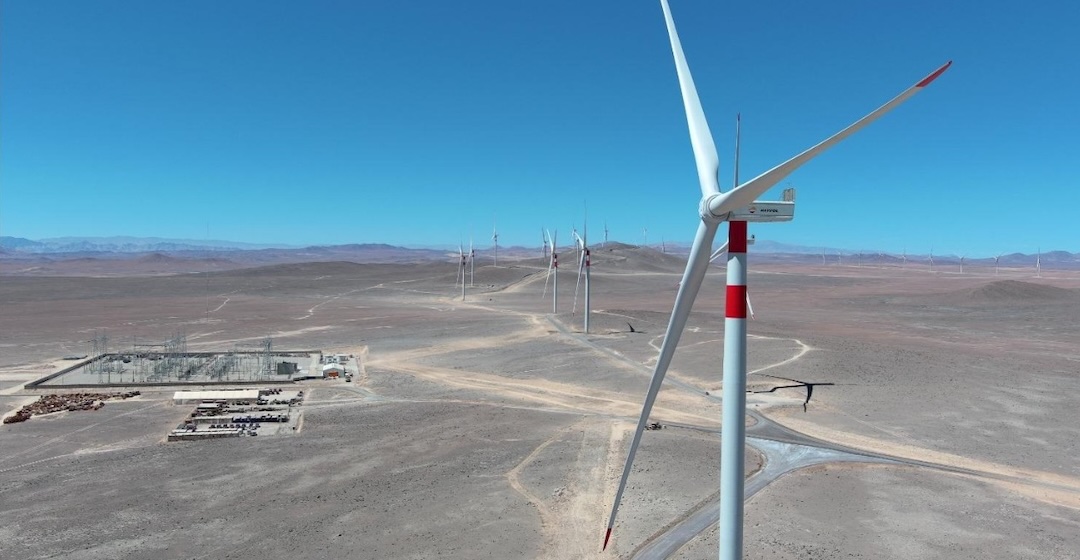
Photo above
Chile has great potential for the production of green hydrogen and its derivatives due to favorable conditions for solar and wind energy. Photo: In April 2025, the Spanish oil and gas company Repsol SA commissioned the first phase of a 364-megawatt wind farm in the Taltal region of Antofagasta. © Repsol SA



