
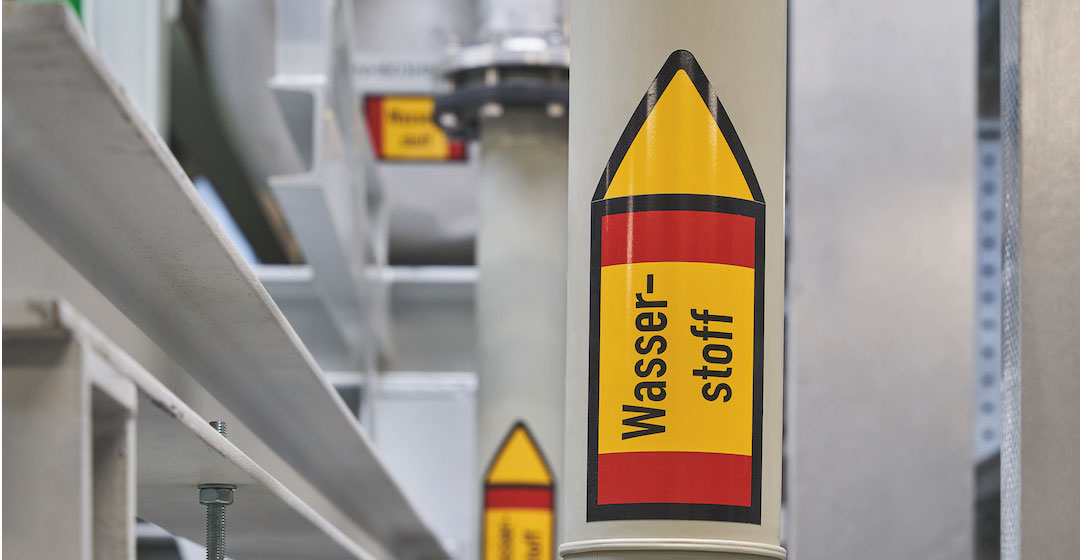
(Munich, Germany) – Blue hydrogen produced from natural gas with CO2 capture offers "structural cost advantages" in the short to medium term – primarily due to lower energy and plant costs, as well as high utilization of production facilities. Green hydrogen, on the other hand, could become significantly cheaper in the long term due to economies of scale as the market ramps up. "Crucial factors are low levelized costs of electricity, high full-load operating hours, and cost reductions in electrolysis," according to a study by Prognos AG commissioned by the Association of Bavarian Businesses (VBW).
VBW: The consistent development of a hydrogen economy can unlock new value creation potential. © Prognos AG
The analysis examines hydrogen costs from the perspective of industrial users under various import and production scenarios up to 2045 and beyond. According to Prognos, green hydrogen will gain importance in the long term, "since the use of blue hydrogen after 2045 is unlikely due to climate targets." Hydrogen storage incurs additional costs – regardless of the production method. The most cost-effective transport is via pipelines for distances of up to approximately 2.000 kilometers.
Ensuring security of supply
"Hydrogen is a key building block for a climate-neutral industry," the authors say, because it offers a way to replace fossil fuels in industry. However, for hydrogen to make a real contribution, "security of supply and economic viability must be guaranteed," says VBW Managing Director Bertram Brossardt.
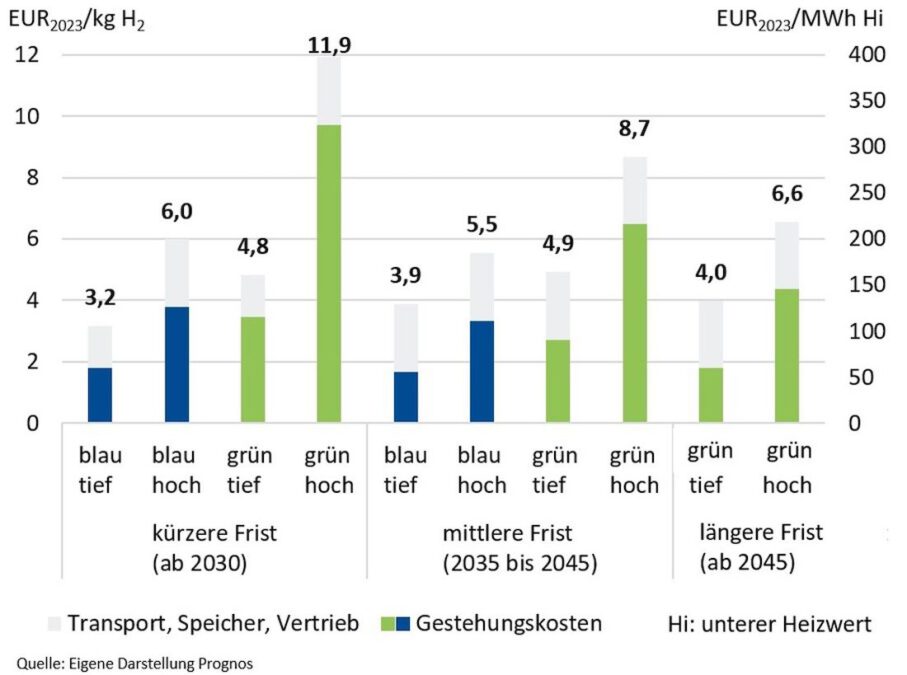
The cost ranges presented allow industrial companies to better estimate potential price developments and align their transformation paths accordingly. © Prognos AG
Thus, based on pessimistic assumptions regarding cost development, the price of green hydrogen, at €11,90 per kilogram, will be almost twice as high as that of blue hydrogen (€6,00) between 2030 and 2035. However, "even assuming an unfavorable cost development, green hydrogen will become significantly cheaper in the subsequent period." In the period up to 2045, blue hydrogen will now become twelve percent cheaper to €5,50 (minus 50 cents), while the price of green hydrogen will drop by almost 27 percent to €8,70 (minus €3,20). However, it should be noted that emissions are generated during the production of blue hydrogen. "Therefore, in view of the climate targets and the expiration of CO2 certificates, it is unlikely that blue hydrogen will still be used after 2045," says Brossardt. "Green hydrogen, on the other hand, can become significantly cheaper in the long term and gain in importance."
With the "consistent development of a hydrogen economy," new value creation potential could be tapped. VBW believes that the expansion of all renewable energies and the urgently needed energy infrastructure must be implemented more quickly. A successful energy transition is "crucial for securing the competitiveness of our location."
The Prognos presentation "Hydrogen Costs for Industry" is available free of charge as a PDF (30 pages). It was commissioned by the Association of Bavarian Industry (Vereinigung der Bayerischen Wirtschaft e. V.).
Photo above
VBW: "It is unlikely that blue hydrogen will still be used after 2045." © Zukunft Gas / Swen Gottschall



