

(Berlin, Germany) – The use of hydrogen at German commercial airports is technically feasible, permissible under regulations, and supported by policymakers. However, significant uncertainties remain regarding the timing, scale, and economic viability. For airports, operators, and policymakers, the question is therefore less about whether hydrogen will play a role in the future, but rather under what conditions, for which applications, and in what timeframe its use can be implemented effectively. These are some of the findings of the study "Hydrogen Infrastructure at German Airports" by the Fraunhofer Institute for Material Flow and Logistics (IML).
A key finding of the study is the clear differentiation between gaseous (GH2) and liquid hydrogen (LH2). © Now GmbH
According to the report, widespread deployment in the short term is not expected. Instead, a "selective and gradual ramp-up is anticipated, closely linked to external developments, particularly in the areas of vehicle availability, regulation, and regional hydrogen markets." It is considered certain that hydrogen is "not a generic replacement for battery-electric solutions" but rather "a complementary technology for clearly defined use cases"—especially where battery-electric systems reach their technical, operational, or seasonal limits, for example, in special-purpose and security vehicles, winter road maintenance, and the ground support equipment (GSE) sector.
In early market phases, “mobile, modular, and reversible infrastructure solutions” such as trailers, mobile dispensers, and tank trucks (Bowser) dominated. The economic viability of hydrogen-based infrastructures generally arises “not from airport operations alone, but from integration into regional multi-use systems (logistics, public transport, industry). Airports primarily function as integrators, not as the sole drivers of demand.”
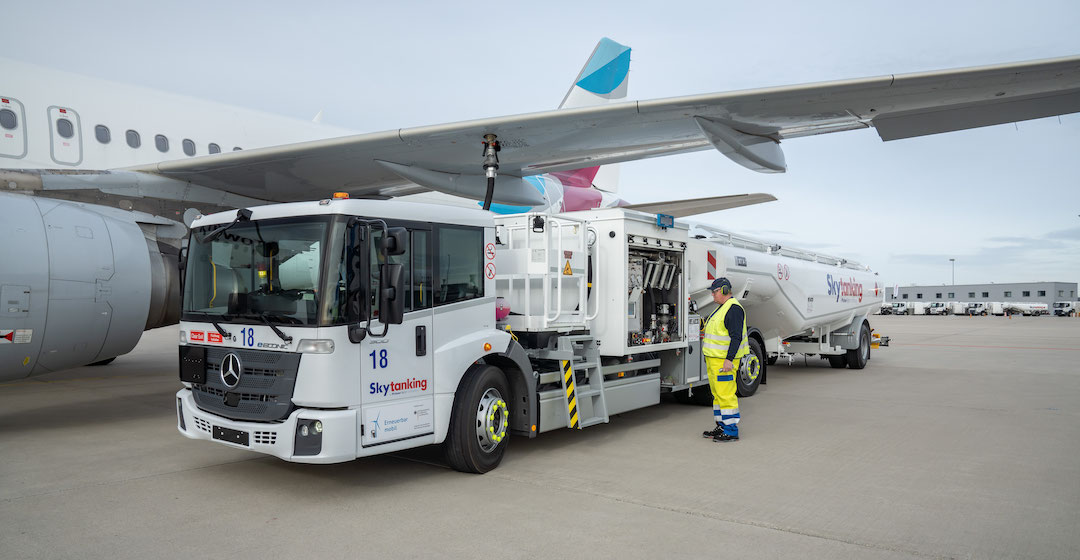
Refueling vehicle at Stuttgart Airport: Gaseous hydrogen is a "short-term viable entry point," especially for applications in apron operations with vehicles such as trailers, mobile dispensers, and tank trucks. © Daimler Truck AG
Another key finding of the study is the clear differentiation between gaseous (GH2) and liquid hydrogen (LH2). These two forms differ fundamentally in terms of their technical requirements, application logic, and temporal relevance. Gaseous hydrogen represents a "short-term viable entry point," particularly for vehicles and equipment on the apron. The necessary technologies are generally available and can be integrated modularly into existing processes.
Liquid hydrogen, on the other hand, is primarily considered in the context of future hydrogen-powered aircraft and is associated with significantly higher demands on infrastructure, safety, and operation. Its relevance therefore lies primarily in a long-term perspective.
Bottleneck in vehicles and standards
The main bottleneck currently lies not in technical feasibility, but in the availability of near-production vehicles, the lack of standardization, and uncertainties regarding permits, liability, and insurance. Furthermore, master plans need to be developed to secure areas, corridors, and safety zones as "H2-ready" in the long term.
Overall, the study makes it clear that hydrogen at the airport is "less a short-term implementation project than a strategic transformation path" with external dependencies. Future analyses should focus less on cost comparisons ("euros per kilogram") and more on scenarios with economic viability assessments, capacity utilization, multi-use demand, electricity price volatility, logistics distances, and operator roles.
The study “Hydrogen infrastructure at German airports” by the Fraunhofer Institute for Material Flow and Logistics (IML) was commissioned by the Federal Ministry of Transport and is available free of charge as a PDF (142 pages) on the Now GmbH website.
Photo above
Commercial airports have great potential for hydrogen use. © Anikka Bauer / Berlin Airport



