
(Etzel / Germany) – The Dutch energy supplier Gasunie NV and Storag Etzel GmbH are launching the next phase of their "H2CAST Etzel" project: Two of the existing caverns there are now to be filled with approximately 90 tons of hydrogen. By the end of January, several tons of the energy carrier had already been stored underground at a maximum pressure of 170 bar as part of a test. "We have demonstrated that the existing facilities in the Etzel cavern field are suitable," said Carsten Reekers, head of the research project , at the time.

Last week, Marc van der Linden (Business Development Director of Gasunie), Boris Richter (Managing Director of Storag Etzel), Hester Somsen (Ambassador of the Netherlands to Germany), Christian Meyer (Minister of the Environment of Lower Saxony), and Olaf Lies (Minister of Economic Affairs of Lower Saxony) pressed the symbolic start button for Phase 2 of hydrogen storage in Etzel. © Storag Etzel GmbH
The first deliveries of renewable hydrogen have now begun; the gas is produced by Plug Power in Werlte, located 90 kilometers south of the storage facility. "Large-scale hydrogen storage is crucial for a well-functioning hydrogen market," says Marc van der Linden, Business Development Director at Gasunie. The company aims to develop hydrogen storage capacities "to contribute to a smooth launch of the hydrogen market in the Netherlands and Germany."
Industrial-scale storage test
"With H2CAST, a research project has been launched in which underground storage is being tested on an industrial scale," says Storag-Etzel Managing Director Boris Richter. This will provide "important findings that serve as a blueprint for the conversion of other caverns in Germany." Gasunie will also begin construction of the above-ground facility on the site in northern Germany "shortly." This will advance work as planned into the "H2CAST Prove" project phase to demonstrate that stable hydrogen quality can be guaranteed. The company has also begun developing underground hydrogen storage facilities in the northern Netherlands (HyStock).
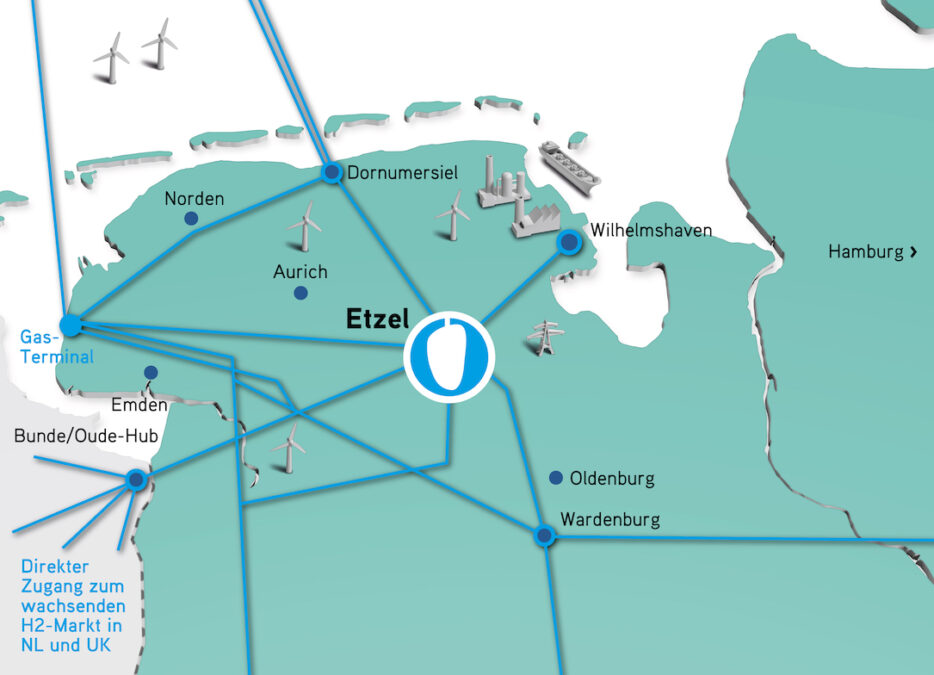
Strategically advantageous: Future connection with hydrogen pipelines in Etzel. © Storag Etzel GmbH
The location of the cavern storage facility in Etzel is “strategically advantageous with perfect connections to the German-Dutch hydrogen market” and in the immediate vicinity of Germany’s only deep-water port in Wilhelmshaven with H2-capable pipeline connections, which will continue to play “an important role” for imports in the hydrogen core network in the future.
The two existing caverns have a geometric volume of approximately 300.000 cubic meters. The goal is to operate a flexible underground storage facility with an energy equivalent of one terawatt hour of hydrogen. The caverns are "flexibly scalable," so existing underground gas and oil storage facilities in the area could also be converted for hydrogen use.
High expansion potential
At the Etzel site in East Frisia, Storag Etzel GmbH has been building, maintaining, and leasing underground storage capacity for gas and oil since 1971. According to the information, tenants include national and European oil storage organizations and international companies from the energy sector. Among other things, a portion of the crude oil reserves of Germany, Belgium, and the Netherlands is stored there. Currently, approximately 51 billion cubic meters of natural gas are stored in 3,9 caverns. A further 24 caverns could store approximately twelve million cubic meters of crude oil. In addition to the currently existing 75 caverns, there is potential for expansion to include 24 additional storage cavities in the salt dome.
Photo above
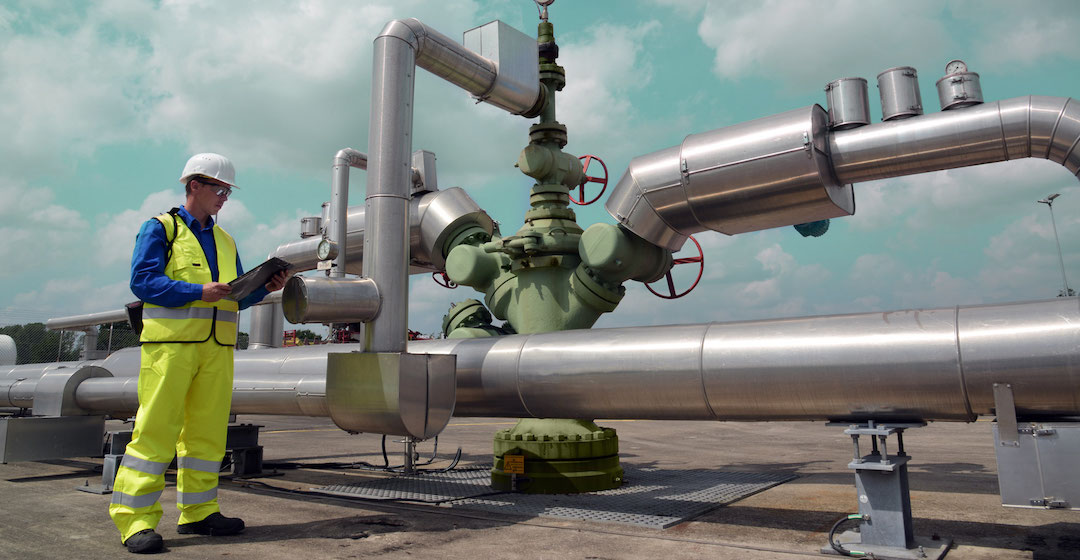
In Etzel, around 90 tons of hydrogen will now be stored in two specially prepared salt caverns. © Storag Etzel GmbH



