
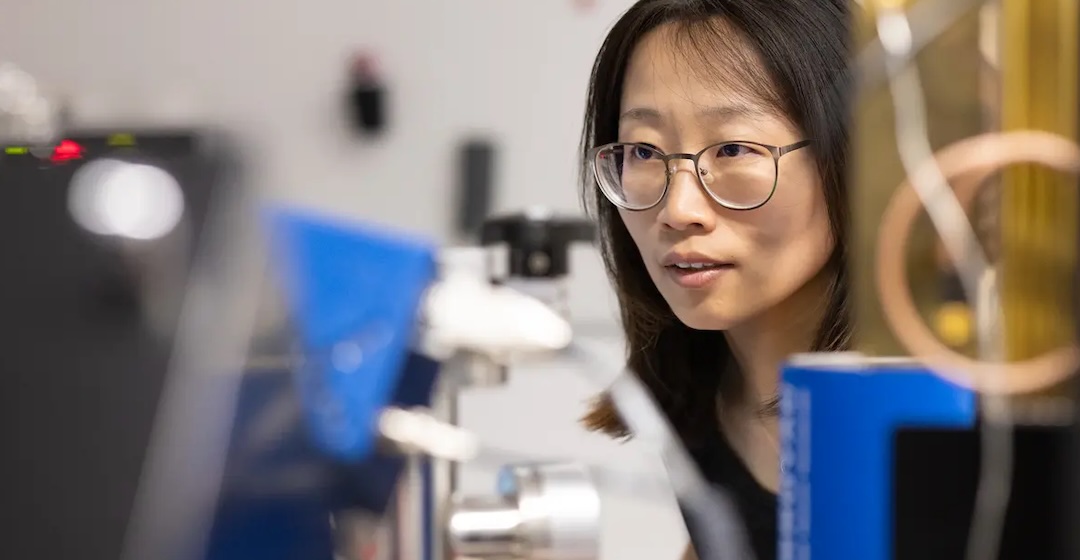
(Düsseldorf, Germany) – Hydrogen reacts highly aggressively with metallic materials at room temperature. This is well known, has been extensively studied, and still poses a costly problem for parts of the hydrogen economy. An international research team investigated how hydrogen affects nickel-based superalloy blades in gas turbines at high temperatures. The result: Hydrogen embrittles the turbine material at least twice as fast at elevated temperatures as at room temperature.
Methane leads to material failure
The study investigated the effects of hydrogen on nickel-based superalloys at temperatures between 400 and 1.000 degrees Celsius. The team, which included researchers from the Max Planck Institute for Sustainable Materials (MPI-SusMat), analyzed the material and found that hydrogen-induced damage occurred exclusively at 400 degrees Celsius. "Only at this temperature is the reaction of hydrogen and carbon to form methane thermodynamically favored." No methane formation was observed above 400 degrees Celsius.
“When hydrogen penetrates a nickel-based superalloy at room temperature, it typically becomes trapped at interfaces and dislocations, leading to embrittlement,” says Xizhen Dong, a postdoctoral researcher at the MPI-SusMat and one of the study’s first authors. At elevated temperatures, another effect comes into play: “Hydrogen penetrates the carbides, which are actually responsible for the material’s strength, and combines with carbon there.” The resulting methane exerts high pressure on the interfaces between the carbides and the nickel matrix, which “leads to material failure more quickly,” the scientist explains. “To power gas turbines with hydrogen, future alloys will need to rely on other strengthening mechanisms.”
Important for gas turbines and aircraft engines
“This finding is particularly important for gas turbines in power generation and for aircraft engines,” explains co-author Dierk Raabe, Director at the MPI-SusMat. “Unlike stationary steam turbines, which run continuously at very high temperatures, gas turbines are frequently switched on and off. As a result, they are exposed to a significantly wider temperature and stress range, and it is precisely in this range that hydrogen-induced embrittlement can occur more frequently.”
The study involved the East China University of Science and Technology (China), the Max Planck Institute for Sustainable Materials (Germany) and Hunan University (China).
The results were published in “Nature Materials”: “Hydrogen-induced damage in Ni-based superalloys at elevated temperatures”.
Further information on this topic : In February of this year, the Max Planck Institute for Sustainable Materials announced the development of a "cost-effective and high-performance" stainless steel for the hydrogen economy ($4,15 per kilogram). The implementation of small amounts of nickel, manganese, and copper leads to "extremely low hydrogen diffusion coefficients." This "effectively prevents hydrogen diffusion" and avoids hydrogen-induced damage. The results were published in Science Advances 12 (2026) under the title "Segregation passivation makes cost-effective stainless less resistant to corrosion and hydrogen embrittlement."
Photo above
Scientist Xizhen Dong analyzes how hydrogen affects nickel-based superalloys, the material used for turbine blades, at elevated temperatures. © Max Planck Institute for Sustainable Materials GmbH



