

(Berlin / Germany) – The Association of Gas Transmission System Operators (FNB Gas) has submitted its application for the hydrogen core network to the Federal Network Agency . This network will connect “central consumption and production hubs as well as storage and import centers gradually by 2032”.
The length is 9.666 kilometers. Of this, 802 kilometers are lines from 16 other distribution network operators. Around 60 percent of the lines would be converted from existing natural gas pipelines to hydrogen. The amount of energy that could potentially be fed out per hour is 278 terawatt hours. The association estimates the investment costs at 19,7 billion euros.
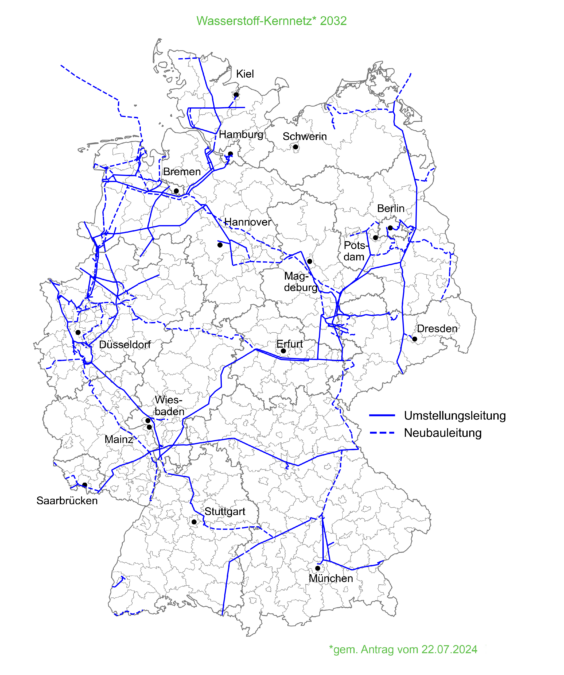
The gas transmission system operators have applied to the Federal Network Agency for the construction of the hydrogen core network. © FNB Gas
"The core network solves the chicken-and-egg problem by initially developing the infrastructure on the basis of a scenario worked out together with politicians," says FNB Gas Managing Director Barbara Fischer. It lays the foundation "for the ramp-up of the hydrogen economy." The long-distance network operators are thus making an advance payment: "The core network is the offer to the market, it comes for the market and develops with it." It is "the starting point for the development of a Germany-wide transport infrastructure," says Thomas Gößmann, FNB Gas CEO. The next step is to develop this further "in order to bring hydrogen to the area as well."
In addition to connecting central industrial sites, "regional balance and integration into the European hydrogen infrastructure are important goals that the core network is to achieve," says the Federal Ministry of Economics. All federal states will be connected. Hydrogen can be imported by pipeline at an early stage via border crossing points. "In the future, Germany will cover a large part of its hydrogen demand through imports by pipeline or ship." The geographical focus of pipeline-based imports is on the North and Baltic Seas and the Mediterranean region, with possible production centers on the Iberian Peninsula and in North Africa.
Consultations until August
According to the information, the Federal Network Agency now has two months to review and approve the project in accordance with the Energy Industry Act (Section 28q Paragraph 8 EnWG). An initial two-week consultation with stakeholders is planned until August 6. Construction will begin after approval. The first hydrogen pipelines could be put into operation as early as "next year".
The regulations for financing the hydrogen core network, also enshrined in the German Energy Industry Act (EnWG), were approved by the European Commission in June under state aid rules. As previously reported , the pipelines are to be financed entirely through private sector fees levied on users, similar to the electricity and natural gas networks.
The FNB Gas association includes Bayernets GmbH, Ferngas Netzgesellschaft mbH, Fluxys TENP GmbH, Gascade Gastransport GmbH, Gastransport Nord GmbH, Gasunie Deutschland Transport Services GmbH, GRTgaz Deutschland GmbH, Nowega GmbH, Ontras Gastransport GmbH, Open Grid Europe GmbH, Terranets BW GmbH and Thyssengas GmbH. Together they operate a pipeline network of around 40.000 kilometers.
Photo above
Welding work on long-distance pipelines of the TNB member Bayernets / © Bayernets GmbH



