
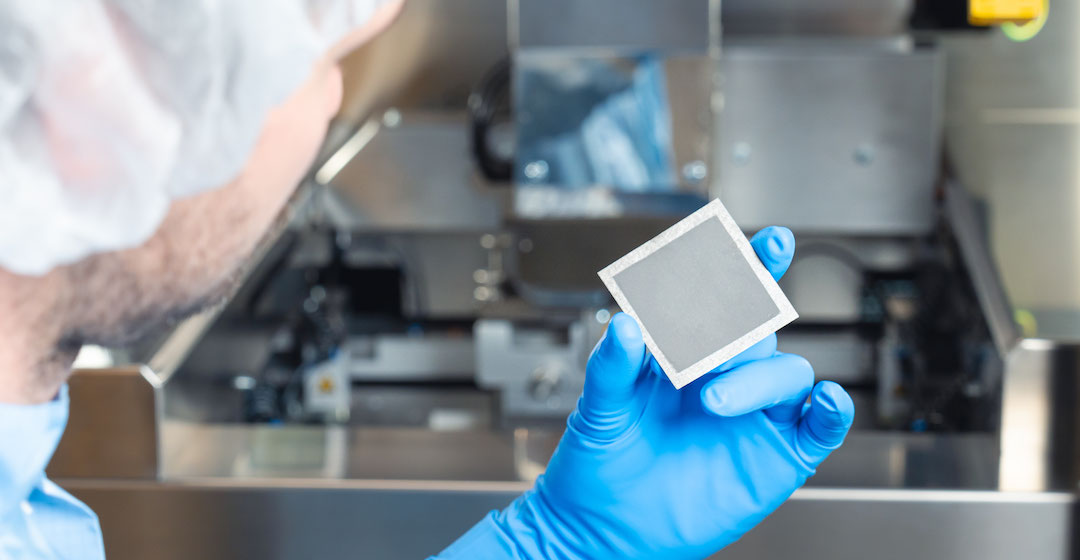
(Freiburg, Germany) – The Fraunhofer Institute for Solar Energy Systems ISE is researching scalable production processes to reduce the material and manufacturing costs for PEM electrolyzers. According to the researchers, they have now succeeded in producing ultra-fine porous transport layers made of titanium.
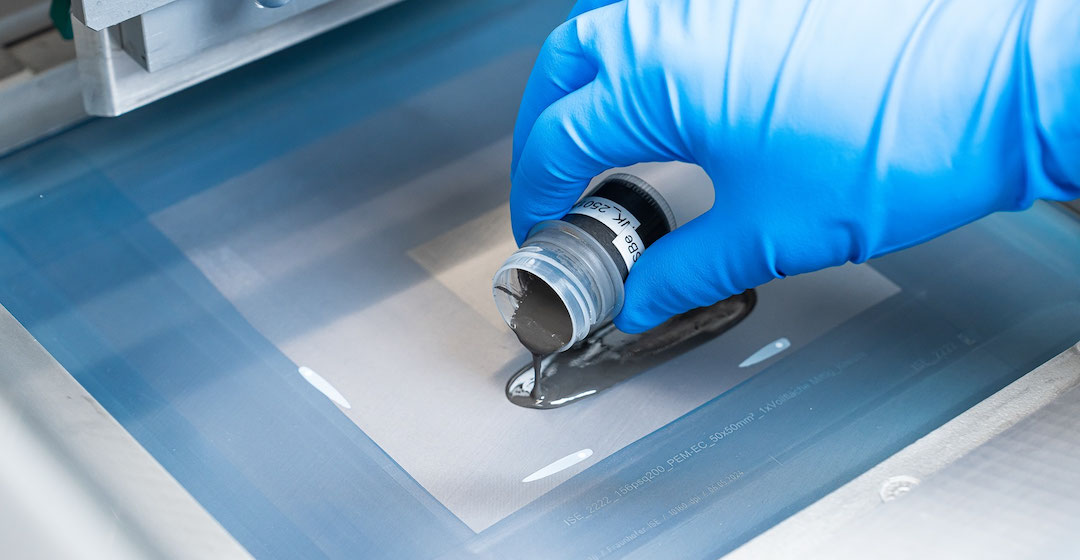
The paste, made of titanium powder, solvent, and additives, is applied to the printing screen. The paste is then applied through the screen as a thin, microporous layer onto a titanium fiber substrate. © Fraunhofer ISE / Joscha Feuerstein
PEM electrolyzers can be operated with high current densities and a flexible power supply from renewable energies. According to Fraunhofer ISE, in addition to the catalyst-coated membrane, the porous transport layers (PTLs) are central to their performance: "As the 'lungs' of the catalyst-coated membrane, the PTLs are responsible, among other things, for the transport of water and gases," says project leader Stefan Bercher. Optimizing the PTLs and their surface properties is "a major lever for reducing costs and increasing performance" in PEM electrolysis. "Therefore, this layer is increasingly becoming the focus of our research."
Control of thickness and structure by screen printing
To improve the surface properties, microporous titanium layers (MPLs) are applied between the PTL layer and the catalyst-coated membrane. Thanks to their low surface roughness, they enable the use of catalyst layers with significantly reduced iridium loading, as they significantly improve catalyst bonding and thus catalyst utilization. Fraunhofer ISE relies on the screen printing process to print the ultrafine MPL structures. This allows "precise control of the thickness and structure of the layers."
The goal of the Fraunhofer ISE project group was to "optimally match the titanium-based MPL to the catalyst layer to be contacted and to make it as fine as possible," since these metals are among the main cost factors in electrolyzers. In a series of tests, the researchers investigated whether PTL coated with microporous transport layers achieve better results than commercially available ones. When characterizing the MPL layer printed on a coarse PTL, the surface roughness and performance were particularly measured. "We were able to print very fine layers of approximately 20 µm thickness and reduce the surface roughness by 46 percent," says Stefan Bercher. "This improves the contact with the catalyst layer, where the loading of the expensive precious metal iridium is continually reduced."
The research team is now looking for industrial partners for further optimization and adaptation to customer-specific porous transport layers.
Photo above
A microporous layer on a titanium fiber substrate after the screen-printing process. In a subsequent step, the two layers are sintered. The microporous layer with reduced surface roughness enables an optimized interface with the catalyst layer. This allows the catalyst loading of iridium to be reduced and enables thinner membranes, according to the ISE scientists. © Fraunhofer ISE/Joscha Feuerstein



