

(Sydney, Australia) – The Australian metropolis of Sydney will only approve new residential buildings, medium to large commercial buildings, hotels, and apartment buildings if they are fully electric. The city council has now given final approval to the planning proposal, which received broad support during the consultation period over the past few months.

From January 2027, new large buildings in Sydney will have to do without gas connections – only fully electrified buildings will be permitted. © City of Sydney / Adam Hollingworth
Regulations concerning indoor air quality, enacted at the beginning of this year, already restrict the use of gas appliances for cooking and heating in new residential buildings. From January 2026, only electric appliances will be permitted for cooking and heating. From January 1, 2027, these restrictions will be extended to outdoor gas appliances and water heaters. Accordingly, new large office buildings with more than 1.000 square meters, hotels with more than 100 guest rooms, and buildings with more than 100 serviced apartments (the fully furnished apartments that are widespread on the continent) will be required to use only electric heating.
However, there are exceptions: For example, cafes and restaurants can continue to use gas – provided there is sufficient capacity for future electrification. According to media reports, extending the new building regulations to smaller new buildings is already being seriously considered.
Avoid expensive retrofits
“The transition to fully electric power is a logical response to the challenges posed by fossil fuels,” says Sydney Mayor Clover Moore. Creating energy-efficient, healthy buildings that meet future energy standards will prevent costly retrofitting. Using electric induction cooktops instead of gas also offers significant health benefits. Exposure to pollutants from gas cooktops has effects “comparable to secondhand smoke.”
This move will not only create healthier homes, but also reduce pressure on the cost of living. Moore: "Relying on gas is bad for the planet, bad for our finances, and bad for our health."
Natural gas is an expensive commodity
Gas is “an expensive commodity” whose price continues to rise “due to market problems and supply risks.” Full electrification will “prevent households from being tied to increasingly expensive and outdated gas contracts.” Households with fully electric systems in new buildings would save around 626 Australian dollars (353 euros) per year in energy costs compared to homes with gas connections, according to Sydney City Council. “Electric systems are more efficient and require only one connection and a single daily rate.”
In developing the proposal, the City of Sydney consulted with municipalities, industry, and various bodies. The move had already received support from numerous industry associations and interest groups, including the Property Council, energy provider Australid, and the Global Cook Safe Coalition – and, of course, Ausgrid, which is hardly surprising, as the company supplies more than a third of the metropolis's approximately 5,5 million inhabitants, according to its own figures.
Sydney is following the lead of eight other cities in the state of New South Wales, as well as the state of Victoria and the Federal District of Victoria (ATC). According to media reports, five more cities are already preparing to take similar steps.
The source of the electricity remains unclear.
The source of electricity for the buildings is not addressed. However, there are currently numerous plans in Australia for large-scale, gigawatt-scale solar power plants. While conservative forces repeatedly downplay solar power, even suggesting risks to the nation's economy, the question remains.
At the same time, according to media reports, the state of Western Australia had a solar power share of up to 90 percent in its grid last Monday. According to the grid operator, Australian Energy Market Operator (AEMO), 64 percent of this came from rooftop PV installations alone. The state's "South West Interconnected System" is the world's largest isolated grid, as it has no connection to neighboring states. Western Australia plans to shut down its four remaining coal-fired power plants by 2029, including three state-owned ones. A tender for wind and solar power plants with a capacity of approximately 1,6 gigawatts is currently underway.
And in South Australia, the share of renewable energy in the grid – measured against demand – was already at 150 percent. The surplus could be passed on to other states. In addition, a number of megawatt battery storage facilities will be completed in the coming years.
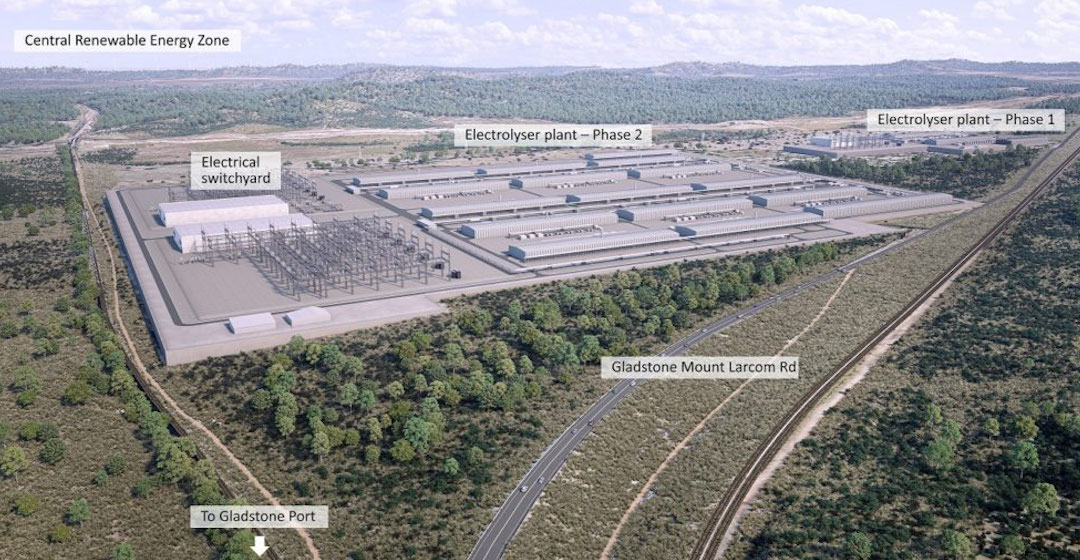
In Queensland, the state-owned Stanwell Corp. had planned to install electrolyzers with a capacity of 640 to 720 megawatts and produce 200 tons of hydrogen per day using solar power. After the NLP government withdrew its support for the "CQ-H2" project and investors pulled out, the project is now in jeopardy. © Stanwell Corp.
In contrast, coal-fired power plants are likely to play only a limited role in Australia. While the Queensland state government recently published an energy plan supporting a rollback, it remains to be seen whether the industry will fully support it. Just a few weeks ago, for example, the British-Australian mining giant Rio Tinto announced it was considering the early closure of its Gladstone Power Station (GPS) coal-fired power plant – at 1,68 gigawatts, the largest in Queensland. "Traditional energy sources" are too expensive, said board member Kellie Parker.
The future role of hydrogen power plants is currently uncertain. Several project developments are already on the verge of collapse due to ever-increasing investment hurdles – in Queensland, for example, also due to a lack of political support from the state's LNP government, which has torpedoed the commitments made by the previous government last year.
Photo above
City Council decision: Sydney will only approve new residential buildings, medium to large commercial buildings, hotels, and apartment buildings if they are fully electric. © Wikimedia / Bernard Gagnon / Creative Commons license



