

(Holmaneset / Norway) – The US technology company KBR Inc. is providing its green ammonia production technology to the Australian company Fortescue Future Industries (FFI). It will be used for the energy project in Holmaneset, Norway. The agreement includes a license to use the "K-GreeN" platform, as well as engineering and other services.
Fortescue Future Industries (FFI) will use KBR technology to produce green ammonia in Norway (Photo: KBR headquarters in Houston, Texas). © KBR Inc.
The planned 300-megawatt project in Holmaneset will produce green hydrogen and, from that, 675 tons of green ammonia per day. The energy carrier will then be shipped to domestic and European markets. Just over a year ago, FFI, part of the Fortescue Metals Group, signed a long-term power purchase agreement (PPA) with the Norwegian state-owned energy company Statkraft SA for green electricity to power the electrolyzer.
Hydrogen and ammonia for Europe
The “Green Ammonia Production” (GAP) in Holmaneset is intended to “pave the way to the production of green hydrogen and green ammonia for Europe,” according to a project description. The integrated system, complete with infrastructure and port facilities, is being built on the coast of the Nordgulen fjord, about eight kilometers west of Svelgen in the municipality of Bremanger in the west of the country.
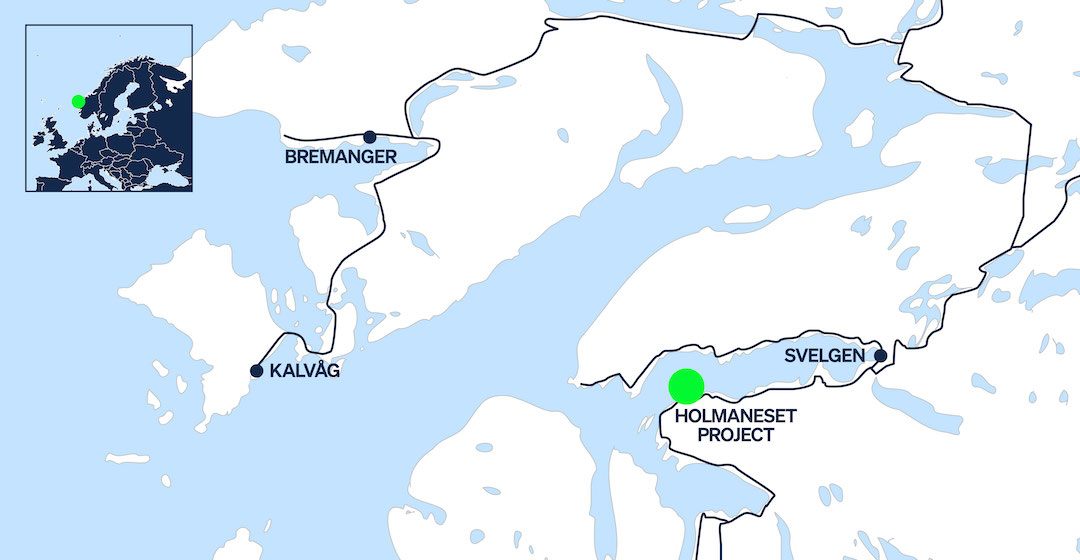
Location of the proposed Holmaneset project in the municipality of Bremanger, Norway. © FFI
The plan is to produce 40.000 tons of hydrogen and 225.000 tons of ammonia per year. The project is currently in the feasibility phase. The plans have already been officially accepted by the municipality of Bremanger. According to the FFI, it is now a matter of environmental and social impact assessment and risk assessment. Fortescue wants to start construction in 2025, with commissioning scheduled for 2027.
Local value creation
The Holmaneset project is also intended to contribute to the development of a local, regional and national value chain, increased employment, business and training opportunities for the municipality of Bremanger and the region. According to preliminary estimates, 35 to 70 permanent jobs could be created, as well as a number of indirect employment opportunities through the use of local suppliers, such as cleaning and maintenance service providers. In addition, production produces by-products such as oxygen, heat and water for use in industries such as aquaculture, water treatment or in the glass, ceramics and paper industries.
The municipality of Bremanger also developed the “CircuS” (Circular Svelgen) project in collaboration with Fortescue. This is intended to promote local industry. In terms of content, they want to focus on four key areas:
- Education: “Green Energy Education” in conjunction with the STEM curriculum in schools
- Career: Development of skills in collaboration with training institutions to provide interested parties with skills required for the green energy projects
- Business Development: Working with local and regional small and medium-sized businesses to identify product and service offerings
- Research and Development: Collaborate with universities and stakeholders to explore how the project can contribute to a circular economy; especially through the by-products to stimulate local economic development.
The European Union is funding the Holmaneset project with around 204 million euros. The funds come from the EU Innovation Fund (CINEA).
Photos (Icon image)
The use of hydrogen should be established in Norway by 2030. © Ministry of Petroleum and Energy, Norway



