
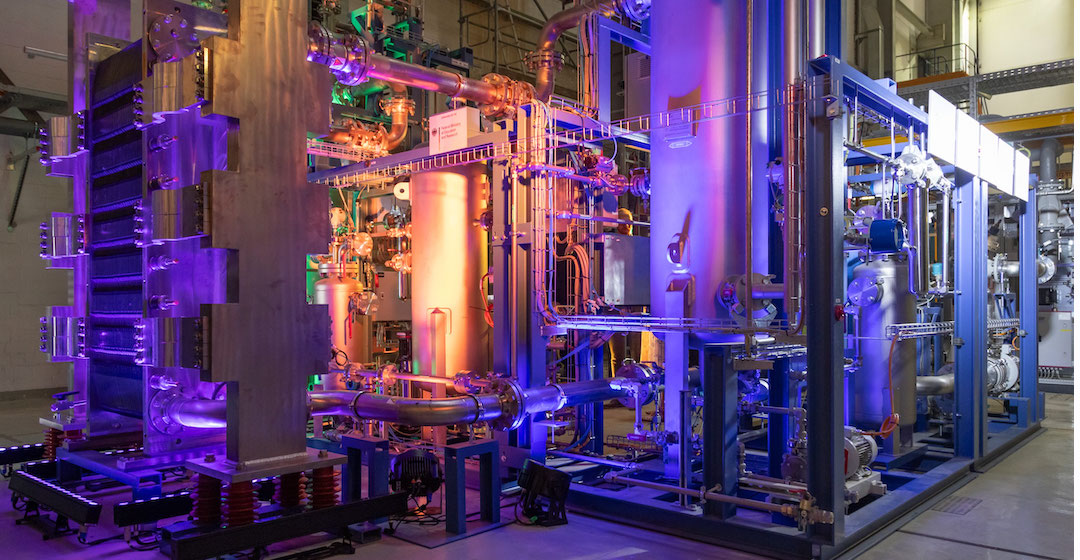
(Jülich / Germany) – The Jülich Research Centre (FZJ) has inaugurated a test facility for electrolyzers. This will allow researchers to investigate "real industrial stacks" that are "continuously monitored with advanced sensors." The facility, part of the "DERIEL" (De-risking Electrolyzer) project, is coordinated by Siemens Energy.
Test facility for real-size electrolyzers
PEM electrolyzers, which are to be researched, use a "proton exchange membrane", which enables rapid load changes, especially for operation with renewable energies. The test facility in Jülich is designed for real-size electrolyzers on an industrial scale. Science and industry want to investigate and optimize numerous parameters that are decisive for the costs and service life of electrolyzers.
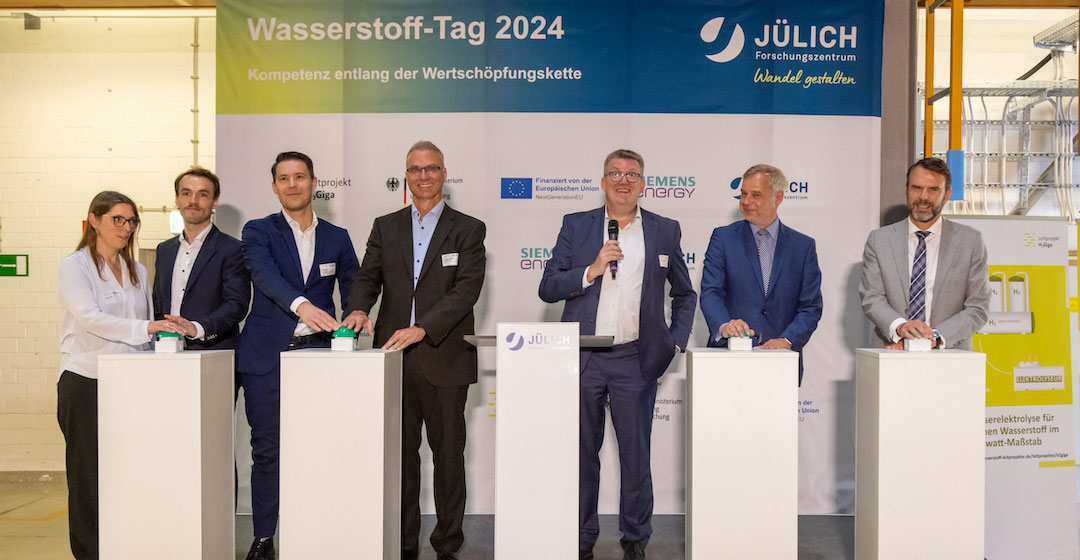
Inauguration of the PEM electrolysis test bench (from right): Peter Jansens (Head of Energy at the Jülich Research Center), Till Mansmann (BMBF Innovation Officer for “Green Hydrogen”), Rüdiger A. Eichel (Institute Director at the Jülich Research Center), Peter Geskes (Product Management Electrolyzer System for Hydrogen Production Siemens Energy), Rafael Oliveira (Finance, Sustainable Energy Systems Operations & Product Management Siemens Energy), André Karl (acting Head of Functional Materials and Components), Eva Jodat (Institute for Fundamentals of Electrochemistry). © Jülich Research Center / Bernd Nörig
The project aims to better understand the aging of electrolysis cells using numerous sensors at all levels, cameras and complex measurement technology. The findings will then be incorporated into future generations of electrolyzers. "For the first time, the research center has been provided with a test bench for PEM electrolysis stacks in the megawatt range," says DERIEL network coordinator Günter Schmid from Siemens Energy. In addition to the complex sensor technology on the running electrolyzer, DERIEL also examines material samples from real operation using computer tomography, electron microscopy, nuclear magnetic resonance spectroscopy and Raman spectroscopy. Digital twins also simulate the entire process - from the electrochemical reaction inside to flows and temperatures to the entire system.
Impulses for the hydrogen economy
"With the inauguration of our PEM electrolysis test bench, we want to provide important impetus for the hydrogen economy in Germany," says Peter Jansens, Head of Energy at the Jülich Research Center. According to Rüdiger Eichel from the FZJ, companies like Siemens Energy can convert the scientific lead into innovative products. At the same time, science is learning a lot about the basic processes - not just from models, but in the real system.
"Germany wants to become a leading provider of hydrogen technologies," says Till Mansmann, innovation officer for "Green Hydrogen" at the Federal Ministry of Research. "To achieve this, electrolyzers made in Germany must be more efficient and more durable than those of the competition." Making this possible is one of the goals at the Jülich Research Center.
DERIEL is part of the "H2Giga" hydrogen flagship project of the German Federal Ministry of Education and Research (BMBF) and is receiving approximately €100 million in funding. H2Giga is one of three flagship hydrogen projects of the BMBF. These projects aim to remove the obstacles that still stand in the way of a German hydrogen economy. H2Giga is responsible for the scaling up and mass production of hydrogen. Although high-performance electrolyzers are already available on the market, their production is still largely done manually.
Photo above
The Jülich Research Centre has a new test bench for industrial-scale PEM electrolysers. © Jülich Research Centre / Bernd Nörig



