
(Dübendorf / Switzerland) – Mushrooms as a power source? Scientists at the Swiss Federal Laboratories for Materials Science and Technology (Empa) have recently developed a "mushroom battery," or more precisely, a "microbial fuel cell"—non-toxic and biodegradable. "The living cells don't produce much electricity," the researchers say, "but enough to power, for example, a temperature sensor for agriculture or environmental research in remote regions for several days."
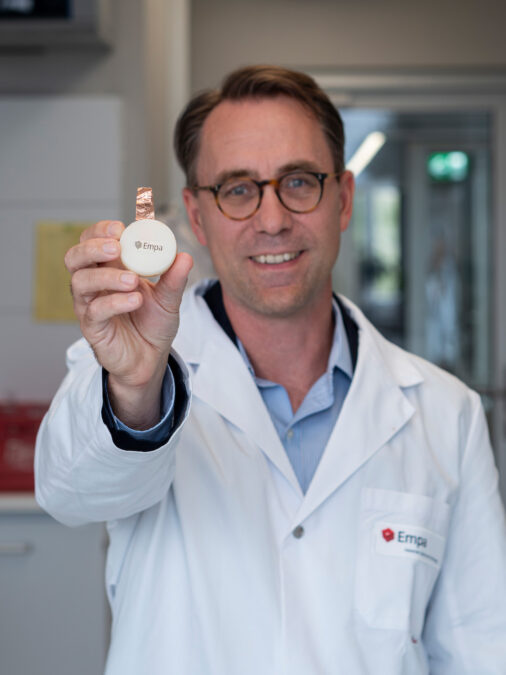
Empa researcher Gustav Nyström with the mushroom battery, which is enclosed in a beeswax capsule. © Empa
Living things convert nutrients into energy - and so do microorganisms. According to the Empa "Cellulose and Wood Materials" laboratory, "microbial fuel cells" make use of this metabolism and capture part of the energy as electricity. "Until now, they have mostly been operated with bacteria. For the first time, we have combined two types of fungi to create a functioning fuel cell," says Empa researcher Carolina Reyes. The metabolisms of the fungi - more closely related to animals than plants - complement each other: "On the anode side there is a yeast fungus whose metabolism releases electrons." The cathode is populated by the white rot fungus "velvet tramete." "This produces a special enzyme that allows the electrons to be captured and led out of the cell."
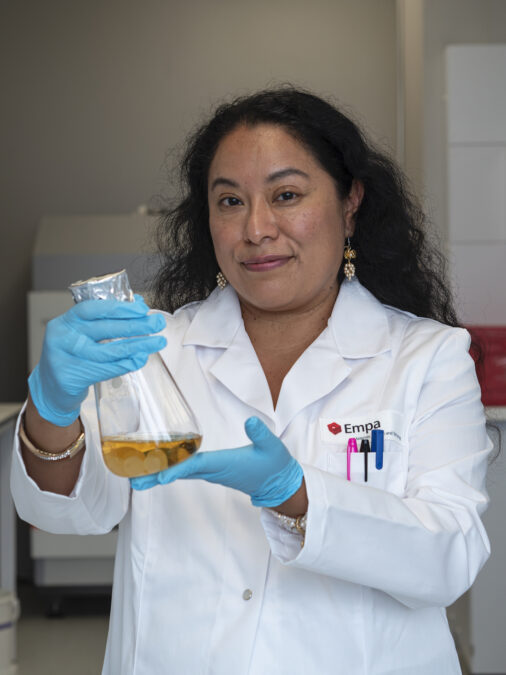
Empa researcher Carolina Reyes: “We have combined two types of fungi to create a functioning fuel cell.” © Empa
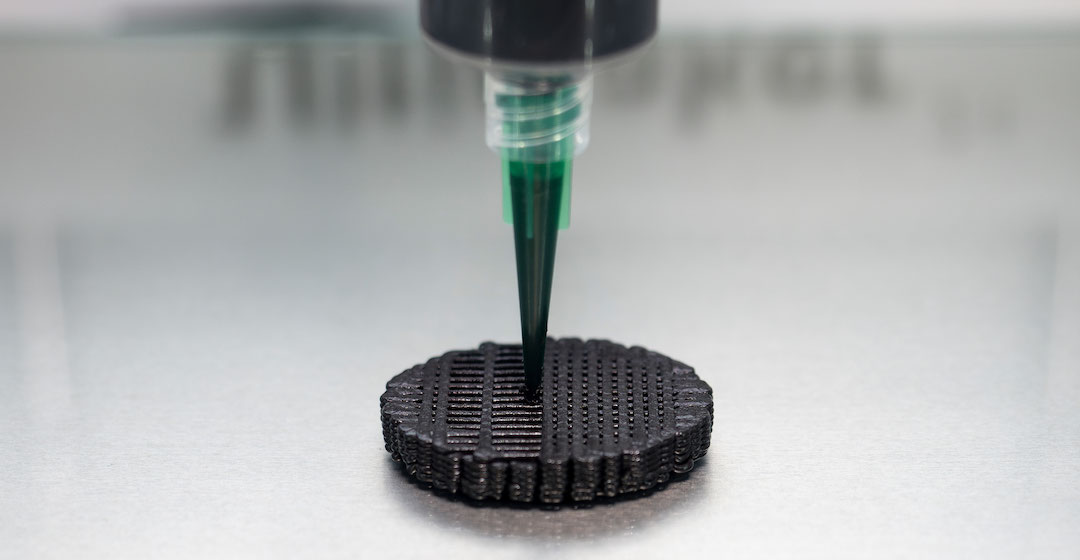
The components of the mushroom battery are manufactured using 3D printing. The mushrooms are therefore "not planted in the battery" but are "an integral part of the cell from the start". This allows the researchers to structure the electrodes in such a way that the microorganisms can access the nutrients as easily as possible. To do this, the mushroom cells are mixed into the printing ink. "It is challenging enough to find a material in which the mushrooms grow well," says laboratory manager Gustav Nyström. "But the ink must then also be easy to extrude without the mushroom cells dying - and of course it should also be electrically conductive and biodegradable." The scientists say they have now produced a suitable ink based on cellulose. The mushroom cells could even use the cellulose as a source of nutrients and help to break down the cell after use. "Their preferred food, however, consists of simple sugar molecules. The mushroom batteries can be stored in a dried state and activated at the site of use simply by adding water and nutrients," says Reyes.
The three-year research project combines microbiology, materials science and electrical engineering and was supported by the Swiss Gebert Rüf Foundation as part of the "Microbials" funding program. The next goal: to make the mushroom battery more powerful and longer-lasting - and to look for other types of mushrooms that are suitable as power suppliers.
The scientific publication is available in English as a PDF.
Photo above
Mushroom electrode from the 3D printer. © Empa



