
(Freiburg, Germany) – The Fraunhofer Institute for Solar Energy Systems ISE has announced the development of a particularly energy-efficient synthesis process for the production of dimethyl ether (DME). The environmentally friendly and non-toxic gas is a "promising energy carrier for hydrogen," according to the scientists. The entire process chain for large-scale production of methanol and DME in Chile was researched in the international "Power-to-MEDME" project.
simplified production process
DME is used as a propellant in deodorants, but also as a solvent and coolant. Its production currently involves a complex and energy-intensive process, which reduces the overall efficiency of converting renewable energy into DME. The hydrogen storage capacity of DME is 47 percent higher than that of ammonia, which is currently the most commonly used hydrogen. This makes it "an ideal candidate for import," says Elias Frei, Head of the Hydrogen Division at Fraunhofer ISE.
The scientists have "enormously simplified the production process" in their newly developed "INDIGO" method. This increases efficiency and reduces costs by more than a quarter compared to the conventional DME synthesis method. Energy requirements are lower, and as a low-energy process, it is particularly suitable for remote regions. In the importing country, the DME can then be split back into hydrogen.
DME production planned in Chile
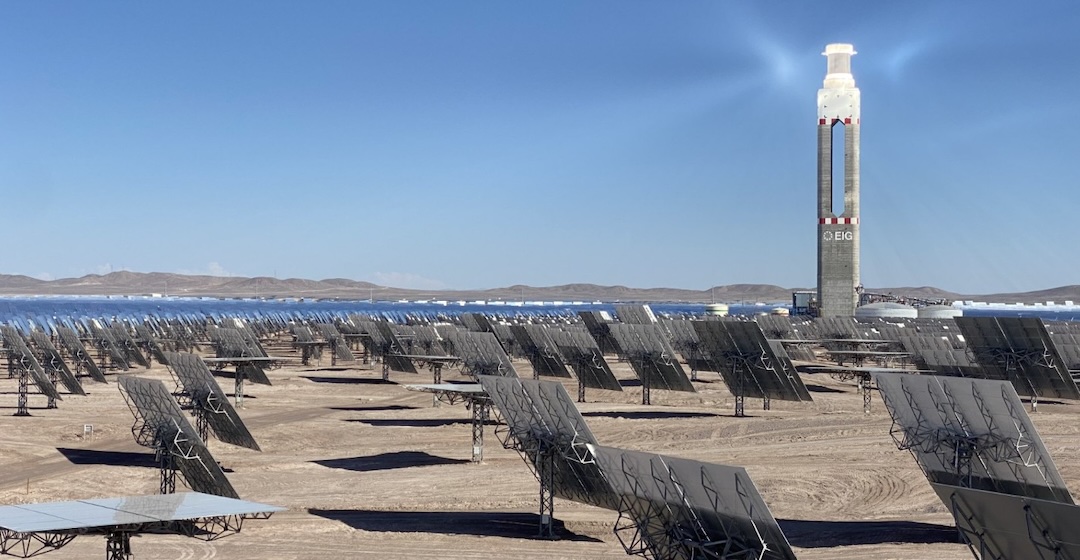
The Power-to-MEDME research project aims to unlock Chile's resources for the production of CO2-neutral energy carriers using this new process. The Antofagasta region in northern Chile has great potential for establishing large-scale production of green hydrogen derivatives, as it already produces such a large surplus of solar power (from photovoltaics and concentrating solar thermal energy) that its grid feed-in has to be throttled.
The institute now intends to work with industry to advance new DME applications and market developments made possible by the current research findings. "The next step is the construction of a pilot plant for the production of green methanol and DME in the megawatt range," said the ISE scientists.
Photo above
The Antofagasta region in northern Chile produces large surpluses of solar power – for example, through concentrating solar thermal energy. This presents a significant potential for the development of large-scale production of green hydrogen derivatives. © Fraunhofer CSET



