

(Stuttgart / Germany) – Baden-Württemberg is launching its second funding round for electrolyzers. €50 million is available for this purpose. Applications can be submitted immediately.
The maximum funding available per project is ten million euros, or 8,25 million euros per project for small and medium-sized enterprises (SMEs). The funding rate is up to 45 percent of the eligible investment costs. For small businesses, this rate can be increased by an additional 20 percent, and for medium-sized businesses by ten percent, according to the "ELY" program of the state's lead environmental ministry.
Make our readers aware of your products! Contact us!
Your advertising will have virtually no wasted reach! Our newsletter subscribers are project developers, investors, engineers, and companies – in short: experts. We would be happy to provide you with a customized offer ( media kit ).
With this funding initiative, the state government is continuing the development of regional hydrogen infrastructure. "Hydrogen hubs can create local/regional hydrogen economies," meaning local ecosystems where hydrogen production, distribution, and use are located close together, according to the authority. Where connection to a hydrogen network or a hydrogen hub is not possible, companies can establish their own self-sufficiency by operating their own electrolyzer.
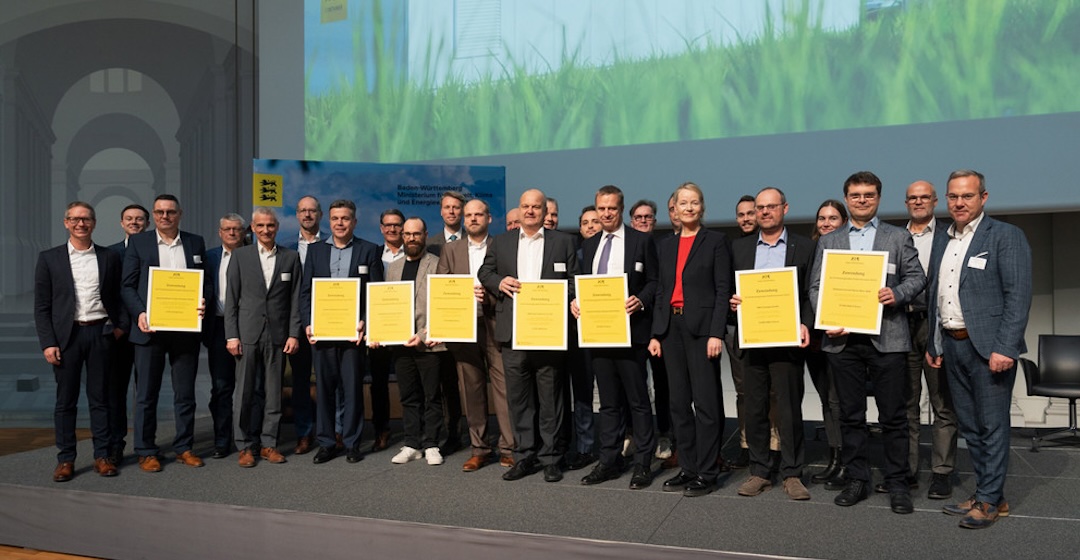
Environment Minister Thekla Walker (front, fourth from right) with representatives of the grant recipients from the first round of the state funding program ELY. © State Ministry of Baden-Württemberg
“The use of hydrogen can make an important contribution to the resilience of our energy supply, serves to build and maintain added value in Germany and Baden-Württemberg, and represents an important international key technology,” says Energy Minister Thekla Walker. “The ramp-up of hydrogen is of central importance for strengthening our economy and a successful energy transition.”
Federal government without a power plant strategy
The minister took the opportunity to criticize the federal government: "The federal government still hasn't presented a final power plant strategy." This continues to cause uncertainty. "Instead, it's being announced that power plants will run on natural gas until at least 2040, but mostly until 2045, and only then switch to hydrogen," Walker said. "That won't lead to a rapid ramp-up of the hydrogen economy." It's all the more important, she added, "that we do our homework and ensure that hydrogen is produced locally."
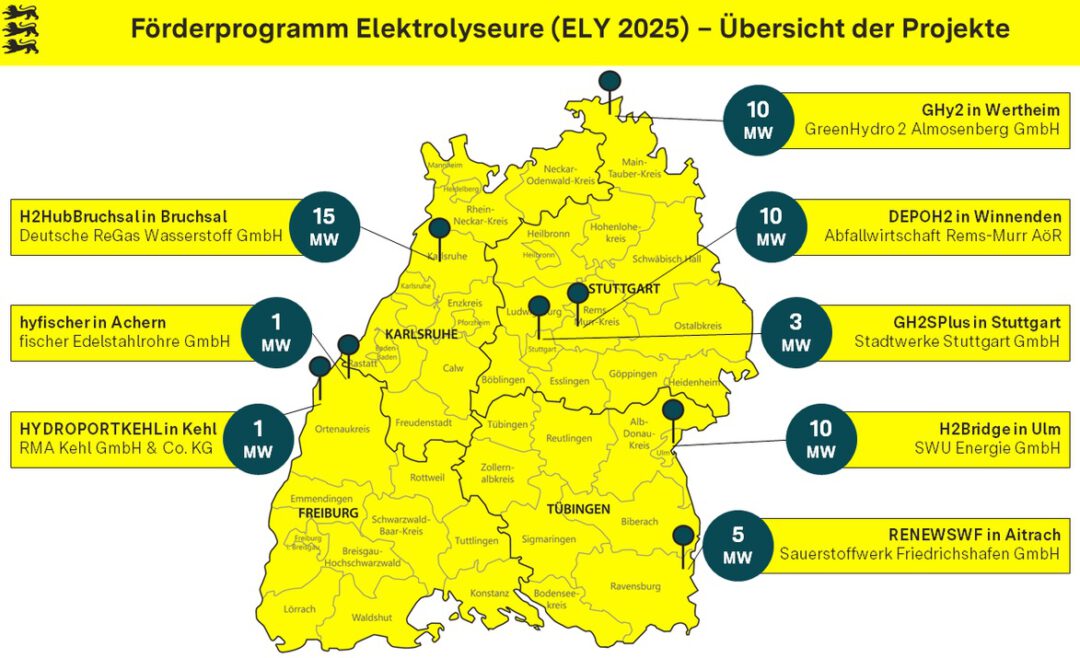
The map of Baden-Württemberg shows the locations of the projects funded in the first round of the state's electrolyzer funding program. The electrical output of the projects ranges from 1 to 15 megawatts. © Ministry for the Environment, Climate and Energy Baden-Württemberg
With careful site selection and grid-friendly operation of the electrolyzer, the electricity system can be relieved by absorbing surplus electricity and thus providing ancillary services. This is why the parallel development and expansion of electricity grids, renewable energy plants, and electrolyzers is so important for the energy transition.
Last December, Energy Minister Walker presented the first grant agreements to eight projects from the first round of the funding program. The allocated €50,7 million will be used to install electrolyzers with a total capacity of 55 megawatts.
Applications for the funding call can be submitted electronically until May 18, 2026. An online consultation session will be held on March 20, 2026, by the Karlsruhe project management agency ( registration required ).
Photo above
50 million euros for electrolyzers in Baden-Württemberg: Hydrogen hubs can create regional ecosystems where hydrogen production, distribution, and use are located close together. © Ministry for the Environment, Climate and Energy Baden-Württemberg



