

(Oldenburg / Germany) – After five years, the energy provider EWE AG has completed its tests and research on underground hydrogen storage in Rüdersdorf. Within the framework of the "HyCAVmobil" project, the company, together with the German Aerospace Center (DLR), has demonstrated that the safe storage of hydrogen in caverns is possible.

In spring 2021, 160 steel pipes were installed and cemented into an existing borehole in the salt dome under Rüdersdorf to a depth of 1.000 meters. © EWE AG / Andreas Prinz
The purity of the hydrogen has changed only minimally due to storage in a newly constructed cavern. However, the tightness requirements for a hydrogen storage facility are higher than the requirements for natural gas storage facilities due to the flow properties of the energy source, because hydrogen consists of smaller molecules than natural gas. Overall, the company concluded, hydrogen storage has been tried and tested, it works and can be applied to large-scale caverns.
Transfer to large-volume caverns
EWE is therefore now transferring the knowledge gained from the construction and operation of the 500 cubic meter test cavern to caverns with 1.000 times the volume. "Our goal is to establish large-scale caverns," says EWE CEO Stefan Dohler. With 37 salt caverns, EWE alone has 15 percent of all German cavern storage facilities that are suitable for storing hydrogen. This means that green hydrogen can be used "in large quantities as needed."

The installed pipe-in-pipe system enables EWE to remove and use the inner pipe for later material tests. © EWE AG / Andreas Prinz
Since the start of the HyCAVmobil research project in 2019, there have also been problems and project steps had to be adjusted. The first important milestone was the proof "that the cavern bore is watertight up to a depth of 1.000 meters," said Ralf Riekenberg from the EWE hydrogen team in Rüdersdorf. There were "unexpected and hydrogen-specific challenges with the cementation between the rock and the steel piping." These could have been resolved. With the later storage of hydrogen and the start of operation of the storage facility, EWE then gained experience in the injection and withdrawal of hydrogen at different pressures.

DLR employees are investigating the durability of the steel in the hydrogen cavern in the laboratory. © DLR
The DLR has set up a new laboratory in Oldenburg to determine the purity of hydrogen. The quality of the stored hydrogen is particularly relevant for use in fuel cells. In this configuration, as in Rüdersdorf, the cavern is therefore suitable as a large-scale storage facility for hydrogen, says Alexander Dyck, Head of Urban and Building Technologies at the DLR Institute of Networked Energy Systems. "It was also a benefit for us to be able to carry out measurements on a real cavern for the first time and thus provide important basic knowledge for the design of the future hydrogen infrastructure in Germany."
Conversion of natural gas storage facility in Huntorf
The next step is to transfer the findings from Rüdersdorfer to other objects. "At our cavern site in Huntorf in the Wesermarsch, we are converting a natural gas cavern for the storage of hydrogen," says Ralf Riekenberg. "However, we have to look separately at the purity after hydrogen extraction from this existing cavern." The natural gas stored there so far "could not be completely removed from the storage facility."

EWE wants to convert the Huntorf gas storage site and connect it to the hydrogen core network. © EWE AG
The Huntorfer project is part of the "Clean Hydrogen Coastline" project, which combines the production, storage, transport and use of green hydrogen. EWE is receiving funding for the four-part major project as part of the IPCEI (Important Project of Common European Interest) program. Detailed planning is currently underway and the intention is to store hydrogen in the next three to four years.
In April 2021, EWE and the energy group Uniper SE announced that they would build a Hydrogen hub to establish.
Green hydrogen for industry and the mobility sector will be produced and stored there using wind power. EWE CEO Stefan Dohler had already stressed at the time that the cavern storage facility could "also be used for hydrogen storage in the future" and that existing natural gas pipelines could be used to transport hydrogen.
demand for start-up financing
However, "nobody can invest in hydrogen storage from scratch in a completely competitive manner in order to drive the market ramp-up," says Dohler after the results now available from Rüdersdorf. As with the hydrogen core network, "a kind of start-up support" is also needed in the storage segment. Until the regulatory framework is clarified, we are taking risks, doing preparatory work and developing concepts "on how we can convert our current gas storage sites in Rüdersdorf, Huntorf, Jemgum and Nüttermoor" and connect them to the hydrogen core network.
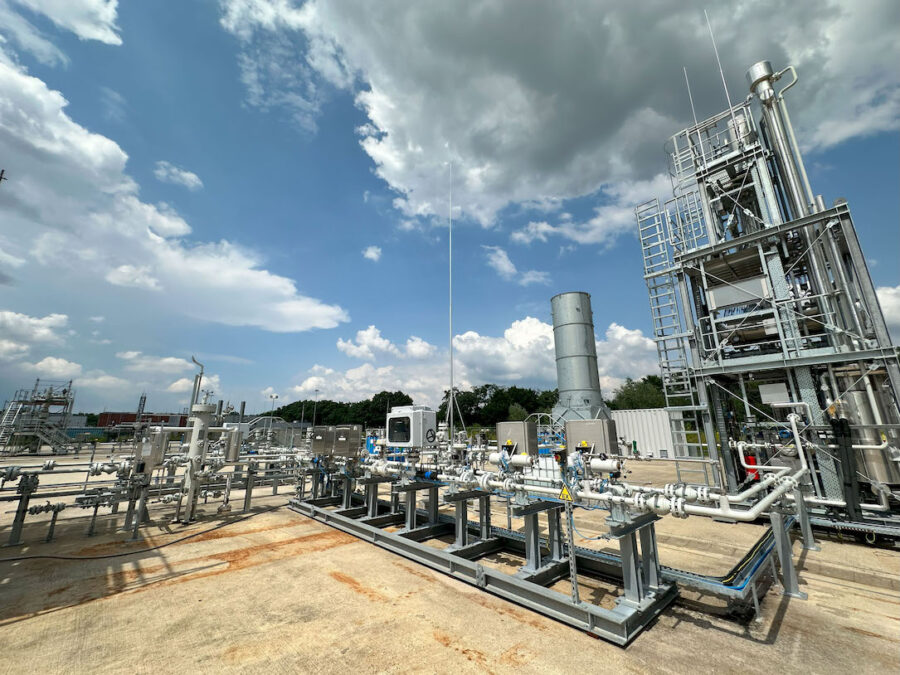
Cavern area in Rüdersdorf: From spring to autumn 2023, the above-ground facility for the operation of the hydrogen storage facility was built. © EWE AG / Nadine Auras
For the subsequent use of additional natural gas storage facilities or the construction of new underground hydrogen storage facilities, "in view of the necessary lead times for commissioning, rapid clarity on the regulatory and financing aspects is needed," says Dohler. Only a "simultaneous development of the hydrogen core network and hydrogen storage facilities makes sense. "This creates system stability and security of supply and enables the efficient integration of volatile renewable energies." The small test cavern will not be operated for the time being, but further tests will be carried out on site from January in order to examine the mixing behavior of hydrogen and natural gas as well as the water vapor content of the hydrogen in more detail, says Ralf Riekenberg.

EWE has completed the tests on hydrogen storage in Rüdersdorf (from left): Ralf Riekenberg from the EWE hydrogen team, Alexander Dyck, Head of Urban and Building Technologies at the DLR Institute of Networked Energy Systems, Stefan Dohler, EWE CEO. © EWE AG / Gerd Markert
"Our Rüdersdorf storage site can become an elementary component of the hydrogen infrastructure in eastern Germany," says Stefan Dohler. EWE is currently evaluating "the conversion and the construction of additional caverns" there. The company has already signed a letter of intent with the Leipzig-based long-distance pipeline operator Ontras Gastransport GmbH to integrate the site into the hydrogen core network. "Once the regulatory framework is in place, we can be more specific."
The investment volume for "HyCAVmobil" amounted to more than 14 million euros, of which EWE contributed almost eight million from its own funds. The Federal Ministry for Digital and Transport (BMDV) provided funding of around 6,5 million euros from the National Innovation Program for Hydrogen and Fuel Cell Technology.
Photo above
Stefan Dohler, EWE Board Member: “Our Rüdersdorf storage site can become an elementary component of the hydrogen infrastructure in Eastern Germany.” © EWE AG




Is there a serious view on storage losses in the porous mountain - hydrogen is also a migration candidate. Approach 7% pa