
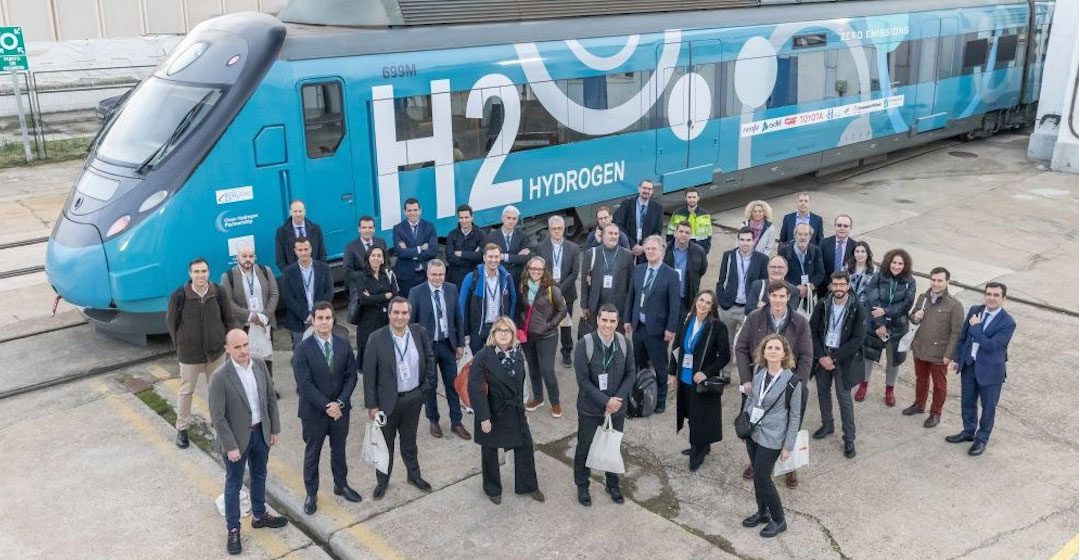
(Zaragoza, Spain) – On a journey between Zaragoza, Spain, and the Villanueva de Gallego railway station in Portugal, visitors to the "RailLive! 2024" conference were able to experience a new Iberian hydrogen train for the first time. The event also marked the conclusion of the "FCH2Rail" project, a Spanish-Portuguese co-production for researching and testing fuel cell-battery hybrid technology as an alternative to conventional diesel trains.

On electrified railway lines, the multiple unit gets its electricity from the overhead line. In sections without contact wire, fuel cells and batteries provide the electricity. © Adif
Over the last four years, a consortium of industry and research has developed a bimodal demonstration train with fuel cell propulsion. The vehicle can draw its traction power either from overhead lines or from the on-board fuel cell system for non-electrified railway lines. The Spanish railway company Renfe provided a local train for this purpose, which was converted with a power generation system called a "Fuel Cell Hybrid Power Pack".
In addition to Renfe, the participants included the Spanish rail vehicle manufacturer Construcciones y Auxiliar de Ferrocarriles (CAF) based in the Basque Country, the German Aerospace Center (DLR), the vehicle and mechanical engineering company Toyota, the Spanish railway network operator Administrador de Infraestructuras Ferroviarias (Adif), the Spanish national hydrogen research center Centro Nacional del Hidrógeno (CNH2), the Portuguese IP Group and the German Stemmann-Technik GmbH.
First tests started in 2022
"FCH2RAIL" began developing the new system and integrating it into the rail vehicle in January 2021 with a budget of over 14 million euros - about 70 percent of which came from European funds. Technical trials then started in 2022 at the CAF plant in Zaragoza, where the installation, interfaces and their functions were tested, and hydrogen tightness tests and the first hydrogen refueling of the train were carried out.
Dynamic tests began in mid-2022, initially on internal and later on external tracks. Fuel cells and batteries were optimized on the routes defined as representative in the project, commercial operation was simulated on all routes and tested under various aspects of power requirements.

The train completed its first long-distance journey on the 220 kilometer route from Zaragoza to Canfranc in the Pyrenees. © CAF
A milestone was the granting of approval for testing on the Spanish national rail network and the first journey of a hydrogen train on the Zaragoza-Canfranc line in the Aragonese Pyrenees in November 2023 ( as we reported ). The route is particularly challenging due to its gradients and descents. The train's arrival at Canfranc station demonstrated the reliability of the technology, it was stated at the time. To test the new technology across a broad range of performance and energy demands, the train then ran for several months on various routes, primarily in Aragon, Madrid, and Galicia, where it crossed the border and was subsequently tested on a Portuguese line.
Prototype with more than 10.000 kilometers of hydrogen operation
In total, the prototype has covered more than 10.000 kilometers in hydrogen operation. In addition, the consortium has participated in European standardization committees for rail transport to promote the development of new or updating of existing standards as necessary prerequisites for the integration of fuel cell technology into the European rail network.
Photo above
Visitors to the "RailLive! 2024" conference in Zaragoza, Spain, were able to experience the new hydrogen train for the first time. © German Aerospace Center



