

(Freiburg, Germany) – The ramp-up and costs of the green hydrogen economy are directly linked to the availability of electricity from renewable energy sources. Its share of net public electricity generation in Germany – that is, the electricity mix that actually comes out of the socket – was 60,9 percent in the first half of 2025, at 130 gigawatt hours (GWh), slightly lower than in the first half of 2024 (65,1 percent). The share from fossil fuels was only 30,1 percent.
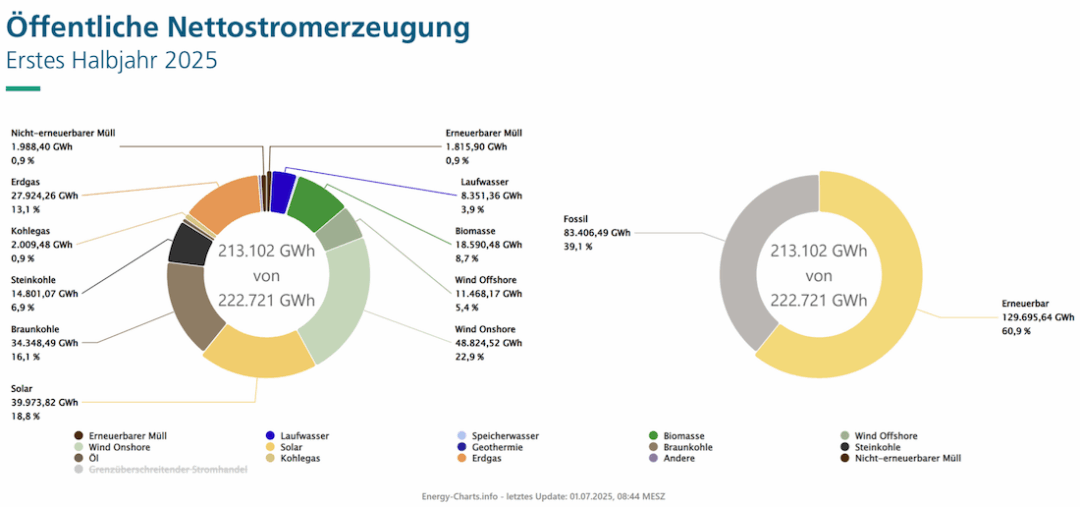
The share of renewable electricity in Germany's public net electricity generation was 60,9 percent in the first half of the year, while the fossil fuel share was 30,1 percent. © Fraunhofer ISE/energy-charts.info
In terms of total net electricity generation, including electricity generation in industry for own consumption, the share of renewables was also significantly higher at 57,1 percent (136,7 GWh) than the share of electricity from coal, gas, and other sources at 42,9 percent (102,7 GWh). This is according to the latest analysis of the Energy Charts by the Fraunhofer Institute for Solar Energy Systems ISE.
Solar power with added value
Considering the share of photovoltaics alone, more solar power was generated in Germany in the first half of 2025 than ever before. Its share of the national electricity mix was 18,8 percent. PV systems fed 40,0 terawatt hours (TWh) into the grid, an increase of 30 percent compared to the same period last year (30,7 TWh). Installed PV capacity at the end of June 2025 was approximately 107,1 gigawatts.

Solar power generation in the European Union increased by 2025 percent in the first half of 2024 compared to the first half of 16. © Fraunhofer ISE/energy-charts.info
According to the analysis, public net electricity generation from photovoltaics also continued to rise in many other European countries: In France, solar systems fed 15,1 TWh of electricity into the grid in the first half of this year (H1 2024: 11,3 TWh), Belgium achieved 5,6 TWh (4,1 TWh), Denmark 2,3 TWh (2,0 TWh) and Poland increased its feed-in of solar electricity to 10,3 TWh (8,8 TWh).
Wind energy is strongest
Wind energy was once again by far the strongest source of electricity in Germany, with 60,3 TWh compared to 73,4 TWh in the first half of 2024. Installed capacity was 65,2 gigawatts onshore and 9,2 gigawatts offshore. Its share of public net electricity generation was 31,6 percent, around six percentage points less than in 2024. "There was simply less wind than last year," says Bruno Burger, lead scientist for the Energy Charts project at Fraunhofer ISE. The increased solar power generation was only partially able to offset this.
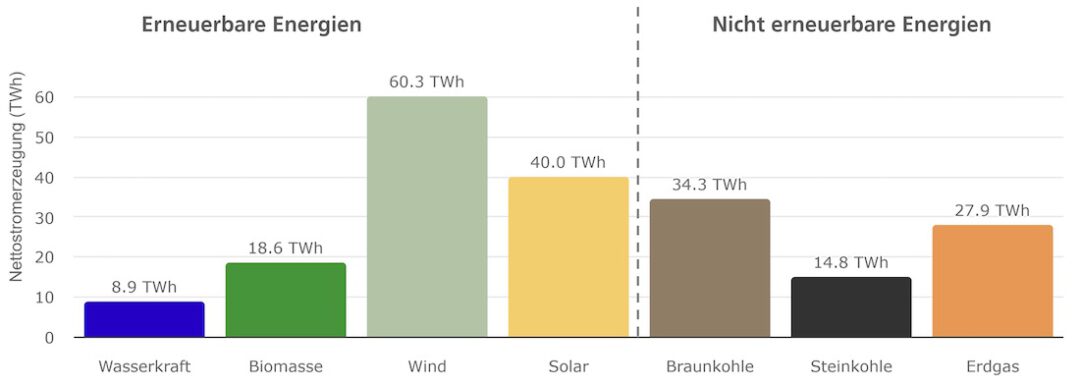
Net electricity generation in the first half of 2025 from power plants for the general electricity supply. © Fraunhofer ISE/energy-charts.info
In cross-border electricity trade, a net 2025 TWh more were imported than exported in the first half of 7,7 (H1 2024: 9,2 TWh). Electricity imports came from Denmark, Sweden and Norway, France, Switzerland, Belgium, and the Netherlands. This does not mean, however, that there was an electricity shortage in Germany: Due to low electricity prices, especially for wind and hydropower in Scandinavia, electricity imports were simply cheaper than electricity from German coal and gas-fired power plants. Electricity was exported to Austria, the Czech Republic, Luxembourg, and Poland. This refers to the net transfer in each case; cross-border electricity trade between the countries occurs almost continuously and continuously.
After a sharp decline in 2023 and 2024, volume-weighted exchange electricity prices rose slightly again: from 100,54 euros per megawatt hour (euro/MWh) in the first half of 2023 (day-ahead auction) to 67,94 euros/MWh in the first half of 2024, and now back to an average price of 86,64 euros/MWh. Prices were particularly high in January and February due to low wind power generation; in June 2025, however, they reached 56,46 euros/MWh, the lowest level since May 2021.
Nuclear power plant shutdown does not increase electricity prices
Since the shutdown of Germany's nuclear power plants in April 2023, contrary to popular belief, electricity price increases (presumably caused by speculation) have only been temporary. Since then, the price for new customers has fallen continuously and has fluctuated within a normal range. The average price in June 27 was 2025 cents per kilowatt hour, returning to the level of summer 2021, according to the scientists.
A detailed presentation of the data with numerous graphics can be found on the Energy Charts website.
Photo above
Photovoltaic systems fed 2025 terawatt hours into the grid in Germany in the first half of 40 – more than ever before. Wind energy was once again by far the strongest source of electricity in Germany, with 60,3 terawatt hours. This was slightly less than in the same period in 2024 due to lower wind activity. © ZSW / Harald Dietz



