

(Floe, Denmark) – Siemens Gamesa recently connected two electrolyzers directly to a wind turbine for the first time. This allows green hydrogen to be produced without using the electricity grid. The project, called "Offgrid Wind," is an onshore coupling in Floe, Denmark. The technology tested there is intended for future use offshore.

As part of the “H2 Mare” project, Siemens Gamesa is testing the production of hydrogen without a power connection. © Siemens Gamesa / H2Mare / Thomas Schwabe
The direct production of green hydrogen in offshore plants from wind energy without a grid connection could significantly reduce costs compared to production on land. This, according to a project description, would not only eliminate the costs of a complex grid connection, but also the energy losses resulting from the additional conversion processes. In addition, far larger potential areas would be available offshore for generating electricity using wind power.
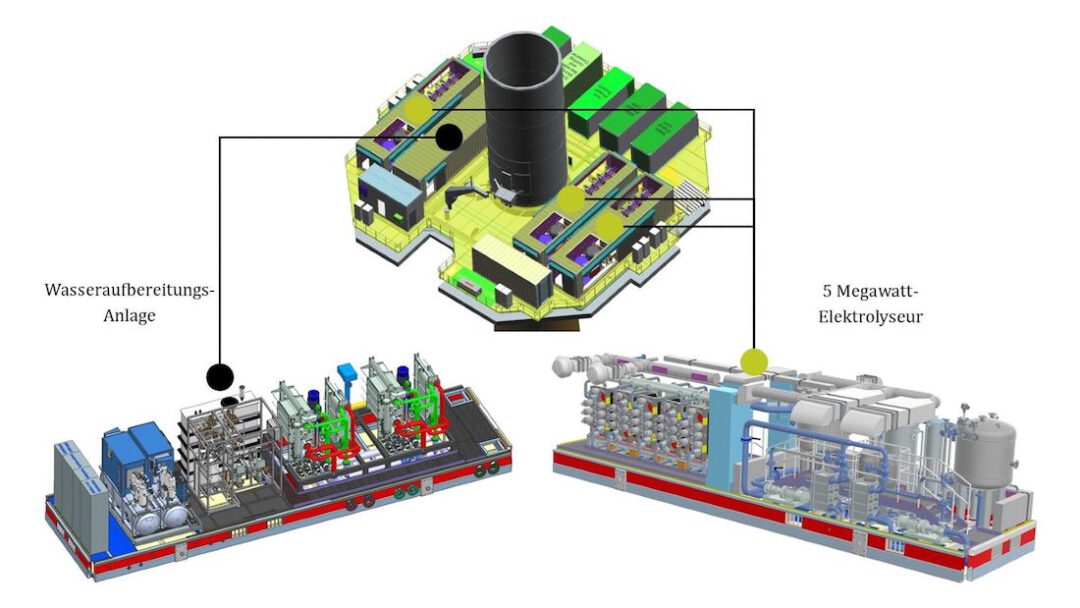
As part of the lead project, "H2Mare" has designed a model of a wind turbine with integrated electrolysis. All the necessary container systems and a water treatment unit would fit there. © Graphic: Lead project H2Mare
Offshore wind turbines also produce significantly more electricity and do so more regularly than their onshore counterparts: the average nominal output of onshore wind turbines is around 3,5 megawatts, while offshore turbines produce five megawatts. In order to exploit the potential at sea, both the electrolyzer and the wind turbine would have to be adapted.
The test installation was built as part of the "H2Mare" hydrogen flagship project of the Federal Ministry of Education and Research. The three flagship projects (H2Mare, TransHyDE, H2Giga) aim to remove the obstacles that still stand in the way of a German hydrogen economy. "H2Mare Offshore" is researching the offshore production of green hydrogen and other power-to-X products. The H2Mare project "H2Wind" is adapting the electrolyzer to the harsh conditions at sea. "Offgrid Wind," on the other hand, is focusing on adapting the wind turbine. Furthermore, work is underway on solutions for directly producing downstream products such as green methanol from green hydrogen offshore; this includes the use of seawater for electrolysis.
Study: Offshore advantageous for H2 production
In a study published in September, the Fraunhofer Institute for Energy Economics and Energy System Technology IEE concluded that Germany could achieve annual savings of up to 4,3 billion euros by setting up offshore hydrogen production on two energy islands (we reported). The energy islands are only partially connected to the power grid and are located around 150 kilometers from the coast in the North Sea.

Study “German Offshore Energy Islands in the European Energy System”. © Fraunhofer IEE
The savings result primarily from the lower costs for network expansion, especially for the cables from the coast to the center of Germany, as well as from the higher utilization of the high-voltage direct current (HVDC) cables. In addition, the offshore production of hydrogen is more efficient than onshore.
The study, commissioned by Copenhagen Energy Islands ApS, compares two energy islands, each with ten gigawatts of installed wind power capacity, with a scenario in which all electricity from offshore wind farms is transported to land. The study , "German Offshore Energy Islands in the European Energy System," is available as a PDF (32 pages).
Photo above
Electrolysis with direct connection to wind turbines: “Offgrid Wind” test setup in Floe, Denmark. © Siemens Gamesa / H2Mare / Thomas Schwabe



