
(Berlin / Germany) – Germany has apparently reached an agreement in principle with the European Commission on the German power plant strategy. To secure Germany's electricity supply, further gas-fired power plants are to be built.
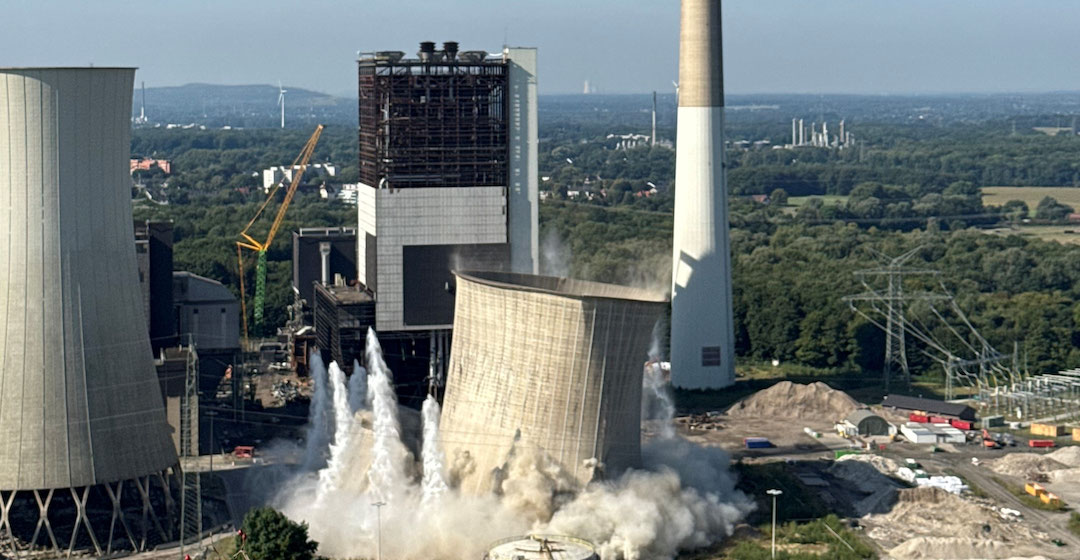
The site of the former Gelsenkirchen-Scholven coal-fired power plant is being cleared to make way for a new hydrogen-capable gas-fired power plant. © Uniper SE
According to the Federal Ministry for Economic Affairs and Energy (BMWi), twelve gigawatts (GW) of dispatchable capacity will be put out to tender this year; ten of these will be hydrogen-capable gas-fired power plants and two gigawatts will be technology-neutral. For ten gigawatts, a long-term criterion is also planned, meaning that the awarded capacity must be able to generate electricity continuously over an extended period "for reasons of security of supply." This long-term capacity, such as highly efficient gas-fired power plants, is scheduled to begin operation no later than 2031. Further tenders for dispatchable capacity will follow in 2027 and 2029/2030, with these also needing to be available by 2031 at the latest.
Decarbonizing power plant fleet with hydrogen
All power plants built under the power plant strategy must be capable of using hydrogen. To further decarbonize the power plant fleet, additional measures will incentivize an early switch to hydrogen, with the goal of converting two gigawatts of capacity to hydrogen by 2040 and another two gigawatts by 2043.
Back in November 2025, the German government's coalition committee had already committed to building new gas-fired power plants with a cumulative capacity of twelve gigawatts. Ten gigawatts were to be put out to tender in 2026 and connected to the grid by 2031, eight of which were to be hydrogen-ready, it was stated at the time.
As previously reported , the German government originally intended to promote 20 gigawatts of capacity by 2030, which would equate to approximately 40 newly constructed or modernized power plants in the 500-megawatt class. However, as early as October of last year, it was speculated that this plan would not be approved in Brussels and that discussions would now only cover twelve gigawatts.
The previous government, under Economics Minister Robert Habeck (Greens), planned to implement 12,5 gigawatts of hydrogen storage capacity plus 500 megawatts of long-term storage, as well as two gigawatts for modernizing existing gas-fired power plants for hydrogen use. Power plants with a capacity of 500 megawatts were intended to operate on 100 percent hydrogen from the outset.
Industry: 12 GW is too little – more speed is needed

Timm Kehler: "Twelve gigawatts of controllable capacity are not enough." © Lotte Ostermann / Gas and Hydrogen Industry Association
The German Association of Gas and Hydrogen Industries (VDE) welcomed the agreement. However, board member Timm Kehler criticized the announced 12 gigawatts as insufficient. He stated that "a supply gap persists." Kehler, citing the Federal Network Agency, asserted that Germany's electricity supply can only be guaranteed if at least 22 GW of dispatchable capacity are installed by 2035. "We expressly welcome the requirement that all new plants must be hydrogen-capable from the outset," the association explained. "This will generate demand for hydrogen, sending a clear signal for the core hydrogen grid."

Kerstin Andreae: "The law must go through the parliamentary process before this summer, if possible." © Thomas Imo Photothek / BDEW
Kerstin Andreae, Chair of the Executive Board of the German Association of Energy and Water Industries (BDEW), is urging the federal government to accelerate the process and ensure the legislation goes through the parliamentary process "ideally before this summer." Only after its passage by the Bundestag can the Federal Network Agency issue the final tender. "We can't afford to lose any more time, because it takes around five years before the power plants are connected to the grid and can feed electricity into it," Andreae stated. For the coal phase-out to proceed as planned, hydrogen-ready gas-fired power plants must be built quickly. "By 2038, dispatchable electricity generation capacity will be steadily disappearing from the market, particularly coal-fired and older gas-fired power plants."

Sönke Tangermann: "The German government's regulations for converting to hydrogen are a mere fig leaf." © Green Planet Energy eG
The energy cooperative Green Planet Energy eG, founded by Greenpeace in 1999, welcomes the fact that the German government, under pressure from the European Commission, has almost halved the total capacity of planned gas-fired power plants from 20 to 12 gigawatts. However, co-board member Sönke Tangermann criticizes the decision to prioritize gas-fired power plants, arguing that it remains an "unjustified market intervention in favor of climate-damaging energy sources." He adds, "To this day, the German government has failed to explain why these subsidies are necessary, appropriate, and proportionate." Storage and other future technologies are now competing with heavily subsidized gas-fired power plants. "Fossil fuel subsidies thus weaken the innovative capacity of the energy transition."
Tangermann considers the German government's targets for converting to hydrogen to be a "light green fig leaf": Firstly, four gigawatts by 2043 is far too little, and secondly, it is unclear whether green hydrogen will actually be used. "This is a rejection of the climate goals. Demand for green hydrogen must be stimulated more quickly."
Merz overreaches himself with the Habeck comparison.
Katherina Reiche's plan to use hydrogen in gas-fired power plants is similar to that of former Economics Minister Robert Habeck, according to the " Frankfurter Rundschau ". He, too, wanted to build new gas-fired power plants during the coalition government, although five of them were to be powered by fossil gas and another five by hydrogen.
"This point, however, doesn't seem to have fully registered with Chancellor Friedrich Merz," the newspaper reports. Just a few days earlier, at the Chamber of Industry and Commerce's New Year's reception in Halle, he had "clearly distanced himself from the Green Party minister's plans – or at least attempted to." The Chancellor claimed "that the new gas-fired power plant plan differs from that of the previous government in that the new regulation does not stipulate that the power plants must be hydrogen-capable from day one," according to the Frankfurter Rundschau. This view, however, contradicts the statements made by the Minister of Economic Affairs: "All power plants built as part of the power plant strategy will be hydrogen-capable and will be fully decarbonized by 2045 at the latest," it states verbatim on the BMWE website.
Presumably, the discussions surrounding the power plant strategy are not yet over. The federal government is now expected to submit the draft legislation, which in turn must be approved by the European Commission under state aid rules and subsequently passed by parliament.
Photo above
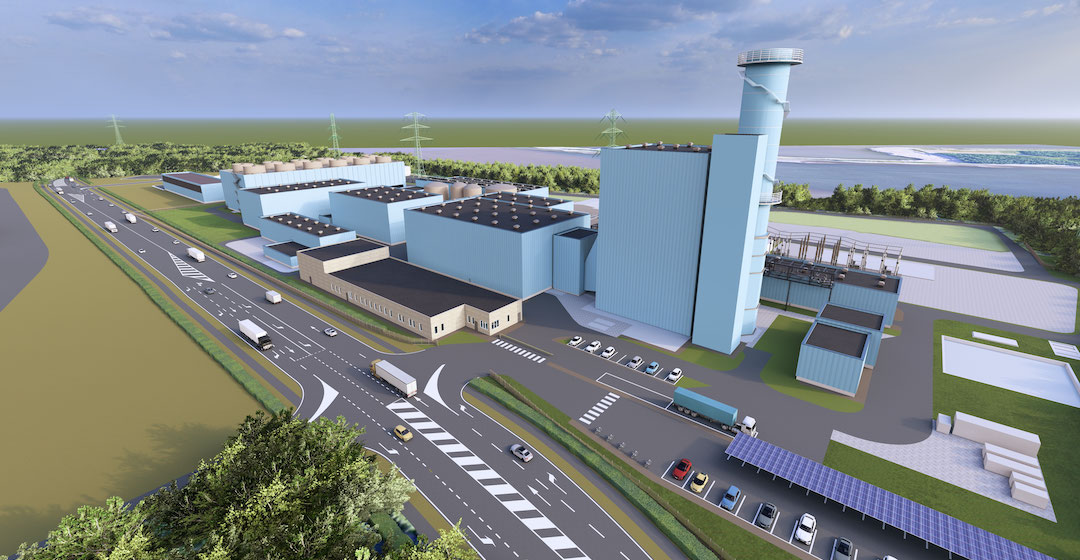
Graphic representation of the planned RWE gas power plant in Voerde: The site on the decommissioned coal-fired power plant north of Duisburg is located directly on the future pipeline of the hydrogen core network. Cooling tower and chimney have already been blown up there. © RWE Generation SE



