

(Cologne, Germany) – From 2030 onwards, the use of sustainable aviation fuels (SAF) in combination with new aircraft technologies could lead to significant CO2 savings and thus a more climate-friendly aviation sector – despite the expected growth in global air traffic. This is the conclusion of a study by the German Aerospace Center (DLR).
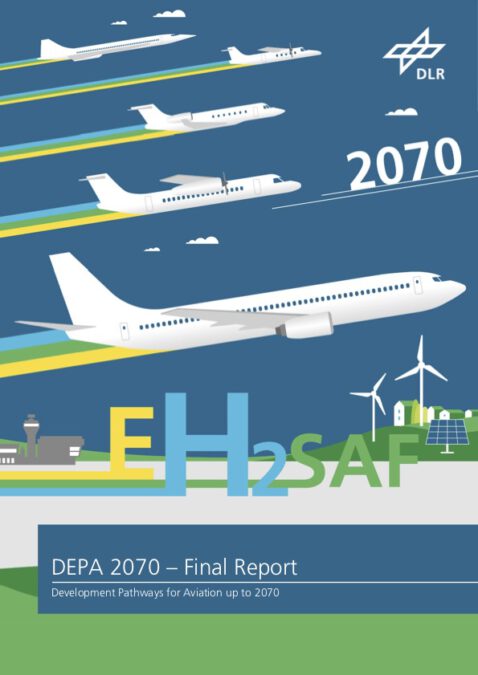
"DEPA 2070" provides forecasts for the development of passenger aviation through 2070. The follow-up project "DEPA – ext." (DEvelopment Pathways for Aviation – extended) examines factors such as capacity bottlenecks, supply problems, and structural changes in the air transport network. © DLR
The task was to assess the technological, economic, and social impacts of various aviation developments over a 50-year period. The forecast predicts that the global gross value added generated by air transport could double from the current level of around €1,1 trillion to approximately €2,2 trillion by 2070. The number of employees in the aviation sector is also expected to rise from around 17 million today to more than 37 million worldwide. Nevertheless, in a conservative scenario, emissions per 100 passenger kilometers could be reduced by around 23 percent. In a progressive scenario, which considers the early deployment of hydrogen-based and battery-electric propulsion systems from 2050 onward, savings of up to 89 percent are even conceivable.
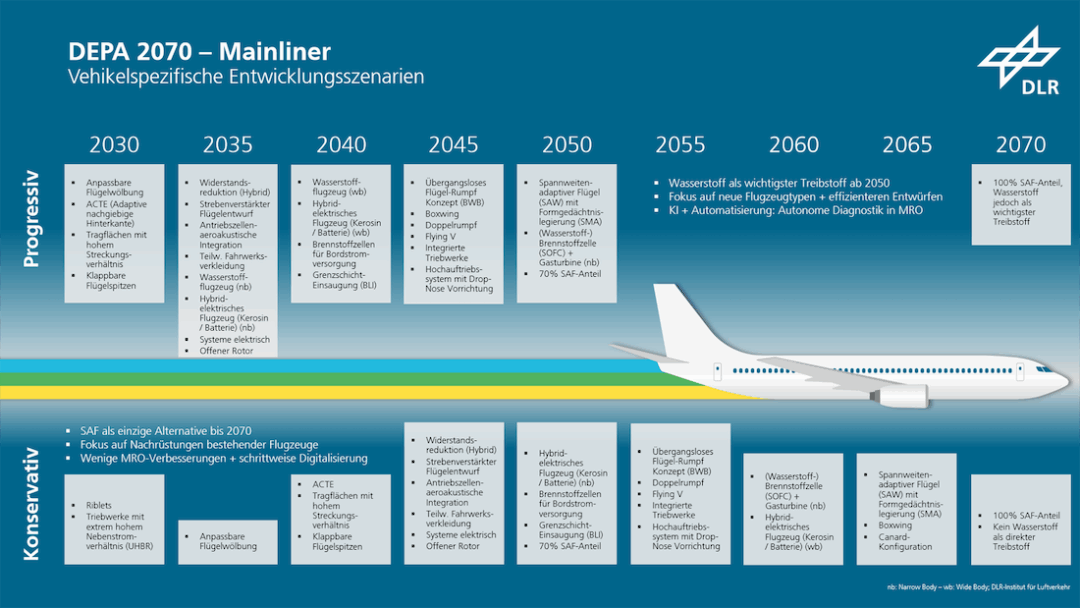
Political decisions will determine how climate-friendly air travel will become: In the progressive scenario, hydrogen will be the primary fuel for mainliners starting in 2050. In the conservative scenario, existing aircraft will use SAF after technological upgrades, but no hydrogen will be used until 2070. © DLR (CC BY-NC-ND 3.0)
The study focused on two alternative future scenarios for various market segments, such as mainliners, regional aircraft, small aircraft, business jets, and supersonic aircraft. The conservative scenario assumes moderate, gradual technological progress. The progressive scenario assumes a more rapid market entry of new zero-emission technologies. Both scenarios were modeled "taking into account projected growth in global air traffic." External factors such as population growth, energy prices, and geopolitical changes were also considered.
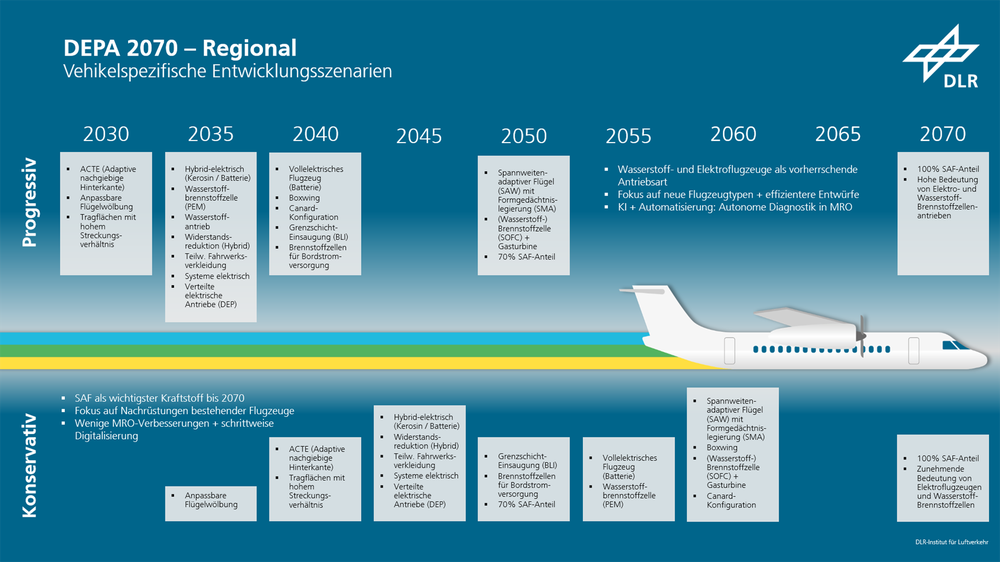
New mobility concepts are required: On intra-European routes, a combination of small regional aircraft and high-speed connections could save four hours of travel time. Technical adjustments would make more climate-friendly flights possible starting in 2030; the conservative scenario would take many years longer. © DLR (CC BY-NC-ND 3.0)
New mobility concepts offer great potential. Hybrid-electric short-haul aircraft, more efficient airport access, and supersonic connections could make travel more flexible and faster in the future. Especially on intra-European routes, "combinations of small regional aircraft and express connections could save an average of more than four hours of travel time compared to current travel chains," says study leader Alexandra Leipold of the DLR Institute of Air Transport. These developments could also improve accessibility to structurally weak regions.
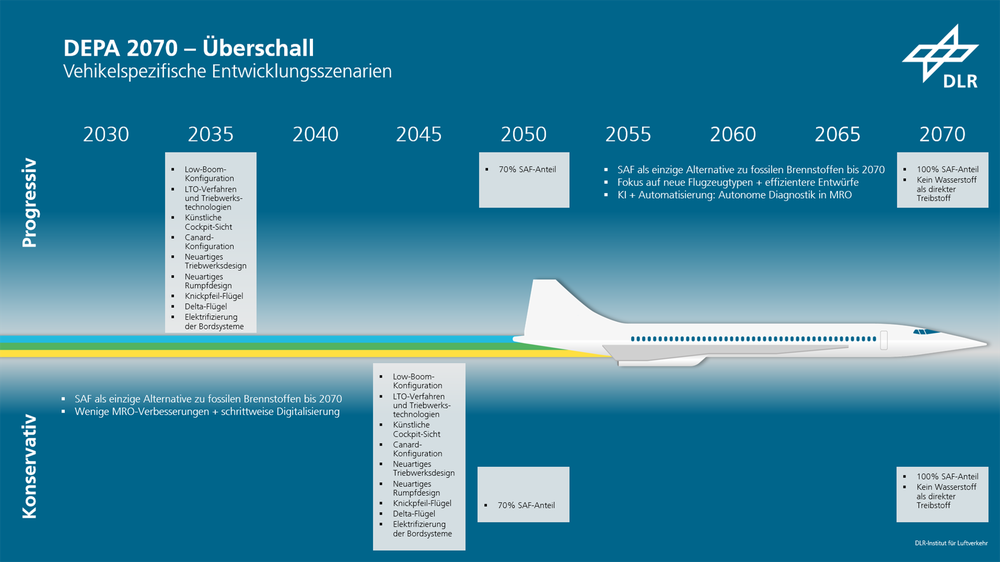
Supersonic flight no longer plays a role in civil aviation. From 2050 onward, newly developed aircraft could be operated at 70 percent SAF. However, hydrogen plays no role as a direct fuel. © DLR (CC BY-NC-ND 3.0)
Due to the predicted increase in demand and necessary fleet renewals, "a significantly growing need for new aircraft is evident." While sustainably produced aviation fuels are considered the most important technology in the conservative scenario, liquid hydrogen takes on the central role in the progressive scenario. The share of battery-powered and hybrid-electric aircraft remains limited, but grows significantly, especially in the progressive scenario. They could thus "offer a sensible alternative to car traffic" – for both private and business travel.
However, not only new aircraft technologies must be considered, but also new requirements for airports and supply systems. "Strategic decisions will be required in the coming years – for example, regarding the future use and distribution of hydrogen, SAF, or electricity at airports," the analysis states. While planning certainty is particularly necessary in the short term, the phase of concrete investments begins in the medium term. In the long term, it is a matter of providing sufficient capacity for alternative energy sources and new aircraft types.
Solutions for politics and industry
The study's findings provide "an important basis for strategic decisions in air transport in the coming decades." It enables authorities and policymakers, as well as the aviation industry and industry, to "draw on well-founded scenarios and practical solutions" to make air transport sustainable, competitive, and future-proof.
"Aviation will remain a key economic driver in the long term – its growth will continue," says Markus Fischer, DLR Executive Board Member for Aeronautics. "The key is that we succeed in reconciling climate protection with growth." The scenarios examined show that CO2-neutral air transport is possible "if we set the course today and systematically advance new technologies."
The project report “Development Pathways for Aviation up to 2070” (DEPA 2070) is available as a free PDF download (131 pages). A summary (18 pages) is also available on the website.
Photo above
"Aviation will remain a key economic driver in the long term": The results from DEPA 2070 provide a basis for strategic decisions to make air transport sustainable, competitive, and future-proof. The graphic shows a concept study of hydrogen-powered aircraft. © Airbus



