
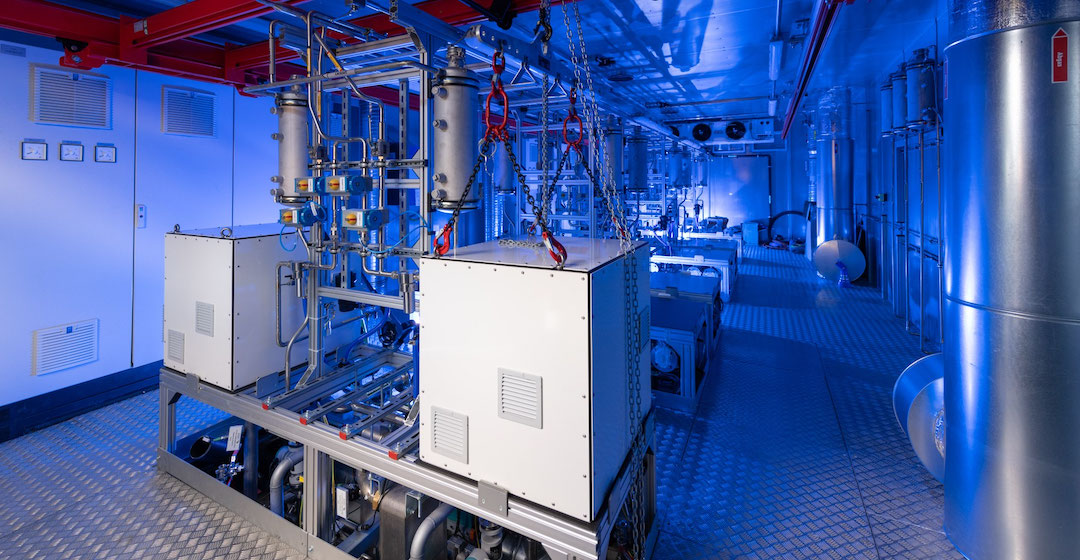
(Empfingen / Germany) – Researchers at the German Aerospace Center (DLR) have succeeded for the first time in achieving a power output of more than one megawatt each with fuel cells and electric motors. The modular test field, called "BALIS," at the Institute of Technical Thermodynamics, enables the development of propulsion systems for mobile applications with a power output of up to 1,5 megawatts, and allows for the comprehensive investigation of individual components and entire drive trains, from the fuel cell system and electric motors to refueling infrastructure and control technology.
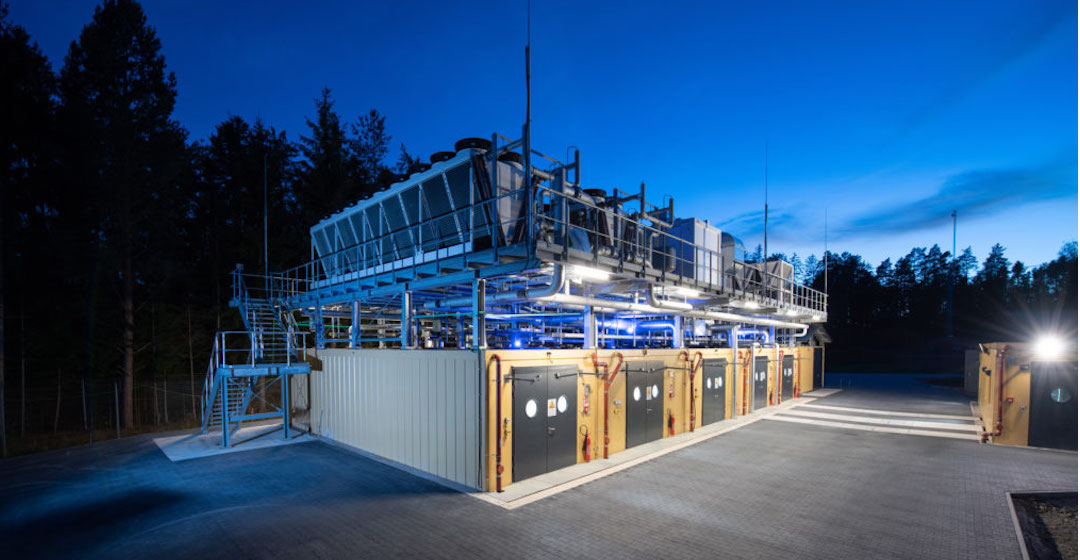
The test field has a modular design, with all components housed in containers on the innovation campus of the E2U Development Center for Environmental Technology in Empfingen. © DLR (CC BY-NC-ND 3.0)
"This is an important milestone in the construction and commissioning of the test field and the first generation of the fuel cell test system," says project manager Cornelie Bänsch. Systems of this performance class are currently unavailable on the market. The technical challenge lies in "developing and integrating all the components so that they run stably at a high output of one megawatt or more."
To do this, the scientists are connecting twelve fuel cell modules, each consisting of more than 400 individual fuel cells. "All modules exchange information and interact," according to the DLR. Using sophisticated operating strategies, they aim to gradually operate the test system stably for increasingly longer periods and increase its output even further beyond one megawatt. "Once that works, we will also run dynamic profiles," i.e., under conditions similar to those found in practical applications: operation at different, high power levels for different periods of time.
Strengthening the high-tech industry

The foundation stone for BALIS was laid in October 2021, and commissioning took place three years later in October 2024. © DLR
All components of the facility, which opened last October on the innovation campus of the E2U Empfingen Development Center for Environmental Technology, are housed in containers (as previously reported) . The fuel cell systems developed at BALIS could, in the future, power ships, be used in heavy-duty road transport, or in aviation. By utilizing green hydrogen, this climate-friendly and environmentally sound technology will contribute to "becoming less dependent on fossil fuels and strengthening the innovative capacity and competitiveness of German industry in the high-tech sector."
BALIS is already fully booked with research projects for the coming years. Cooperation partners include the DLR spin-off H2Fly, the fuel cell manufacturer Power Cell, the electric drive specialist Compact Dynamics, and the industrial gas manufacturer Air Liquide. In the aviation sector, DLR is collaborating with companies such as Diehl Aerospace, GE Aerospace, and Deutsche Aircraft, and AVL is a systems partner.
Photo above
DLR reports initial development successes: At the BALIS test facility, scientists are researching fuel cell technologies from individual components to complete powertrains. © DLR (CC BY-NC-ND 3.0)



