
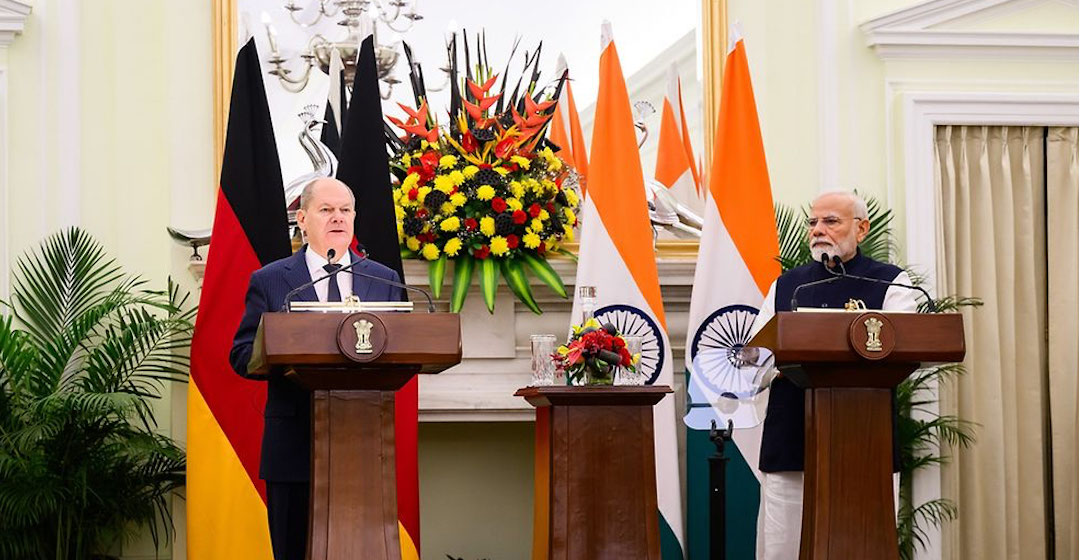
(New Delhi / India) – Germany and India intend to increase their cooperation on hydrogen. Both countries signed a “Green Hydrogen Roadmap” in New Delhi. According to the German Federal Ministry for Economic Affairs and Energy, this roadmap is intended to “make green hydrogen economically viable in the long term and to support global production and trade in green hydrogen.”
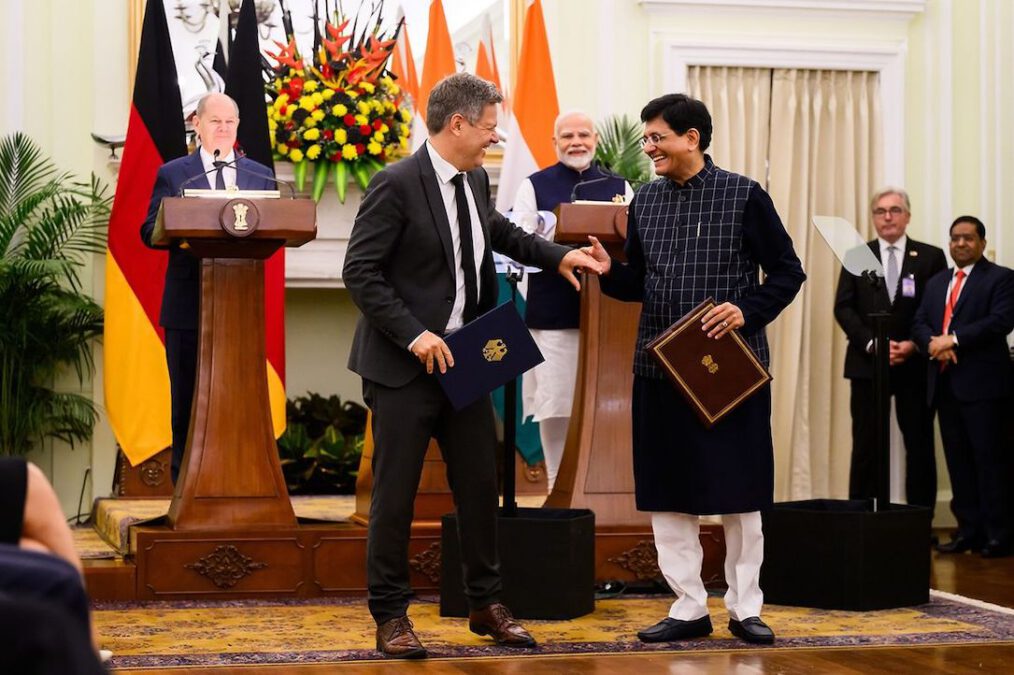
On the occasion of the government consultations, Federal Minister of Economics Robert Habeck signed a German-Indian roadmap in New Delhi as a declaration of intent on future cooperation on green hydrogen. © Federal Government / Marvin Ibo Güngör
The roadmap places a key focus on promoting private sector investment. The aim is to give companies from the other country access to existing funding programs. At the same time, both parties want to intensify the exchange of information, particularly on sectors that are difficult to decarbonize, as well as framework conditions for promoting the production, trade, export and use of green hydrogen. To this end, a permanent working group will be created within the framework of the existing German-Indian energy partnership (Indo-German Energy Forum, IGEF). However, the agreement now reached is more of a declaration of intent. According to "dpa" information, the paper does not contain any concrete financing commitments.
The signing took place last week on the occasion of the most recent German-Indian government consultations (7th India-Germany Inter-Governmental Consultations, IGC). The preparation had already been decided at the previous IGC. At that time, both governments announced the Partnership for Green and Sustainable Development (GSDP), which serves as an umbrella for joint initiatives in this area.
Capacity of five million tons by 2030
The “National Green Hydrogen Mission, ” announced in early 2023, aims to make India a world-leading producer and supplier of green hydrogen. The government committed to building capacity to produce five million tons annually for domestic use by 2030. Potentially, this figure is projected to reach ten million tons to also supply export markets.
Last summer, the Indian Ministry of New and Renewable Energy (MNRE) presented two funding programs to support hydrogen. The total amount is 174,9 billion rupees (1,95 billion euros). Of this, 44,4 billion rupees (0,5 billion euros) are earmarked as an incentive for the production of electrolyzers ("Component I") and 130 billion rupees (1,45 billion euros) for the production of green hydrogen ("Component II"). The implementation will take place between the fiscal years 2025-26 and 2029-30.
According to forecasts from the National Hydrogen Strategy, hydrogen demand in Germany will rise to 2030 to 95 terawatt hours per year by 130. Measured by calorific value, this is more than three million tonnes of hydrogen and its derivatives. 50 to 70 percent of this is expected to be imported.
Photo above
Federal Chancellor Olaf Scholz and Indian Prime Minister Narendra Modi at the closing press conference of the 7th German-Indian government consultations. © Federal Government / Marvin Ibo Güngör



