
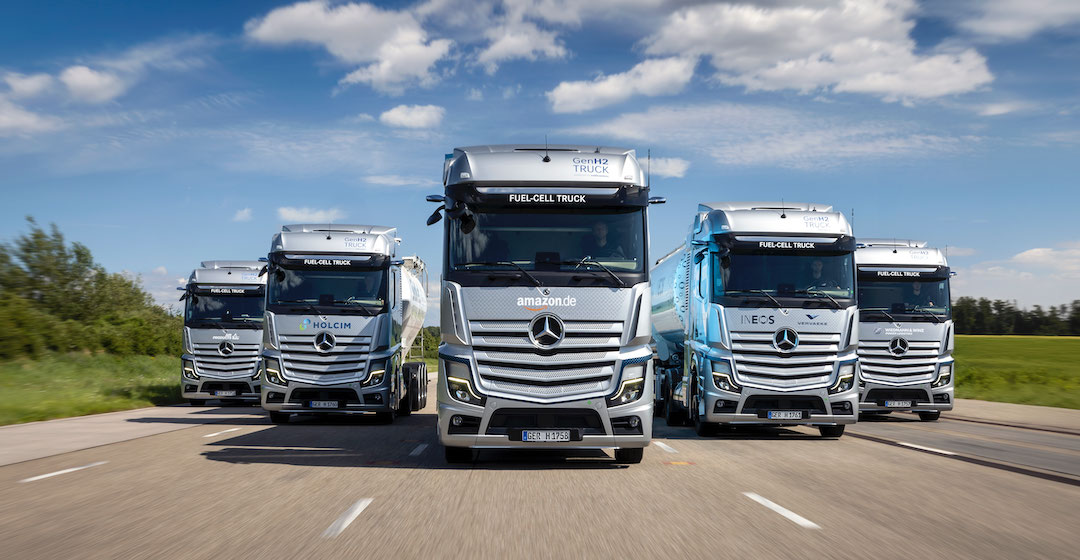
(Leinfelden-Echterdingen, Germany) – Daimler Truck AG is launching a trial phase of its fuel cell trucks with five customers in the logistics sector. The vehicles, dubbed "GenH2," will undergo extensive testing for one year by Air Products, Amazon, Holcim, Ineos, and Wiedmann & Winz. The vehicle manufacturer hopes to gain valuable insights into the liquid hydrogen-powered trucks under real-world conditions and can then incorporate these findings into series production development.
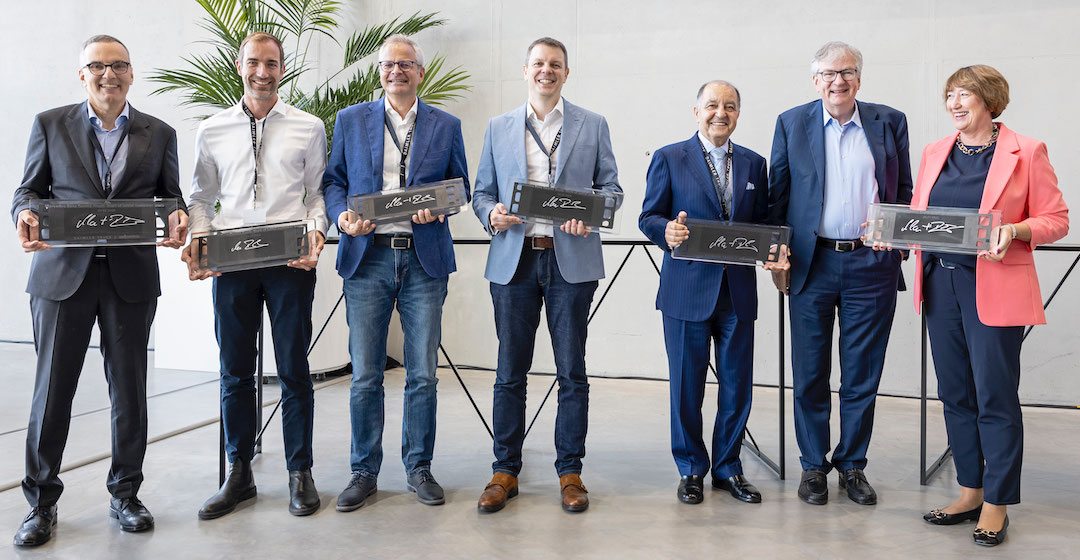
The Mercedes-Benz GenH2 truck starts its test phase with customers (from left): Micha Lege (Wiedmann & Winz), David De Clerck (Ineos Inovyn), Roger Haschka (Holcim), Benoit Robinot-Bertrand (Amazon), Seifi Ghasemi (Air Products), Martin Daum (Daimler Truck) and Hildegard Müller (VDA). © Daimler Truck AG
The five tractor units will be used by customers on specific long-distance routes. Amazon will use the GenH2 truck in its logistics network in Germany, Air Products for the transport of bottled gases, Wiedmann & Winz for sea containers, Holcim for building materials logistics and Ineos through its logistics company Vervaeke for the transport of PVC and vinyl. The manufacturer will look after the vehicles during testing and also provide service. Refueling will take place at designated liquid hydrogen filling stations (LH2) in Wörth am Rhein (Rhineland-Palatinate) and in the Duisburg area (North Rhine-Westphalia).
The vehicles have already been tested on Daimler's own test track as well as on public roads. Road approval was granted in 2021.
GenH2 truck comparable to conventional trucks
According to their own statements, the developers at Daimler Truck based the GenH2 on the characteristics of the conventional long-distance truck Actros from Mercedes-Benz in terms of tractive force, range and performance. The 40-ton trucks allow a payload of around 25 tons.
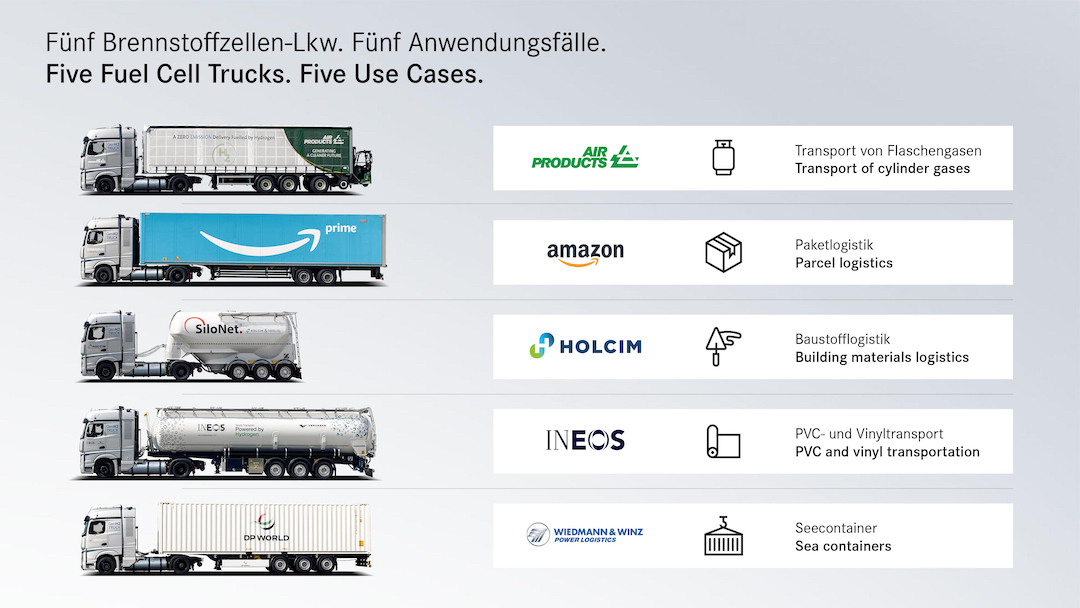
Daimler's GenH2 trucks are being tested by customers with various logistical tasks. © Daimler Truck AG
The fuel cell system comes from Cellcentric GmbH & Co KG, a joint venture between Daimler Truck AG and the Volvo Group founded in March 2021. The output is 300 kilowatts (2 x 150 kilowatts). The storage capacity of the battery is "comparatively low" at 70 kilowatt hours, as it is not switched on to meet energy requirements, but mainly to provide situational power support to the fuel cell; for example, during peak loads during acceleration or when driving uphill with a full load.
At the same time, the lightweight battery allows for more payload and is charged by braking and excess fuel cell energy. The core element of the operating strategy of the fuel cell and battery system is a cooling and heating system that keeps all components at the right operating temperature. This enables the longest possible service life. In a pre-production version, the two electric motors are designed for a total of 2 x 230 kilowatts continuous output and 2 x 330 kilowatts maximum output.
Tanks enable ranges of 1.000 kilometers
The two liquid hydrogen stainless steel tanks each have a capacity of 44 kilograms and consist of "two tubes inside one another that are connected to one another and vacuum-insulated." When developing hydrogen-based drives, Daimler Truck prefers liquid hydrogen. "In this state of aggregation, the energy source has a significantly higher energy density than gaseous hydrogen," says the company. "This means that more hydrogen can be transported, which significantly increases the range and, as a result, enables the vehicle to have comparable performance to that of a conventional diesel truck."
The transport costs for liquid hydrogen are lower, and liquid hydrogen tanks also offer advantages over gaseous pressurized hydrogen in terms of cost and weight, enabling, among other things, a higher payload. In September 2023, Daimler Truck covered a record distance of 1.047 kilometers on a single tankful with a prototype of the GenH2 approved for use on public roads.
Photo above
Five logistics companies are to test Daimler Truck's GenH2 fuel cell truck for a year. © Daimler Truck AG



