
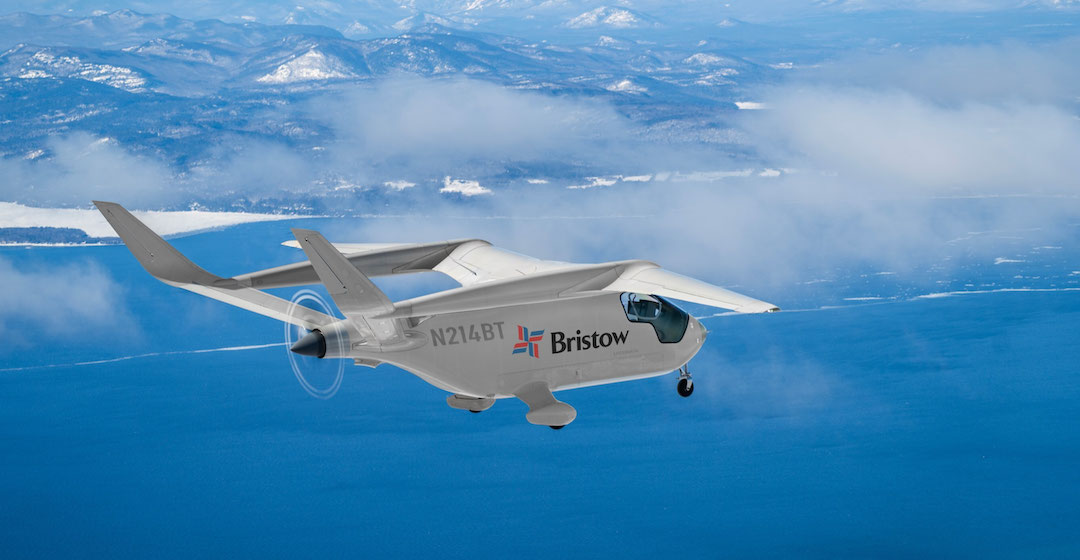
(Bergen, Norway) – Norway aims to establish an “international test arena for zero-emission and low-emission aviation.” A corresponding agreement has now been reached between the American aerospace company Beta Technologies Inc. and the helicopter transport services provider Bristow Norway AS, a subsidiary of the Bristow Group Inc. Preliminary discussions with the Norwegian state-owned Avinor AS – operator of approximately 50 airports – began a year ago. In December, the companies involved signed an initial agreement with the Civil Aviation Authority of Norway (CAA Norway).
 The companies initially plan to conduct demonstration flights without passengers using Beta's conventional takeoff and landing electric aircraft, the "Alia cx300," flown by Bristow Norway. Beta recently completed development of the Alia aircraft, according to the company. It was manufactured at the company's factory in Burlington, Vermont, USA, and has reportedly already received all necessary certifications. It is expected to arrive in Norway shortly. The cargo aircraft will initially fly between Stavanger and Bergen airports.
Basis for battery and hydrogen drive
"With an aviation industry committed to reducing emissions, a network of airports of varying sizes, a significant regional aviation market, a proactive aviation authority, and a supplier industry specializing in battery-electric propulsion systems and hydrogen technology, we have a strong foundation for the early adoption of new technologies," said Transport Minister Jon-Ivar Nygård, promoting the project. The goal is to accelerate the transition to zero- and low-emission aviation within the framework of the National Aviation Strategy and the National Transport Plan 2025-2036 (NTP).
To achieve this, one billion kroner was allocated as part of the NTP. The government has also budgeted approximately 2025 million kroner for the project for Avinor and CCA Norway for 50. "The first important initiative is to establish Norway as an international test bed for zero- and low-emission aircraft," said the Minister of Transport.
Basics for scaling
The aim is to gain insights and lay the foundation for technological scaling. Airlines, manufacturers, suppliers, the energy sector, and other stakeholders will be involved. Avinor's role is to "facilitate the provision of infrastructure at airports and make airspace available to stakeholders who want to test zero-emission aircraft in an operational environment," says Karianne Helland Strand, Executive Vice President for Sustainability, Concept and Infrastructure Development at Avinor. The aim is to learn what the various technologies and aircraft require in terms of airport facilities and the required energy supply.
The Civil Aviation Authority of Norway will also further develop regulations and framework conditions “to enable new technologies and concepts,” says its head Lars Kobberstad.
First start in Stavanger in summer
The project, designed to evaluate the early introduction of new aviation technologies, is proceeding according to the "crawl, walk, run" principle, says Dave Stepanek, Executive Vice President and Chief Transformation Officer of the Bristow Group. The first takeoff of the beta cargo aircraft is scheduled for late summer in Stavanger. Full service between the two airports is scheduled to begin in the fall, initially without passengers.
The procurement process for fast chargers for electric aircraft in Bergen and Stavanger is currently underway to enable the first test flight. Delivery of one charger is scheduled for June 1. A mobile charger will be available for Bergen Airport starting in August.
However, there are currently very few fast chargers for aircraft on the market. Avinor will also procure a charger with a CCS connector, which would technically allow standard car chargers to be used to charge aircraft – however, this would require physical adaptations, as these are designed completely differently than cars and trucks.
Only one manufacturer for aircraft chargers
In aviation, there are also strict requirements regarding the distance between a moving aircraft and a charger. Avinor requires a continuous power output of at least 300 kilowatts for procurement. Currently, there is only one manufacturer that can offer an aircraft-adapted charger that meets this requirement.
 "Avinor wants to involve the Norwegian supplier industry and, through the Test Arena project, bring other players in the field of charging technology on board," says Avinor's CEO Anders Kirsebom. The electrification of the car fleet in Norway has contributed to the development of many innovative solutions for charging various vehicles by Norwegian players. "Avinor hopes for the same innovative spirit in this tender and that we will receive many offers, even if no one has a ready-made solution yet," says Kirsebom.
Test arena for the entire Norwegian airspace
The route now selected is just the beginning. The test arena will essentially cover the entire airport network and Norwegian airspace. Specific geographical locations for the establishment of test operations will be determined in cooperation with interested parties based on their needs as well as an assessment of technological maturity and the availability of relevant energy sources. Manufacturers and operators must be able to present an operational concept and meet specified qualification criteria, for example, regarding climate and the environment, innovation, maturity, and value creation.
Expressions of interest and initial contact are possible via email (testarena@avinor.no).
Photo above
The electric aircraft "Alia cx300 eCTOL" is set to be the first aircraft to fly in Norway's new test corridor for electric and hydrogen propulsion. © Bristow Group



