

(Brussels / Belgium) – The German government plans to build a number of new gas-fired power plants in the coming years. The European Commission has now approved an application for state aid: up to €35,2 billion will be available to the potential operators. This funding is intended to ensure "sufficient capacity for the generation, storage, and flexible consumption of electricity so that electricity generation can consistently meet the expected demand," according to a Commission statement.
Gas-fired power plants must be hydrogen-capable
The capacities to be made available from 2031 onwards would be selected through auctions. All subsidized capacities, for which 15-year contracts apply, must be operated in a climate-neutral manner by 2045 at the latest. All new gas-fired power plants bidding for a 15-year capacity contract must be hydrogen-capable so that they can be converted to hydrogen at a later date.
The first auctions will take place this year. Further auctions are planned for 2027 and 2029. They will be open to "all technologies" and "both existing and additional capacities." Germany will also conduct tenders "to accelerate the decarbonization of part of its gas-fired capacity by converting to hydrogen and thus prevent a possible permanent dependence on natural gas," and will furthermore "support the conversion from gas to hydrogen."
Foreign resources are also possible
This measure – “unlike the initial tenders” – is also open to foreign capacity located in a Member State with a direct grid connection to Germany. Tenders for early decarbonization, aimed at converting two gigawatts of gas capacity to hydrogen by 2040, will be held until December 31, 2027. Tenders for the conversion of a further two gigawatts by 2043 are planned for the period from 2032 to 2035. However, this support for early decarbonization is not covered by the Commission's decision and will be notified and reviewed separately.
Changes before the vote in the Bundestag
The approval is based on the "Act to Safeguard Security of Electricity Supply and to Provide New Capacities" (StromVKG), which entered into force on July 22 following a resolution by the Bundestag ( more information here ). This introduces a capacity market for the year 2031, which is intended to ensure that sufficient electricity generation plants are built and operational.
Compared to the draft legislation from the Federal Ministry for Economic Affairs and Energy, there were some changes before the vote in the summer: One-third of the power plant sites are now to be built in northern Germany and two-thirds in southern Germany. According to a statement from the Bundestag, this was "primarily demanded by the federal states; in particular, the heads of government of the eastern German states felt their regions were being disadvantaged."
For power plant operators, the bid cap was raised from the original €173.000 to €244.000 per megawatt of installed capacity. This is the compensation that operators are allowed to demand in the tenders for making the power plants available.
For suppliers primarily involved in tenders for battery storage systems, the hurdles have been lowered. Instead of providing electricity for at least ten consecutive hours and then supplying it again for ten hours after a break of no more than one hour, a break of three hours is now permitted; after that, the systems only need to be charged to 80 percent.
Tender for an initial nine gigawatts
According to the Federal Ministry for Economic Affairs and Energy, the first contribution to security of supply will come from the tenders for approximately nine gigawatts of "long-term capacity," which, depending on the technology used, corresponds to around ten gigawatts of installed power plant capacity or about 20 power plants. The Federal Network Agency will conduct the first round of tenders on September 8, with the second following on December 29, 2026.
A further two gigawatts – without a "long-term criterion" – would be put out to tender in May 2027. Further rounds would then take place until 2029. The Federal Network Agency will calculate the respective tender volumes in such a way that the full capacity requirement for the year 2031 is covered.
Study: Plans completely oversized
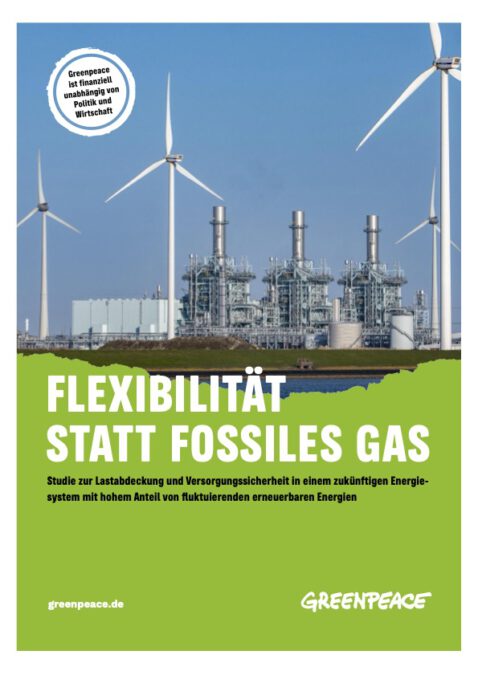
"It is uncertain whether new capacities on the scale currently planned by the German Federal Government as part of its power plant strategy will even be needed by 2032." © Wuppertal Institute
However, a study published in March by the Wuppertal Institute on behalf of Greenpeace Germany criticizes the planned construction of new natural gas power plants as part of the power plant strategy, arguing that it is "significantly oversized" ( more on this here ). New dispatchable capacities are only rarely needed as backup during periods of low wind and solar power generation. Flexible, climate-friendly options such as electricity and heat storage, energy efficiency measures, and flexible biogas plants could significantly reduce the need for new power plants.
According to the report, "a combination of different flexibility options can reliably compensate for fluctuations in wind and solar power, at least in the medium term." Stefan Thomas, head of the Energy, Transport and Climate Policy department at the Wuppertal Institute, says it is uncertain whether new capacities on the scale currently planned by the German government as part of its power plant strategy "will even be needed by 2032."
DUH: Complaint against subsidies
The German Environmental Aid Association (DUH) also criticizes the EU Commission's decision: Despite significant concerns regarding state aid law, Brussels is giving the green light to a funding model whose initial tenders are specifically tailored to fossil gas power plants and disadvantage clean alternatives. "In its own communication, the Commission emphasizes that the funding should, in principle, be open to all technologies – while simultaneously admitting that battery storage is effectively excluded from the first round of tenders. This doesn't add up," says DUH Federal Managing Director Sascha Müller-Kraenner. The DUH is appealing to the EU to open a formal investigation. "The fact that the EU Commission is approving this billion-euro fossil fuel package, despite considerable doubts about its compatibility with the state aid requirements of technological neutrality, is highly problematic." In August, DUH, together with Green Planet Energy, officially filed a complaint against the planned subsidies due to these state aid concerns.
The “Study on load coverage and security of supply in a future energy system with a high proportion of fluctuating renewable energies” is available free of charge as a PDF (147 pages).
Photo above
Germany receives the green light from the EU Commission to fund the construction of new gas-fired power plants with €35 billion. © EU Commission



