

(Bonn, Berlin / Germany) – The Federal Network Agency (BNetzA) has approved the hydrogen core network proposed by the transmission system operators, with a pipeline length of 9.040 kilometers. There were "minor adjustments." Only pipelines necessary for the transport task were approved. Of these, approximately 60 percent will be converted from natural gas to hydrogen, and 40 percent will be newly installed. This is "the starting point for the development of a nationwide hydrogen infrastructure in Germany," says agency head Klaus Müller.
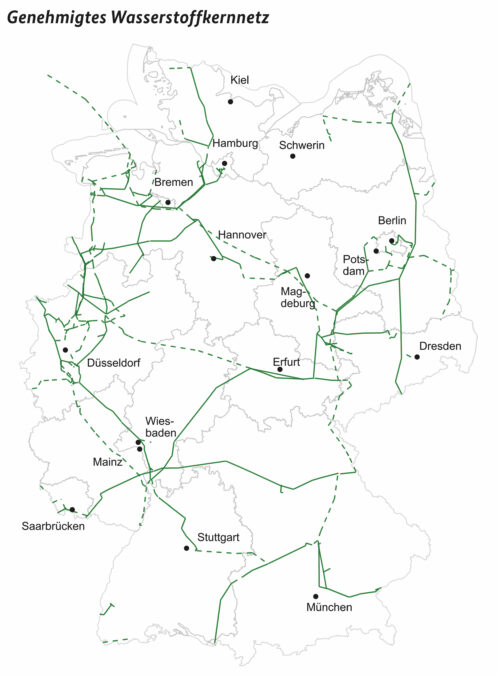
The German hydrogen core network currently comprises a good 9.000 kilometers of pipelines. Around 60 percent are conversions of existing gas pipelines. Dashed lines: new construction. © Federal Network Agency
With the approval, the network operators can now gradually build and operate the infrastructure for hydrogen. The first lines will be converted starting next year. All plants are to be put into operation gradually by 2032 and will connect the future hydrogen clusters across Germany. Regional and local projects will be bundled in this, for example in industrial or business parks. Neighbouring countries will be connected later on.
In addition to the 15 transmission system operators (TSOs), ten distribution system operators are also involved in the core network. According to the Federal Ministry for Economic Affairs and Energy (BMWK), the feed-in capacity in 2032 will be 101 gigawatts and the feed-out capacity 87 gigawatts. According to the transmission system operators Gas eV (FNB Gas), this offers potential for the transport of 278 terawatt hours of climate-neutral hydrogen.
In the last two gas network development plans for 2020 and 2022, the TNB had already conducted market surveys for hydrogen production and demand and identified pipelines for converting from natural gas to hydrogen. Models for the development of the network were incorporated into the plans.
In spring 2023, the federal government decided to set up a hydrogen core network with the aim of connecting the main production, import and consumption points across Germany. In July 2023, the network operators published their planning status. This was discussed and modified.

Development of plans since 2023. © Federal Network Agency
In November 2023, the transmission system operators (TSOs) submitted the draft application for the hydrogen core network to the Federal Network Agency (BNetzA). Following subsequent consultations, the organization revised the application, adding individual lines in some regions and removing lines in others. According to the BNetzA, further infrastructure development will now take place within the framework of the regularly prepared "Gas and Hydrogen Network Development Plan." The Federal Ministry for Economic Affairs and Energy stated that the first of these network development plans is to be prepared by a newly established coordination office by May 31, 2025, and approved by the Federal Network Agency by June 30, 2026.
start of new energy infrastructure
"With the approved core network, we are creating planning security for everyone involved - from hydrogen producers at home and abroad to the operators of power plants and storage facilities and future industrial users," says Federal Minister for Economic Affairs and Climate Protection, Robert Habeck. "The core network is the starting point for a new infrastructure and a central building block of the energy transition."
Since a large part of the future hydrogen demand in Germany will be covered by imports, 13 border crossing points in neighboring European countries are planned. The long-distance network operators plan to invest a total of 2032 billion euros by 18,9. First of all, natural gas pipelines that are no longer needed for natural gas transport will be converted to hydrogen and put into operation.
According to a decree issued by the Federal Network Agency (BNetzA) in June , the core network lines are to be built and operated by private companies and financed through user fees. However, since there will be relatively few customers at the beginning, the investment costs cannot yet be fully passed on – therefore, network fees will be capped. An amortization account ensures that the lower revenues of the first phase are offset by higher revenues later on. With the exception of the IPCEI (Important Project of Common European Interest) line projects, which are funded by the federal and state governments, no federal funds will flow into the core network lines – however, the financing concept includes a financial safeguard for the federal government against unforeseen developments.
FNB: “Actively drive forward ramp-up”
"The development of the H2 market is now a joint task," says Thomas Gößmann, CEO of FNB Gas: "All players are required to actively drive the ramp-up." To achieve this, particularly in the current economic situation, favorable framework conditions are needed to trigger private investment along the entire H2 value chain. The members affiliated with FNB Gas together operate a pipeline network of around 40.000 kilometers.
The approved hydrogen core network, including all measures, is published on the website of the Federal Network Agency.
Photo above
The Federal Network Agency has now approved the hydrogen core network in Germany. In September, as reported, future European operators of hydrogen transmission networks submitted drafts to the European Commission and the European Union Agency for the Cooperation of Energy Regulators (ACER) to formally establish the European Network of Network Operators for Hydrogen (ENNOH) as an association. © ACER



