
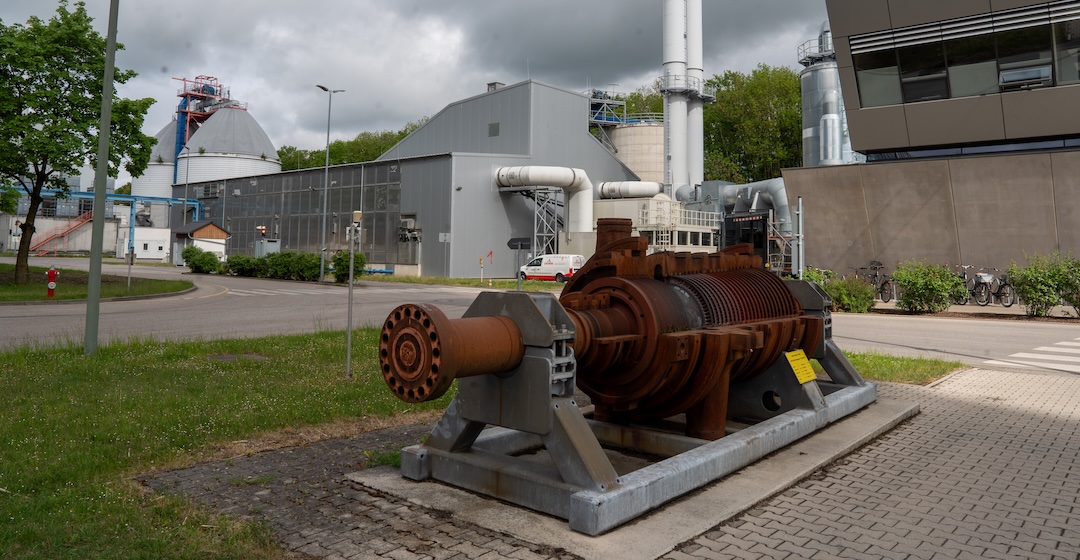
(Zolling, Germany) – The Bavarian state government supports the plans of power plant operator Onyx Power to build a hydrogen-ready combined cycle gas turbine (CCGT) power plant in Zolling (Freising district). Economics Minister Hubert Aiwanger and Onyx power plant manager Roman Ritter have now formalized this in a joint declaration of intent. However, the specific nature of the support was not disclosed.

Bavaria's Minister of Economic Affairs, Hubert Aiwanger (front right), signed the letter of intent with Onyx manager Roman Ritter. © StMWiBU / Aneta Ufert
The plant, with a capacity of approximately 800 megawatts (MW), is to be built as part of the first tender under the Electricity Supply Security and Capacity Act (StromVKG) and is intended to help "ensure the supply of electricity to the southern Bavarian economic region at all times, even during periods of low generation from renewable sources." To realize the project, "reliable legal frameworks and functioning tendering mechanisms are needed," says Roman Ritter, Onyx power plant manager in Zolling. The company will continue to advance the planning for the hydrogen-capable gas and steam turbine power plant and is in "close contact with political decision-makers" regarding this matter.
ResInvest has acquired Onyx
Onyx Power has approximately 2.000 megawatts of installed generation capacity at four power plant sites in Germany and the Netherlands, employing around 400 people. In February of this year, the Berlin-based electricity and heat supplier was acquired by the trading and investment company ResInvest Group. ResInvest recently acquired the German power plant Datteln 4 from the European energy company Uniper, following the acquisition of two coal-fired and biomass power plants in Poland. According to the company, it operates in 16 countries and specializes in raw materials, biomass, agricultural products, and sea freight.
The Federal Cartel Office criticizes the draft of the Electricity Supply Act (StromVKG).
However, it remains unclear exactly when the current version of the Electricity Supply Act (StromVKG) proposed by the Federal Ministry for Economic Affairs and Energy, which provides for high subsidies for gas-fired power plants, will be passed by the Bundestag. Among the most prominent of the numerous critics is the Federal Cartel Office, which already raised objections in December that have still not been taken into account.

The Federal Cartel Office in Bonn has raised serious objections to the draft Electricity Supply Security and Capacity Act (StromVKG) in its current form. © Federal Cartel Office
The draft legislation stipulates that proof of grid connection must be provided when applying for tenders. This effectively leads to preferential treatment of existing power plant sites. New sites that have not yet been approved would have no realistic chance of receiving a grid connection commitment within the proposed application period. This applies particularly to battery storage facilities, which could, in principle, be implemented by 2031 even without a prior grid connection commitment, as they have significantly shorter construction times compared to gas-fired power plants.
Battery storage is virtually ruled out
Furthermore, battery storage projects are "effectively excluded from the tender" anyway. The Federal Cartel Office had advocated against necessarily limiting capacity projects to natural gas (and/or hydrogen). While the draft bill generally assumes technological neutrality, the detailed regulations it contains regarding the necessary requirements for the technologies to be used could "in fact make the participation of individual technologies (such as battery storage) more difficult" – or even exclude them entirely.
The draft, published at the end of April and approved by the cabinet on May 13, is currently going through the parliamentary process. It remains unclear whether Onyx would invest in the gas-fired power plant even without the Electricity Supply Act (StromVKG).
Photo above
An 800-megawatt G&D power plant is to be built at the Zolling site. © StMWiBU / Aneta Ufert



