
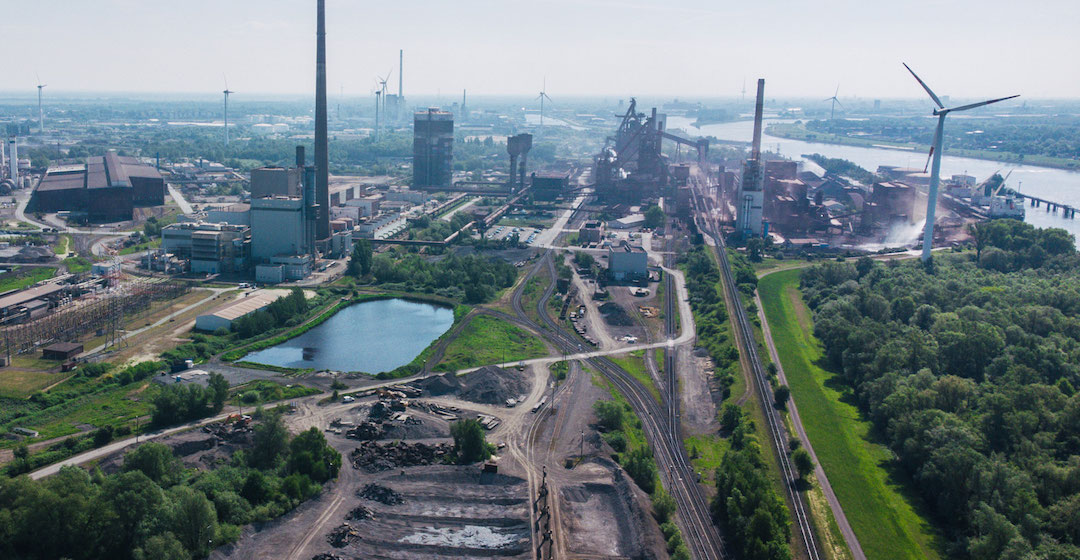
(Bremen / Germany) – The steel industry is one of the largest CO2 emitters in Germany – worldwide, steel production accounts for eight to eleven percent of emissions. It's good for everyone when new technologies are used to reduce pollutants. ArcelorMittal SA also wanted to contribute to this.
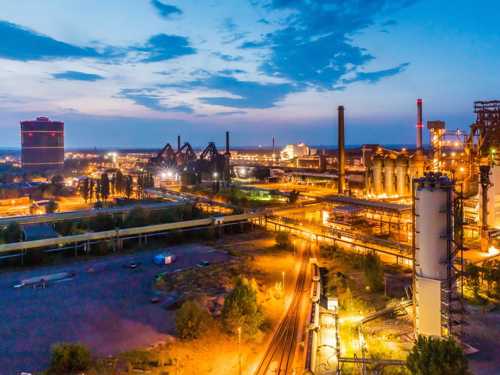
Project stopped: The Luxembourg-based company had been planning for years to replace the coke-fired blast furnaces at its flat steel plants in Bremen and Eisenhüttenstadt by 2030. © ArcelorMittal SA
But now the Luxembourg-based company has halted its long-announced project. The plan was to replace the coke-fired blast furnaces at its flat steel plants in Bremen and Eisenhüttenstadt by 2030. In Bremen, a direct reduction plant (DRI), initially powered by natural gas and later, in the long term, by green hydrogen, was to filter the iron from the ore and process the resulting pellets into crude steel in an electric arc furnace (EAF). Construction was scheduled to begin this month. The new production facilities were slated to go into operation in 2026 (as we have reported several times ). According to media reports , the steel plant is responsible for approximately half of the greenhouse gas emissions in the state of Bremen.
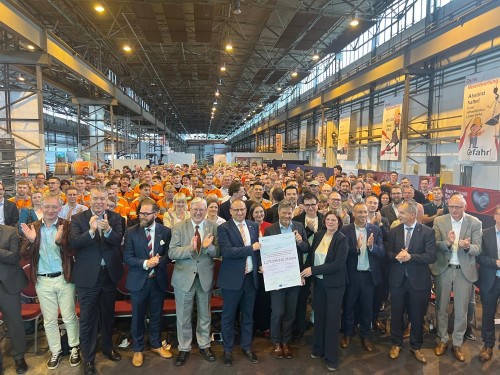
Premature celebration: Former Economics Minister Robert Habeck presented the ArcelorMittal management and employees in Eisenhüttenstadt with funding approval for €1,27 billion a year ago, with an additional €251 million coming from the state of Bremen. Now the steel company has announced it is no longer interested. © ArcelorMittal SA
State funding of €1,3 billion was planned for the project. The then Federal Minister of Economics, Robert Habeck, specifically presented the EU-approved funding notice in Eisenhüttenstadt a year ago to great applause. The sum included co-financing from the state of Bremen of around €251 million for the DRI plant in the Hanseatic city. "With the funding notice, we have secured part of the costs we need for the construction and operation of new decarbonization plants," rejoiced Thomas Bünger, CEO of ArcelorMittal Flachstahl Deutschland, in June 2024. The total investment for the decarbonization project was reportedly around €2,5 billion.
Company does not see itself as responsible
Then, a few days ago, the bombshell: The company announced that it had been unable to make "final investment decisions." The reason for this was "the political, energy, and market-related framework conditions," which had "not developed in the hoped-for direction." Since the funding agreement with the German government stipulated that construction work would begin by June 2025, ArcelorMittal was obligated to inform the government that it could not continue with the investments "due to the market situation." "Even with financial support, the economic viability of this conversion is not sufficiently ensured," says Geert Van Poelvoorde, CEO of ArcelorMittal Europe.

ArcelorMittal's advice to politicians: limit steel imports, increase subsidies, and lower electricity prices. © German Bundestag / Thomas Trutschel
There is no shortage of advice for policymakers. It is "urgently necessary" to address a number of problems, such as the high imports into the European market, which is otherwise characterized by weak demand: "We need to limit imports of flat products to 15 percent, which corresponds to a reduction of approximately 50 percent compared to the current level," says Geert Van Poelvoorde. In addition, new instruments to support sectors with emissions that are difficult to avoid are important. Furthermore, the electricity price is too high, because the transition means switching from coal as an energy source to a furnace powered by natural gas and electricity.
First signs of crisis in November
The first signs that the project might be in trouble emerged last November. In a statement dubbed an " update, " ArcelorMittal prepared its stakeholders for a slowdown in the implementation of its decarbonization goals. While they have customers who want low-carbon steel, "those who want it and are willing to pay a premium are still very much in the minority," said CEO Aditya Mittal.
He expressed "remains confident that we will meet our net-zero target by 2050, but the way we achieve this may differ from what was previously announced." Here, too, the "European market environment" has already been addressed. Policy and energy markets have "not developed in a favorable direction." Green hydrogen is developing very slowly into a viable fuel source, and natural gas-based DRI production in Europe is "not yet competitive" as an interim solution, the CEO said.
Anger in Bremen and Brandenburg
In the first week of June this year, the new CEO of the Bremen and Eisenhüttenstadt sites, Rainer Böse, visited Bremen's mayor, Andreas Bovenschulte. Afterward, Bovenschulte announced through his press office that he was pleased that "the new head of the plant had sought contact so soon after taking office." "I enjoyed discussing all the issues with him" – there was no indication that things would soon escalate into a major blowup.
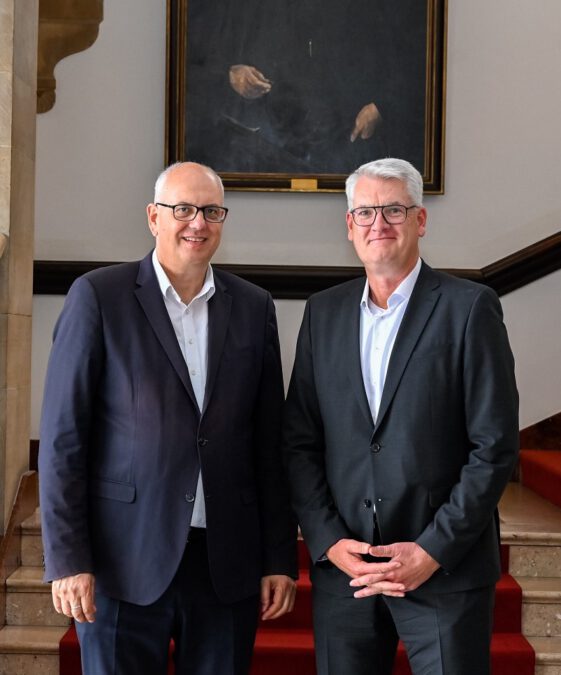
The new head of the ArcelorMittal steelworks in Bremen and CEO Rainer Böse (right) during a friendly inauguration visit with Bremen's mayor, Andreas Bovenschulte. "Contact with the steelworks is important," said Bovenschulte. And barely two weeks later: "We will not absolve the steel bosses of their responsibility." © Bremen Senate Press Office
This made the anger last week all the greater: "We will not absolve the steel bosses of their responsibility," raged Bovenschulte. "It is a severe blow" also "for Bremen as a business location and for the future of the steelworks" that ArcelorMittal is abandoning the transformation of the steel industry. He expected the company to "commit itself to the plant and steel production in Bremen." The Bremen Senate was also annoyed "after politicians and companies worked together for so long on a perspective for the Bremen steelworks." Bremen had advocated for the site to be connected to the hydrogen core network and had created all the prerequisites for the development of the energy hub to enable the steelworks to undergo the transformation.
Finance Senator Björn Fecker described the withdrawal as a "short-sighted step" with regard to long-term competitiveness, especially "in view of the rapidly advancing decarbonization of Chinese steel production." Future economic activity will take place under the conditions of climate change. Fecker stated: "Those who don't lay the foundation for this today will, in the worst case, no longer be on the market tomorrow."
Green steel has long been produced, including in China, says Kristina Vogt, Senator for Economic Affairs, Ports and Transformation: "ArcelorMittal's decision is irresponsible towards its employees and wrong from an industrial policy perspective." The decarbonization of the Bremen steelworks has been massively supported with €840 million in state and federal funding. "I expect the company to quickly put forward a clear plan for the Bremen site that secures both the future of the plant and the jobs it creates."
ArcelorMittal employs approximately 2.700 people in Eisenhüttenstadt. To secure the site and jobs in the long term, the company had planned to replace the blast furnace with a DRI plant and an electric arc furnace for steel production. © ArcelorMittal Eisenhüttenstadt GmbH
In Brandenburg, people are also angry with the steel company. "The steelworks in Eisenhüttenstadt are the heart and backbone of Eastern Brandenburg," says Minister-President Dietmar Woidke. The state government is doing everything it can to protect jobs at the steelworks. "The funding was also intended to be an investment in the Eisenhüttenstadt site, which would have represented an important step in the restructuring of the steelworks," says Daniel Keller, Brandenburg's Minister for Economic Affairs, Labor, Energy and Climate Protection. Funding opportunities have been discussed repeatedly in regular exchanges with the company. "We will consult with the company, the works council, and all other affected parties on how the steelworks in Eisenhüttenstadt can be positioned securely for the future."
Far-reaching consequences for other industries
The withdrawal also has consequences for other projects: Energy supplier EWE AG is now also pulling the plug and putting its plans for hydrogen production at the Mittelsbüren power plant site on hold, reports Radio Bremen . In January 2024, ArcelorMittal and EWE reached a preliminary agreement under which the energy supplier was expected to deliver green hydrogen from a 320-megawatt production plant in Emden to Bremen starting in 2028.

A consortium of renowned companies plans to build a hydrogen cluster with an electrolysis capacity of 400 megawatts in the northwest as part of the four-phase "Clean Hydrogen Coastline" project. Participants include EWE AG, the steel company ArcelorMittal Bremen, the vehicle manufacturer Faun, the long-distance pipeline operator Gasunie, the energy supplier SWB, and the transmission system operator Tennet. © EWE AG
EWE planned to install up to 400 megawatts of electrolysis capacity near the German North Sea coast, which could produce up to 40.000 tons of green hydrogen annually. Furthermore, there was the possibility of expanding the production capacity to the gigawatt scale. The starting point for the large-scale production of green hydrogen for ArcelorMittal was the major project "Clean Hydrogen Coastline." This project integrates production, storage, transport, and industrial use ( as previously reported ).
The further consequences of the steel company's exit remain uncertain for the time being. After all, the planned German hydrogen core network, some sections of which are currently under construction, is based on major industrial customers. But while the media is already speculating that the hydrogen ramp-up is now at risk and that the core network may even have to be redesigned, three other steel companies are – so far – sticking to their decarbonization plans: Salzgitter Flachstahl GmbH (funding: one billion euros), Thyssenkrupp Steel Europe AG (two billion euros), and SHS Stahl-Holding-Saar GmbH & Co KGaA (2,6 million euros) are continuing to convert their steel production to potentially green hydrogen. Perhaps the exit of their competitor ArcelorMittal will now even make it easier for them to meet the large demand for hydrogen – and they can accelerate the transition by gaining competitive advantage.
------
Comment – Quite clearly: ripcords are there to be pulled. A timely withdrawal from a project at the last possible moment can save small businesses in particular. It's legitimate that global players also make use of this. But corporations don't plan recklessly or in the short term; they plan years in advance. This costs time and money. ArcelorMittal will find an internal solution for its own losses. However, these projects also tie up external partners. Such plans, with their associated funding approvals, are meticulously reviewed by specialists: In the public administrations of Eisenhüttenstadt, Bremen, Berlin, and even Brussels, engineers have been calculating, and administrative experts have spent months poring over mountains of files, checking every comma in the submitted documents and expert opinions, discussing and verifying that everything is legally sound. Someone should calculate how much taxpayers' money has been wasted here on materials and manpower – for absolutely nothing. These working hours were then unavailable to other departments in the administrations for months, and Arcelor has thus potentially blocked successful projects. Recipients of basic income support are to have their already meager budgets cut for missed appointments. Global corporations also receive this "basic income"—and politicians must finally hold them accountable for their failures. Especially since downstream companies that believed they could rely on Arcelor are also being harmed. The corporation is contributing to the very thing it criticizes in politicians: that the framework for businesses is "not developing in the hoped-for direction." Andreas Lohse, Editor-in-Chief
-----
Photo above
No more room for green steel: ArcelorMittal halts plans to decarbonize its Bremen steelworks. © ArcelorMittal SA



