
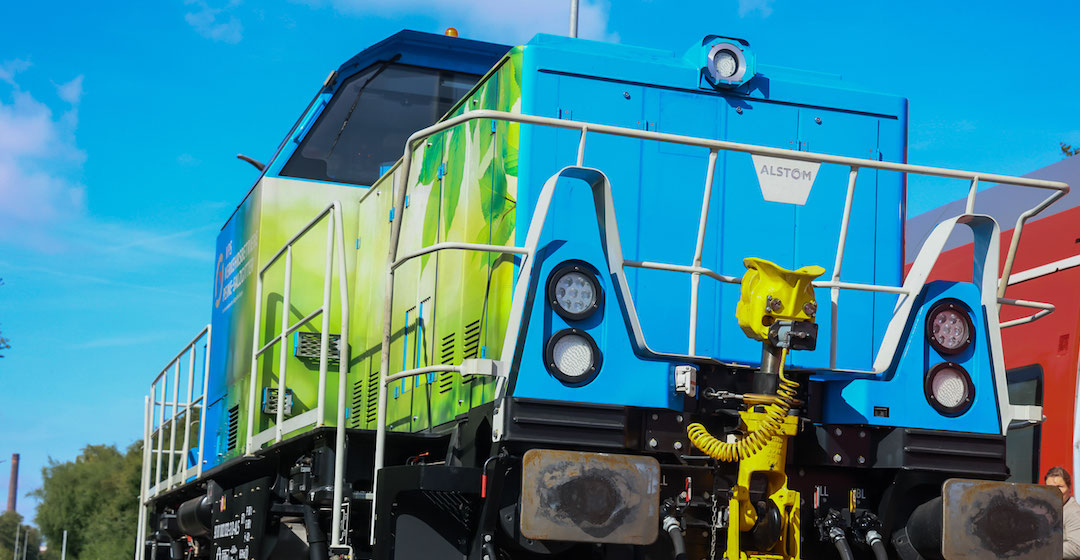
(Salzgitter / Germany) – The French rail company Alstom has presented a shunting locomotive converted from diesel to hydrogen propulsion at its plant in Salzgitter, Lower Saxony. The vehicle's engine is powered by direct combustion of the energy carrier.

Alstom unveiled the rebuilt locomotive in September in the presence of representatives from politics and business (from left): Brecht Günther (VPS), Astrid Paus (Office for Regional Development), Oliver Mairinger (Alstom), Frank Klingebiel (Mayor of Salzgitter), Christian Bieniek (Alstom), Peter Eilts (TU Braunschweig), and Carsten Tietze (WTZ Roßlau). © Alstom / Philipp Ziebart
Alstom is reportedly developing the technology for modernizing existing locomotives together with VPS Verkehrsbetriebe Peine-Salzgitter GmbH, a subsidiary of the steel group Salzgitter AG, as well as with WTZ Roßlau gGmbH, the Technical University of Braunschweig, and the Fraunhofer Institute for Surface Engineering and Thin Films. The industrial test operation, which is now beginning at the steel-producing companies of the Salzgitter Group, is expected to run until the end of October 2025. The company expects the practical operation to provide important insights into everyday suitability and to gather experience for a series production solution. The locomotive will then be restored to its original condition.
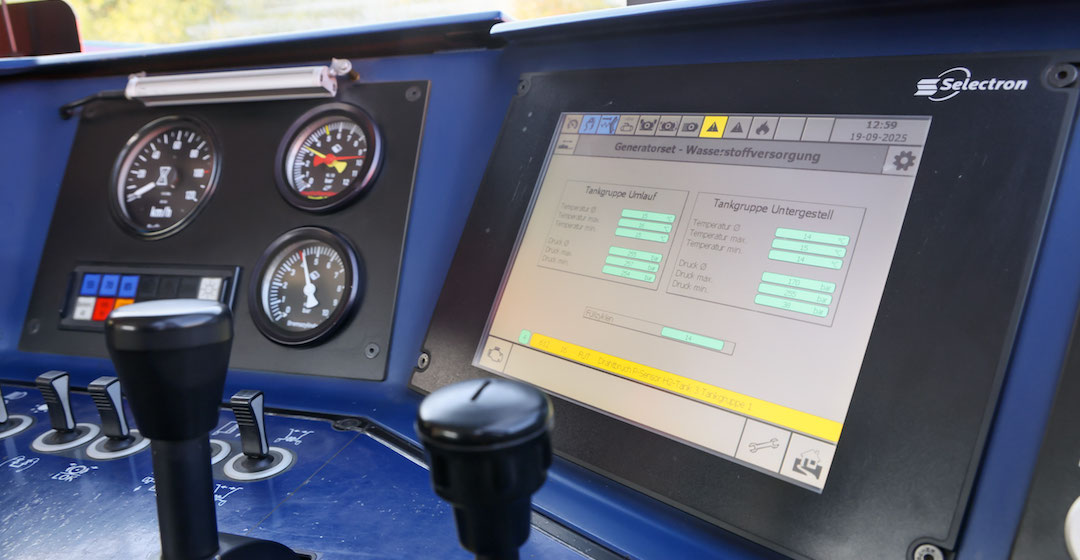
Cockpit of the hydrogen locomotive in Salzgitter. © Alstom / Philipp Ziebart
VPS operates 42 locomotives for the transport of ore and coal, pig iron, and steel products. A total of around 1.000 diesel shunting locomotives are in operation in Germany, and 4.000 across Europe. The average service life of a diesel shunting locomotive is 50 to 70 years, and they emit approximately 150 tons of CO2 per year. A modernized shunting locomotive powered by hydrogen saves up to 3.000 tons of CO2 over a remaining service life of 15 to 20 years. The source of the hydrogen for the Salzgitter project is not disclosed.
Promotion of city and country
On the occasion of the Alstom tests, Salzgitter's mayor, Frank Klingebiel (CDU), quoted former Lower Saxony Minister-President Stephan Weil (SPD), who once described the city as "Germany's transformation capital." Salzgitter AG is investing billions in the "SALCOS" project for low-carbon steel production, VW is building its first battery cell factory, and at the "Hydrogen Campus," "the technologies of tomorrow are being developed in the areas of factory transformation, green hydrogen, and hydrogen storage." The city is supporting the joint project to decarbonize shunting traffic with €1,5 million from the €50 million in structural aid the city received from the state of Lower Saxony.
Alstom is not alone
Thanks to this solution, customers could switch to emission-free operation without having to replace their existing fleet, says Francois Muller, Head of Service for Central and Northern Europe at Alstom. "This is a worthwhile option, especially in shunting operations, due to the long service life of the vehicles." However, claiming that this research project is "pioneering work in the use of hydrogen in rail transport" is only partially true, as hydrogen locomotives are also being developed elsewhere – partly for direct use, partly using fuel cells.
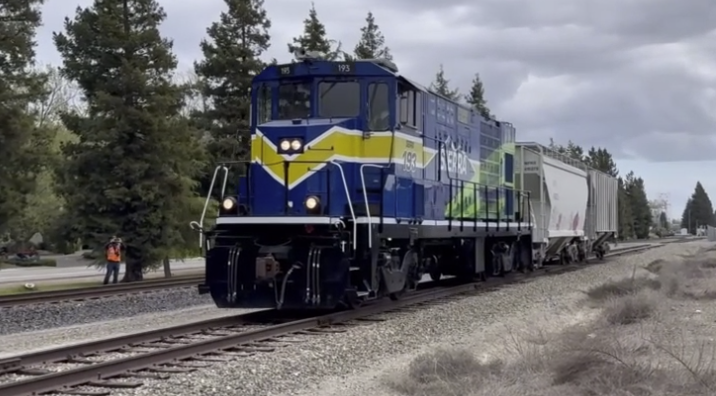
SERA has already tested one H2 shunting locomotive and is building three more. © Sierra Northern Railway / Screenshot from test run video
For example, in April of this year, the Californian railway company Sierra Northern Railway (SERA) completed testing of its first four-axle hydrogen-powered shunting locomotive and has already begun construction of three more. The project was announced in 2022 by a consortium of industry and research institutions, after the California Energy Commission (CEC) pledged a grant of four million dollars the previous year.

The hydrogen tanks of the PESA locomotive, unveiled in 2022, have a capacity of 175 kilograms. One tank allows for 24-hour shunting operations, according to US fuel cell supplier Ballard Power. © Ballard Power Systems Inc.
In June 2023, the Polish rail vehicle manufacturer PESA SA announced that its hydrogen-powered shunting locomotive, certified for the European market, was nearing completion. The four-axle "SM42-6Dn" is powered by two 85-kilowatt fuel cells from the US manufacturer Ballard Power Systems Inc. According to the company, the 70-ton locomotive is designed for shunting operations and hauling light freight trains. The model is a modernization of the SM42 diesel locomotive. The locomotive underwent initial operational testing at the PESA facility in Bydgoszcz in August 2022 and was presented at the InnoTrans trade fair in Berlin in September of that year.

The ports of Bremen have a rail infrastructure with a total track length of 200 kilometers. Electric locomotives are hardly suitable. A consortium conducted research into hydrogen locomotives last year. © Bremenports GmbH & Co.
In Germany, a consortium of research and industry partners announced the "sH2unter@ports" project in February 2023 , in which Alstom is also involved. The aim is to convert locomotives for the Bremen and Hamburg port areas to hydrogen operation. Shunting locomotives there "cannot be electrified by overhead lines," the Bremen port authority stated at the time. "Equipping the high-performance shunting locomotives with batteries is disadvantageous due to their high energy requirements and is not yet feasible due to the available energy density, life cycle costs, and charging cycles."
Photo above
Alstom is testing a shunting locomotive converted from diesel to hydrogen propulsion in Salzgitter for several weeks. © Alstom / Philipp Ziebart



