
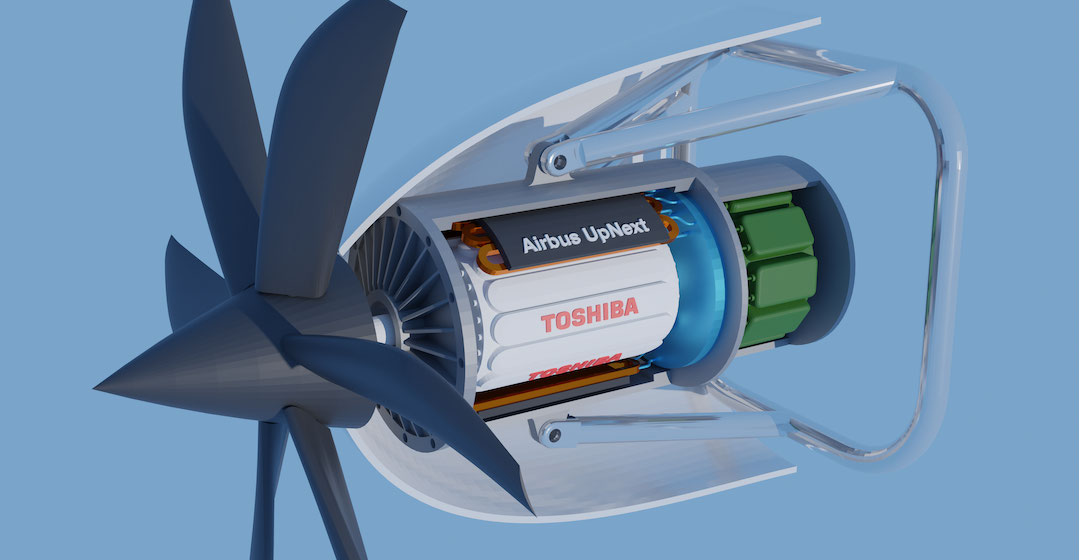
(Tokyo, Japan) – Airbus UpNext, a subsidiary of the aerospace group Airbus, and Toshiba Energy Systems & Solutions Corp. plan to collaborate on superconducting technologies for future hydrogen-powered aircraft. These offer a unique advantage, as they use liquid hydrogen at a temperature of minus 253 degrees Celsius not only as fuel but also for the efficient cooling of electric propulsion systems.
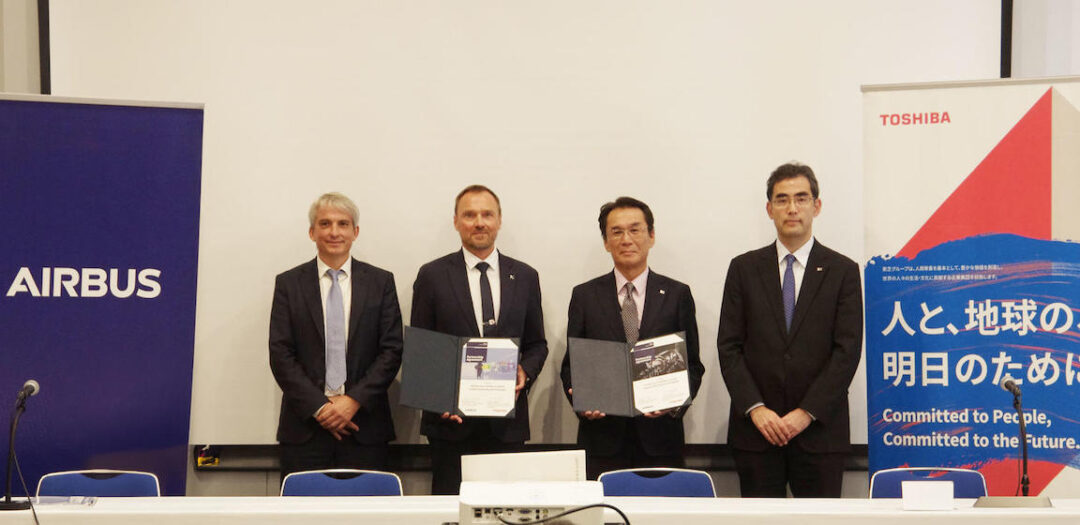
The agreement to further research cryotechnology was signed in Tokyo at the Japan International Aerospace Exhibition 2024 (from left): Ludovic Ybanez (Head of Cryoprop and Cryotechnology, Airbus), Grzegorz Ombach (SVP and Head of Disruptive R&T, Airbus), Tsutomu Takeuchi (Director of Toshiba Energy Systems & Solutions Corporation), Kensuke Suzuki (Head of New Technologies, Power System Division, Toshiba). © Airbus
"Cryogenic technology could enable almost uninterrupted energy transfer within the aircraft's electrical systems, significantly improving their energy efficiency and performance," the companies said. The aim is to jointly develop a superconducting motor with an output of two megawatts.
“The partnership with Toshiba offers a unique opportunity to overcome the limitations of today's partially superconducting and conventional electric motors,” says Grzegorz Ombach, Airbus Senior Vice President and Head of Disruptive R&T. “Through this collaboration, we aim to deliver a breakthrough technology that could open up new design possibilities, especially for Airbus' future hydrogen-powered aircraft.”

Airbus wants to research and put into service a commercial aircraft powered by hydrogen. © Airbus SAS
A "strong foundation" is Toshiba's expertise in superconductor technology for high current flow, motor drive technology for precise current control and "advanced rotating machine technology for stable high-speed operation," says Tsutomu Takeuchi, Toshiba's corporate officer responsible for the Power Systems business unit and director of Toshiba Energy Systems & Solutions Corporation.
Over the past decade, Airbus has researched superconducting technologies and launched the "Cryoprop" project to test a two-megawatt-class superconducting electric propulsion system. Toshiba had already presented its own prototype of a two-megawatt-class superconducting motor for mobility applications in June 2022.
Photo above
As part of their “Airbus Tech Hub Japan” partnership announced in May 2024, Toshiba and Airbus want to develop a superconducting hydrogen-cooled engine for aircraft. © Airbus



