

(Brussels / Belgium) – Worldwide, 500 clean hydrogen projects are operational, under construction, or have progressed to the point where the final investment decision (FID) has already been made. The investment volume amounts to approximately $110 billion, an increase of $35 billion compared to last year.
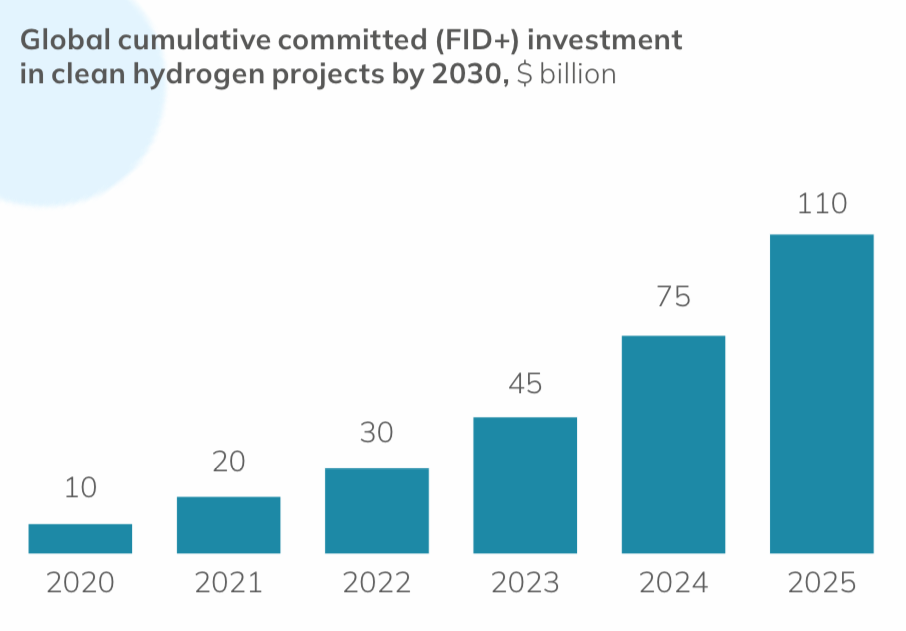
Confirmed global investment in clean hydrogen is approximately $110 billion, up from $75 billion last year. © Graphic from Global Hydrogen Compass 2025
This is the conclusion of the "Global Hydrogen Compass," written by the Hydrogen Council and McKinsey & Company. The study largely refers to "clean hydrogen," which is not necessarily the same as the definition of "green" hydrogen from renewable energies generally used in Europe. In some regions of the world—such as the USA—hydrogen produced using nuclear power, for example, is also considered "low-emission" because the production process does not produce any CO2 emissions ("low-carbon hydrogen").
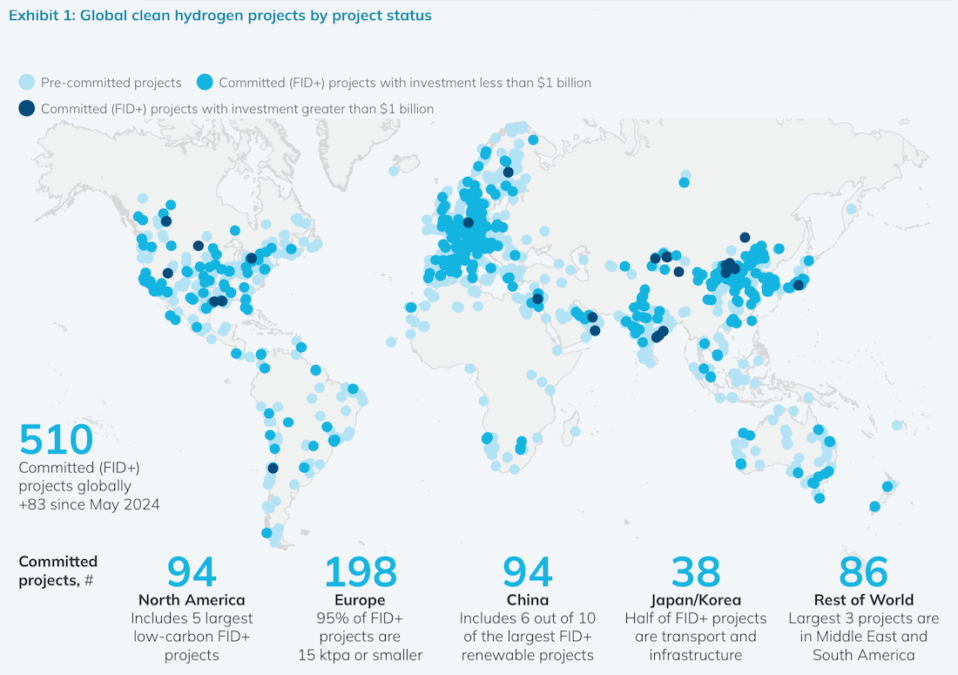
Of the 510 hydrogen projects confirmed worldwide, 83 have been added since May 2024. © Graphic from Global Hydrogen Compass 2025
According to the study, the hydrogen sector has "recorded an average annual investment growth of 50 percent since 2020." This is accompanied by a "natural fluctuation": promising projects are moving forward, while less profitable ones are being withdrawn, "which demonstrates the continuous maturation of the entire industry," the report states. Since 2020, more than 1.700 low-emission hydrogen projects have been announced worldwide, and around 50 projects have been canceled in the last 18 months, corresponding to about three percent of the total pipeline. Most of these are in the early stages. Structural challenges such as persistently high interest rates and delayed policy support in some regions are increasing the pressure.
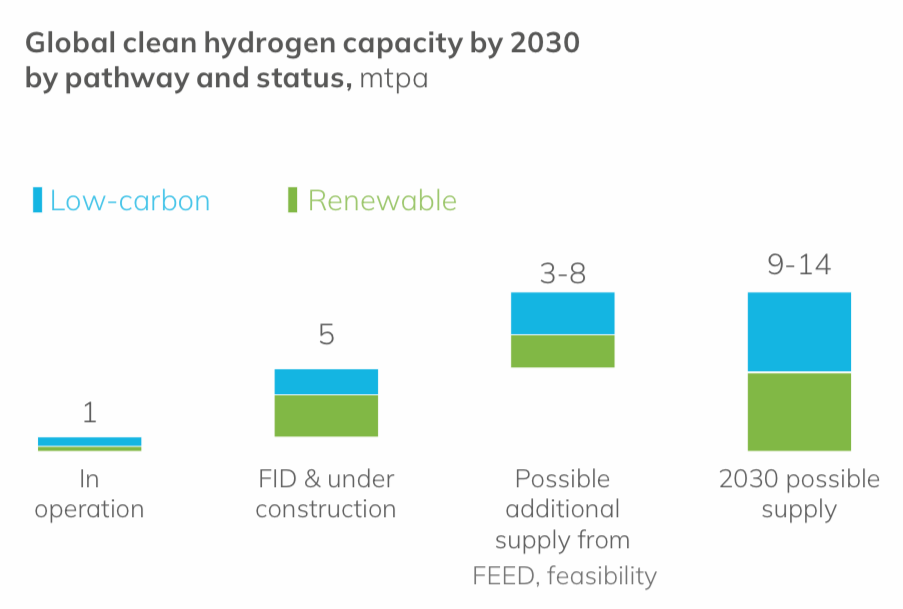
Based on the current project pipeline, a production capacity of nine to 14 million tons per year for clean hydrogen could be achieved by 2030, about half of which would be generated from renewable energy sources. © Graphic from Global Hydrogen Compass 2025
On the supply side, the total committed capacity is more than six million tonnes per year (mtpa), of which one million is already in operation, according to the report: "Taking into account delays and expected retirements, the current project pipeline could provide nine to 14 million tonnes per year of clean hydrogen capacity by 2030." However, tapping into demand is a "significant challenge." On the demand side, only around 3,6 million tonnes have been committed to date. As policy clarity in key markets such as the EU, the US, Japan, and Korea provides, demand for clean hydrogen could rise to eight million tonnes per year by 2030.
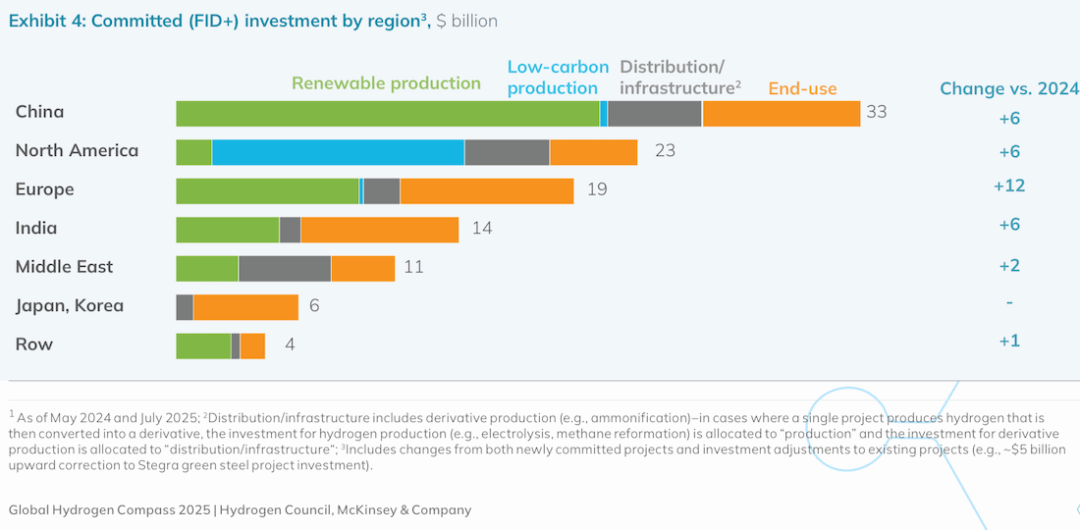
Pioneers in the Far East: Asian countries are investing a cumulative total of more than $50 billion in hydrogen projects. © Graphic from Global Hydrogen Compass 2025
With $33 billion, China leads the world in total committed investments, and, with over 50 percent of the world's currently available renewable energy capacity, it also leads the world in announced renewable hydrogen production. North America follows with confirmed investments of $23 billion, which also accounts for 85 percent of the world's "low-carbon" hydrogen production. Europe, in turn, is investing $19 billion, with the share of green hydrogen projects there being the second largest after China.
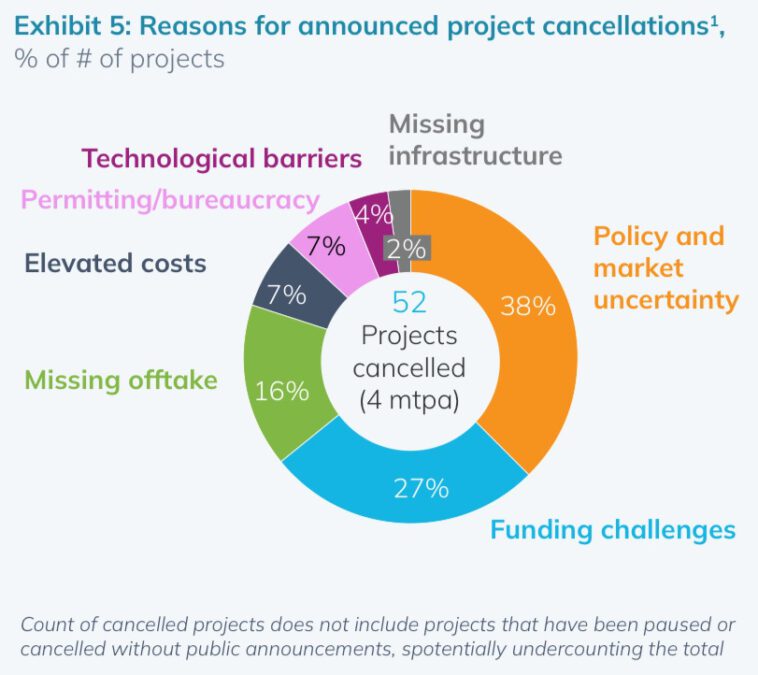
The main reasons for project cancellations are a lack of political support. This is accompanied by market uncertainty and financing difficulties. Infrastructure or technological problems, however, are rare. © Graphic from Global Hydrogen Compass 2025
"Accelerating market development and securing binding offtake agreements must become a priority to ensure that today's projects have real impact," says Sanjiv Lamba, co-chair of the Hydrogen Council and managing director of industrial gases producer Linde. "To achieve this, greater collaboration between companies and governments is needed to create the frameworks and partnerships necessary for progress."
New study on the hydrogen economy. © Hydrogen Council
The "Global Hydrogen Compass" combines industry data with insights from industry executives. A majority of 74 percent of the CEOs surveyed reported a "stable or increased willingness to invest in the last two years." Around 97 percent said hydrogen is "a crucial decarbonization solution for hard-to-decarbonize sectors" and for the overall economy (65 percent). Around 83 percent expect further growth in the industry. The Hydrogen Council is a global, CEO-led initiative with around 140 companies from more than 20 countries in North and South America, Europe, Africa, the Middle East, and the Asia-Pacific region.
The “Global Hydrogen Compass 2025 – Industry progress and lessons learned from the first wave of mature clean hydrogen projects” is available free of charge as a PDF (54 pages).
Photo above
In mid-September, Siemens Energy AG began delivering twelve PEM electrolyzers with a total capacity of 200 megawatts to Normandy, France. Air Liquide is currently building its "Normand'Hy" plant in the Port-Jérôme-sur-Seine industrial zone there, producing 28.000 tons of renewable hydrogen annually. © Air Liquide



